Quantitative Portfolio Manager Search: A Mandate-First Approach

A strong track record can still make the wrong case for a hire. In a quantitative portfolio manager search, returns alone don’t show whether performance came from the PM’s decisions, a particular market regime or the platform around them.
That distinction matters. A PM suited to a pod shop with tight risk limits may not fit a prop shop or an institutional SMA mandate. Before building a candidate list, align the strategy, capacity assumptions, drawdown remit and operating model. Otherwise, the comparison may look tidy on paper without answering the investment question.
I’m James, co-founder of QNT Partners. I’ll cover how to define the mandate, examine a manager’s contribution and compare candidates against evidence rather than headline returns. I’ll also look at how the search changes across fund structures, and why discretion matters in a small market where existing relationships can shape who hears about a role.
The goal is a clear manager profile and a defensible basis for selection, tied to the institution’s strategy and requirements. Start by specifying the work and decisions the PM will own. That is what makes the right candidate identifiable.
Key Takeaways
- A quantitative portfolio manager search is more focused when the mandate defines the strategy, capacity assumptions, risk remit and intended portfolio role.
- Assess how a candidate develops and tests investment hypotheses, and interpret performance attribution only as far as the records allow.
- Keep the search route separate from the proposed investment or employment structure. Each raises different questions about access and fit.
- Agree evaluation gates before outreach so candidates are assessed against the same mandate criteria.
- Manager search and SMA sourcing can connect institutional investors’ strategy requirements with relevant investment managers.
Start a Quantitative Portfolio Manager Search with the Mandate
A search brief without a defined mandate produces weak comparisons. Candidates may all have credible track records while running different strategies, owning different decisions and relying on different portfolio structures. The first task in a quantitative portfolio manager search is to specify what the investor needs the PM to deliver.
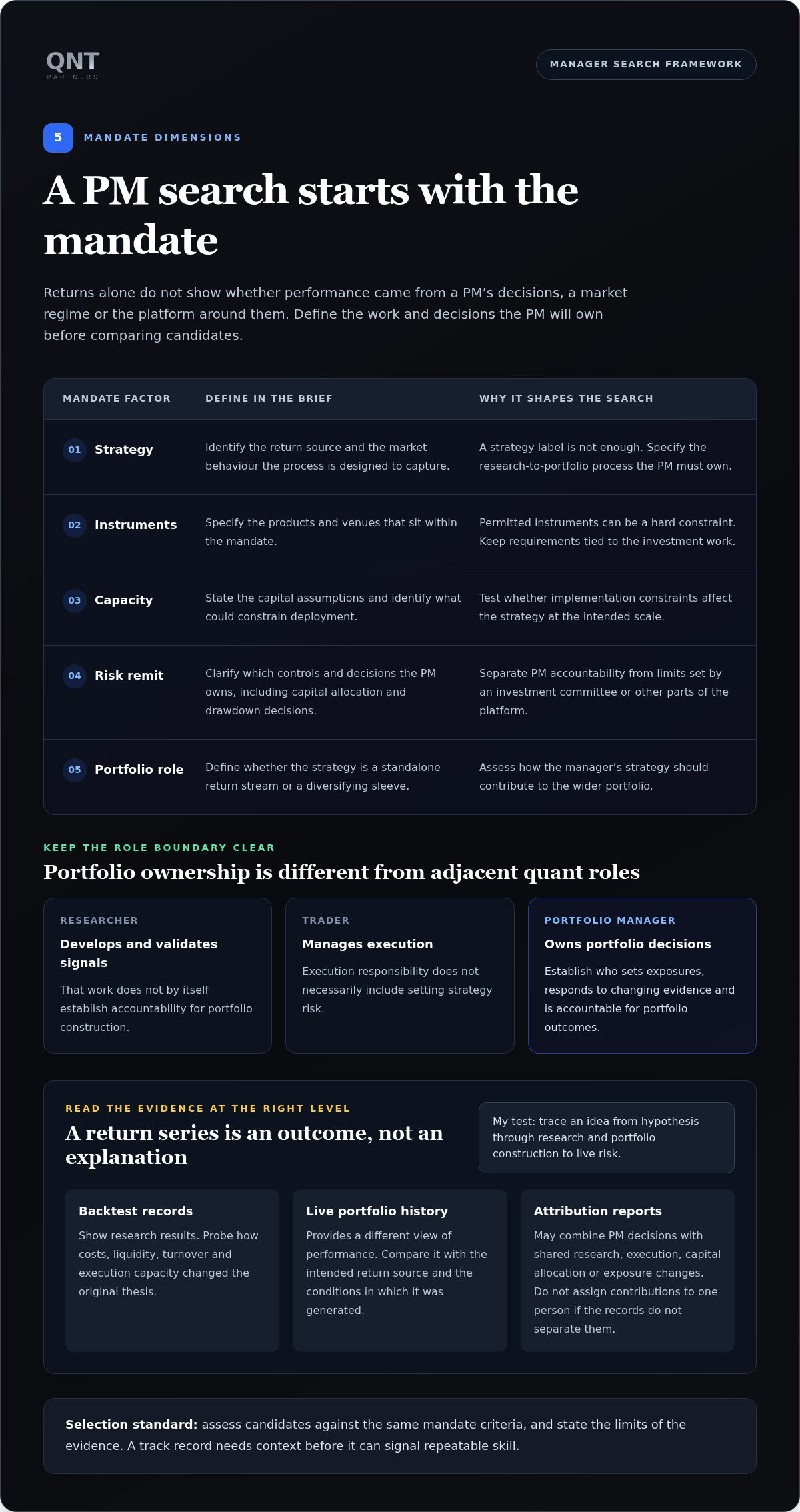
Write down the strategy and return source, instruments in scope, capacity assumptions, risk remit and intended portfolio role. Is the mandate for a standalone return stream or a diversifying sleeve? Will the manager own capital allocation and drawdown decisions, or work within limits set by an investment committee? Those distinctions determine which experience is relevant.
Mandate fit is alignment between a manager’s strategy, portfolio role and the investor’s requirements. Use that as the test for every criterion in the brief. Separate hard constraints, such as permitted instruments or a defined risk remit, from preferences that may narrow the field without improving fit, such as a particular past employer or familiar strategy label.
- Strategy: Identify the return source and the market behaviour the process is designed to capture.
- Instruments: Specify the products and venues within scope.
- Capacity: State the capital assumptions and identify what could constrain deployment.
- Risk remit: Clarify which controls and decisions the PM is expected to own.
- Portfolio role: Define how the strategy should contribute to the wider portfolio.
Translate the investment thesis into a search brief
Describe the work behind the return source, not just the strategy name. A statistical arbitrage mandate and a trend-following mandate imply different hypotheses, research cycles and deployment decisions. Quantitative analysis in finance provides broad context. The brief needs to say what research-to-portfolio process the PM must own, from forming and testing hypotheses through to capital allocation.
Set out decision rights, risk limits and interfaces with research, trading and technology. If the role depends on a shared execution stack or specialist infrastructure, make that part of the operating remit. Keep requirements tied to investment work. A prestigious title or employer name doesn’t show that a candidate has owned the decisions this mandate requires.
Distinguish a PM search from a general quant hire
A researcher can develop and validate signals without being accountable for portfolio construction. A trader can manage execution without setting strategy risk. A strategy-development hire may build a process intended for future deployment rather than own live capital. These are differences in responsibility, not just job title.
For a PM mandate, establish who sets exposures, responds to changing evidence and is accountable for portfolio outcomes. If the role is research-led, define it that way instead of asking for PM credentials that don’t map to the work. Broader hiring sits within quant trading recruitment, but the mandate here is portfolio ownership. That boundary gives the search team a sharper brief and prevents researchers or traders from being assessed against responsibilities they haven’t held.
Assess Strategy Fit, Portfolio Role, and Evidence
A return series is an outcome, not an explanation. To assess whether a manager’s process fits the mandate, trace an investment idea from hypothesis through research and portfolio construction to live risk. I look for a candidate who can explain what would change their mind, not only what produced the backtest.
In a quantitative portfolio manager search, read attribution at the level the records support. Portfolio returns may combine the PM’s decisions with shared research, execution, capital allocation or changes in exposure. If the records don’t separate those contributions, don’t assign them to one person by assumption.
A track record needs context before it can signal repeatable skill. Compare results with the strategy’s intended return source and the conditions in which they were generated. Consider whether implementation constraints affected deployment and whether the outcome depended on a team or infrastructure the candidate won’t have in the proposed role.
Test the investment process, not just the headline record
Ask the candidate to walk through a research decision from initial hypothesis to deployment. How were features selected and tested? What evidence led to changes in position sizing or portfolio construction? How did the team monitor signal decay? What happened when live behaviour diverged from research expectations?
Failed hypotheses matter. A PM who can explain why a line of research was rejected gives you a clearer view of their decision process than a polished summary of successful signals. Probe how transaction costs, liquidity, turnover and execution capacity changed the original thesis. These details help distinguish research performance from a strategy that can operate at the intended scale.
Use the evidence available, and state its limits. Backtest records, live portfolio history and attribution reports answer different questions. No single return threshold or evaluation window establishes suitability across strategies. The question is whether the evidence supports the decisions and remit this role requires.
Match the manager to the operating structure
Structure changes what PM experience means. In a pod shop, a manager may run a defined book within platform risk controls, with central teams supporting execution or research. In a multi-manager environment, capital allocation and risk authority can sit across different parts of the platform. At a prop shop, the PM may operate within a firm-owned trading model and share more responsibility for the trading setup.
Map ownership explicitly. Who controls capital and exposures? Who can reduce risk or pause deployment? Which research and execution resources are dedicated, shared or outside the PM’s control? A strategy reliant on particular data, exchange connectivity or low-latency infrastructure may not transfer unchanged between operating models.
Assess the proposed seat, not an abstract ranking of structures. QNT Partners works with institutional clients on manager search and SMA sourcing, connecting strategy requirements with relevant investment-manager experience. Our work with institutional clients sits at that intersection. Before advancing a candidate, record which portfolio decisions they owned and which depended on the surrounding platform.
Compare Search Routes and Manager Structures Without Confusing Them
A search route determines how candidates are identified and approached. It doesn’t determine whether the eventual arrangement is an SMA, an employed PM role or an equity partnership. Keep those decisions separate in a quantitative portfolio manager search. Otherwise, the process can mistake a sourcing preference for an investment requirement.
Internal referrals can offer useful context about a manager’s work, but the network may reflect existing relationships. Direct search gives the investor control over the target list and outreach. Specialist manager search can add market knowledge and a sharper reading of strategy-specific backgrounds, particularly when relevant candidates aren’t publicly signalling interest. No route is right for every mandate. Let the investment requirement, candidate market and need for discretion guide the choice.
Internal referrals
Useful for informed introductions and contextual references. Reach depends on the investor’s existing network.
Direct search
Lets the investment team define and approach its own targets. The team needs capacity to map candidates and assess fit.
Specialist manager search
Can bring focused market mapping and discreet outreach. Its value depends on understanding the mandate, not simply producing names.
Public profiles and inbound applications show only part of the market. A manager may have no public indication of interest in a move, while an employed candidate may only consider a carefully handled conversation. Specialist access can help identify and approach candidates discreetly, but it can’t guarantee a response or a particular outcome.
Separate an SMA mandate from a portfolio manager role
An SMA describes an investment account structure, not a candidate’s job title. An investor may appoint an external manager to run an account under agreed parameters, while an employed PM works within the investor’s organisation. An equity partnership raises different questions about ownership and the working relationship. The appropriate route depends on investor requirements, the manager’s operating preferences and the design of the mandate.
For an SMA, clarify the portfolio remit and how the account sits alongside the investor’s existing allocations. For an employed PM, define decision authority and interfaces with internal research, risk and trading. A partnership may suit a different alignment of interests, but it doesn’t replace clear investment responsibilities. QNT Partners insight on SMA and SVA partnerships explores the distinction.
Choose a search route that suits the market
Choose the search route after agreeing what evidence and candidate access the mandate requires. Internal referrals may be a useful starting point; direct or specialist search can extend the field beyond familiar contacts. In every route, keep candidate evaluation anchored to the same investment criteria. The sourcing method should help reach relevant managers without quietly changing the mandate.
Run a Discreet Search with Clear Evaluation Gates
A discreet process needs structure before the first candidate is approached. Agree what evidence each stage requires, who can access sensitive information and what would justify progressing a candidate. That keeps outreach controlled and stops the selection criteria shifting once the search is under way.
Use a sequence the investment team can apply consistently:
- 1. Calibrate the mandate. Resolve internal differences on the role, investment remit and essential constraints before taking the brief to market.
- 2. Map the market. Identify relevant backgrounds and operating models. Record why each profile merits consideration instead of relying on employer names or public visibility.
- 3. Make confidential contact. Share enough about the opportunity to establish relevance. Protect the client’s identity and the candidate’s interest in a discussion until disclosure is appropriate.
- 4. Assess against agreed gates. Review each candidate against the same criteria, separating evidence of fit from questions that remain open.
- 5. Reach a decision. Document why each candidate is progressed or declined, including unresolved questions that matter to the investment decision.
Make candidate evaluation consistent
Set the evaluation gates before outreach. Apply the same criteria to strategy discussions, evidence review and operating fit. One candidate may explain a process clearly while the records leave attribution uncertain. Another may show clearer decision ownership but have less experience in the proposed structure. Keep those observations separate instead of compressing them into a score that suggests more certainty than the evidence supports.
Record demonstrated strengths separately from unknowns. Distinguish a documented history of owning portfolio decisions from an account of how a team generated a signal. Limit the circulation of names, documents and interview notes to stakeholders who need them. Confidentiality depends on handling each disclosure deliberately, not simply describing the search as discreet.
Account for transition constraints early
Garden leave, non-competes and notice arrangements can affect an individual’s ability to move or start. Establish what the candidate reports about their circumstances, but don’t draw legal conclusions from a summary conversation. If interpretation is needed, leave it to the relevant professional advisers.
Discuss transition constraints early enough for stakeholders to plan, while keeping them separate from investment fit. Don’t promise a standard search duration. Candidate interest, available evidence and individual transition requirements all affect the process. Set expectations around decision points and open issues rather than an unsupported end date.
A clear record of the evaluation gates gives stakeholders a consistent basis for their decision. QNT Partners supports institutional manager search around defined mandates and confidential candidate assessment.
Bring Mandate-Led Manager Search into the Investment Decision
The selection process should leave the investment committee with a clear decision record, not pressure to deploy capital because the search has concluded. Separate the candidate assessment from the allocation decision. Record what the evidence supports, which assumptions remain open and what conditions need to hold before the strategy takes its intended portfolio role.
That record gives stakeholders a basis for the next stage of diligence. The investment team can identify where further discussion is needed, whether around implementation, decision rights or dependencies on the manager’s existing team. Tie the decision to the institution’s objectives rather than treating a completed search as a reason to proceed.
Where specialist search adds value
Quantitative trading, research and portfolio management each require a distinct understanding of the work. QNT Partners is a boutique firm founded by former industry operators, with a specialist focus across these areas. That background provides practical context for relating a candidate’s experience to the role, while the institution retains responsibility for the investment decision and interpretation of evidence.
Mandate-led screening keeps discussions focused on the investor’s priorities. It helps stakeholders distinguish relevant experience from a strong profile that doesn’t address the requirement. The process should clarify where a candidate fits and where further diligence is needed, without implying a particular performance outcome.
Set the next discussion around the mandate
For the next internal discussion, state the strategy the institution wants to access, the portfolio role under consideration and the questions still unresolved. Be precise about what would change the decision. That keeps the conversation useful to investment stakeholders and stops candidate interest being mistaken for suitability.
I’m James, co-founder of QNT Partners. If your institution is defining a manager requirement, get in touch to discuss the strategy, portfolio role and selection priorities.
Carry the Mandate into the Next Decision
Manager selection should give the investment committee a clear basis for its next decision, not pressure to deploy capital simply because the search has concluded. Keep candidate assessment distinct from allocation. Record what the evidence supports, which assumptions still need testing and what conditions must hold before the strategy takes its intended portfolio role.
This discipline makes a quantitative portfolio manager search useful beyond the appointment itself. It gives investment, risk and operational stakeholders a shared reference point as they consider implementation, account structure and the manager’s decision rights. The mandate can guide both selection and the work that follows, without overstating what a track record proves.
If your institution is defining its next manager requirement, arrange a confidential mandate discussion with QNT Partners. A precise starting point gives the investment team a stronger basis for its decision.
Frequently Asked Questions
What does a quantitative portfolio manager do?
A quantitative portfolio manager turns research into portfolio decisions. Depending on the mandate, that can include deciding which signals enter production, sizing positions, setting exposures and adjusting risk as conditions change. A model may identify a short-horizon opportunity, for example, but the PM still decides whether it belongs in the live book and how its expected turnover fits the available execution capacity.
How do you assess a quantitative portfolio manager's track record?
Reconstruct how the record was produced before treating it as evidence of individual skill. Separate live results from backtests, and examine how capital, exposures and strategy changes affected performance. Establish whether the candidate inherited an existing book or built the process. If records allow, compare research expectations with realised turnover and implementation costs. A headline return without that detail can leave important questions unanswered.
What is the difference between a quantitative researcher and a portfolio manager?
A quantitative researcher develops and tests models or signals; a portfolio manager decides how to deploy them in a portfolio. The boundary varies by team. One researcher may own a complete research pipeline, while another works on a narrow component. Clarify who decided a signal was ready for production, who set its allocation and who responded when live results diverged from expectations. Titles alone don’t establish responsibility.
Can a quantitative portfolio manager run an SMA?
Yes. A PM can manage a separately managed account when the mandate and operating arrangement give them responsibility for investment decisions. The account structure doesn’t, by itself, define the manager’s title or authority. Before selection, establish how the account guidelines affect instruments, position limits and reporting, and whether the manager’s process can operate within them. The arrangement should fit both the investor’s objectives and the manager’s approach.
How does a prop-shop PM role differ from a multi-manager role?
A prop-shop PM generally makes decisions within a firm trading its own capital, while a multi-manager PM may work on a platform that allocates capital across separate teams and applies central risk controls. The labels cover different arrangements, so clarify the actual seat. Ask who controls deployment, how risk authority is divided and which research or execution resources are shared. Those mechanics often matter more than the organisation’s label.
What should an institutional investor include in a manager-search mandate?
Alongside the strategy and risk remit, specify how the investment committee will make its selection decision. Identify the evidence it expects to review, who can assess technical material and which unresolved issues would prevent approval. State mandate exclusions explicitly, including instruments outside scope. This gives stakeholders a common reference during interviews and helps distinguish a genuine mismatch from a question that still needs investigation.
How should garden leave affect a portfolio manager search?
Treat garden leave as an individual transition factor, not a reason to assume a standard start date. Establish what the candidate understands about their notice and restrictions, and keep that information separate from investment fit. If the terms need interpretation, the relevant parties should seek appropriate professional advice. Plan stakeholder expectations around the individual’s circumstances rather than an assumed timeline.