Quantitative Leadership Executive Search: A Case Study in Systematic Talent Architecture

The most significant risk to a systematic fund's longevity isn't market volatility, but the architectural failure of its leadership. You've likely seen the fallout when a generalist recruiter fails to distinguish between a competent technologist and a true alpha-generator. This gap often leads to talent leakage toward tech giants or decentralized finance, making a specialized quantitative leadership executive search essential for firms that can't afford the cost of a misaligned hire. It's a high-stakes environment where a single error at the C-suite level can stall a firm's evolution for years.
Securing a leader who can drive alpha while satisfying the increasingly rigorous performance standards of 2026 requires more than a standard database. It demands a peer-to-peer vetting process. This article demonstrates how an operator-led methodology identifies elite talent capable of scaling technology and aligning with institutional investor expectations. We'll examine the specific framework for systematic talent architecture, providing a blueprint to minimize hiring risk and ensure your leadership team is built for sustained, technical mastery and professional discretion.
Key Takeaways
- Understand why a partner-level, operator-led vetting process is the only reliable way to accurately assess the alpha-contribution of senior candidates.
- Learn how a targeted quantitative leadership executive search aligns high-caliber technical talent with the specific mandates of institutional investors.
- Explore the strategic role of AI and LLM expertise in 2026 and how these technologies are reshaping the requirements for research leadership.
- Discover the direct correlation between elite leadership placements and the successful execution of capital raising via SMAs.
- Gain insights into measuring the true ROI of specialized search through long-term alpha preservation and team retention metrics.
The Mandate: Re-Architecting Leadership for a Global Systematic Macro Fund
The catalyst for leadership change in a systematic fund is rarely a sudden event; it's the quiet, persistent erosion of alpha. When strategies that previously dominated the market begin to revert to the mean, the root cause is often a structural deficit in technical stewardship. By 2026, the complexity of global markets has made internal networking insufficient for securing C-suite talent. Relying on personal circles creates an echo chamber that fails to address the rapid evolution of high-frequency trading (HFT) and machine learning research. A successful quantitative leadership executive search must look beyond the immediate network to find leaders who possess both technical depth and institutional gravity.
Generalist search firms often fail because they treat low-latency infrastructure as a generic IT requirement. They don't grasp the nuance of how a Head of Research must interface with a CTO to ensure that theoretical alpha isn't lost in execution. This disconnect is why systematic funds require a specialized approach. The "Systematic Leader" profile for the current era isn't just a manager; they're an architect who understands the interplay between data pipelines, hardware acceleration, and capital mandates.
Case Context: A Tier-1 Systematic Fund in Transition
A prominent global macro fund recently found itself at a crossroads. While their research team was producing sophisticated signals, the firm's execution infrastructure lacked the low-latency precision required to capture alpha in increasingly crowded markets. The leadership gap wasn't just a vacancy; it was a technical disconnect between the "thinkers" and the "builders." In high-frequency environments, a leadership vacuum for even a single quarter can result in significant market share loss to more agile competitors. They needed a leader who could unify these disparate teams under a single, cohesive technology roadmap.
The Failure of Traditional Executive Search
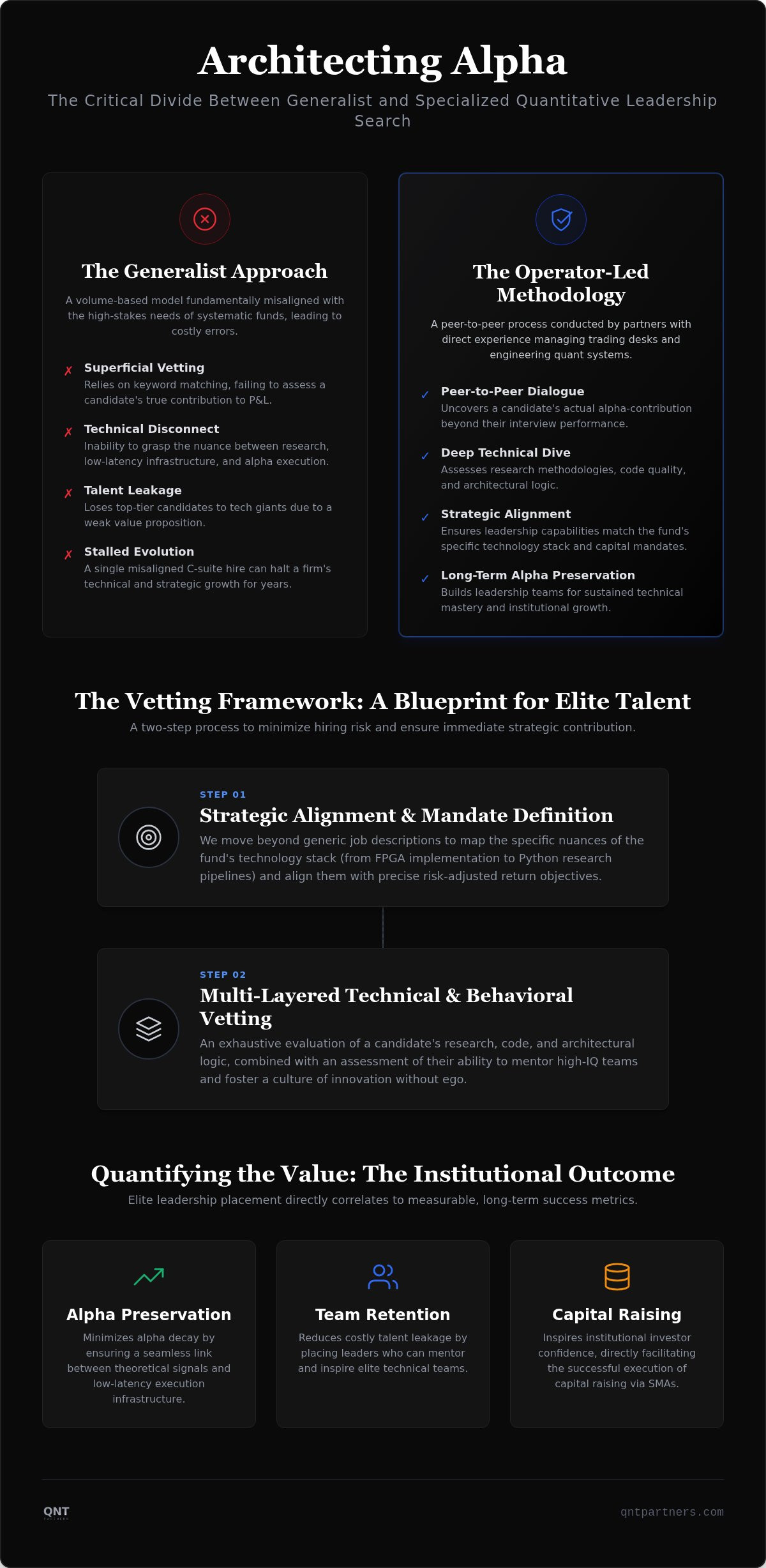
Most recruiters operate on a volume-based contingency model that is fundamentally mismatched with the requirements of a quantitative leadership executive search. Keyword matching fails to account for the nuance of a candidate's actual contribution to a P&L. Generalist firms often lose top-tier talent to proprietary tech ventures or Silicon Valley because they can't articulate the unique value proposition of a systematic fund. Understanding the Executive Search Industry Overview reveals why a specialized, peer-to-peer approach is mandatory. You need an "operator" who has sat in the seat to vet a candidate's technical mastery and ensure they aren't just a high-level manager, but a strategic architect capable of driving institutional growth.
The QNT Methodology: Technical Vetting at the Partner Level
The efficacy of a quantitative leadership executive search depends entirely on the technical literacy of the search partner. Traditional recruitment often relies on administrative checklists, but at the elite level, vetting must be an operator-led process. This means searches are conducted by individuals who have managed trading desks or engineered low-latency systems themselves. This level of immersion allows for a peer-to-peer dialogue that uncovers the actual alpha-contribution of a candidate, rather than just their ability to interview well.
Step 1: Strategic Alignment and Mandate Definition
Before outreach begins, the search must be grounded in a rigorous definition of technical and strategic KPIs. We move beyond generic job descriptions to map the specific nuances of the fund's technology stack, from FPGA implementation to Python-driven research pipelines. Mandate alignment in systematic trading represents the precise synchronization of a leader's technical architecture with the fund's specific risk-adjusted return objectives. This clarity ensures that every candidate presented is capable of immediate contribution to the firm's strategic roadmap.
Step 2: Multi-Layered Technical and Behavioral Vetting
Evaluation at this level is exhaustive. It involves a deep dive into research methodologies and, where possible, an assessment of code quality and architectural logic. Leadership in an autonomous quant environment requires more than technical skill; it demands the ability to mentor high-IQ teams without stifling innovation. Academic Research on Executive Selection highlights that the most successful placements occur when search firms move beyond surface-level traits to analyze deep-seated professional competencies.
Our partners conduct peer review interviews, engaging candidates in high-level discussions on signal decay, portfolio optimization, and execution slippage. This process filters out those who lack the hands-on mastery required for senior roles. Maintaining discretion throughout this process is paramount. We operate with a quiet power approach, engaging in elite, targeted outreach that protects the reputation of both the client and the candidate. For firms seeking this level of precision, exploring specialized recruitment advisory is the first step toward securing a resilient leadership team.
Navigating the 2026 Quant Talent Landscape: Scarcity and Strategy
The 2026 landscape is defined by a fundamental shift from traditional statistical arbitrage toward the integration of complex generative models. This evolution has birthed the "Polymath Leader," an individual who combines deep mathematical rigor with the strategic foresight to implement Large Language Models (LLMs) into production trading environments. Identifying these individuals requires a sophisticated quantitative leadership executive search that recognizes talent capable of navigating both market microstructure and neural network architecture. It is no longer enough to find a researcher; you must find a technologist who understands the nuances of alpha decay in an AI-driven market.
Geography remains a critical constraint for low-latency desks despite the broader trend toward remote work. The physical requirements of microwave tower proximity and exchange co-location mean that leadership must be anchored in specific global hubs like Chicago, London, or Singapore. Talent flows are increasingly circular. We see senior quants moving between traditional hubs and emerging centers in the UAE, requiring a search firm with a truly global reach and the ability to track these movements in real time.
AI and ML Specialists: The New Leadership Frontier
Scarcity is the primary challenge in 2026. The individual who can bridge the gap between academic deep learning and live trading is a rare asset. We often look toward non-finance tech sectors or top-tier research institutions to find "hidden" talent that possesses the necessary technical mastery. Pitching a hedge fund role to a Silicon Valley researcher requires a shift in narrative. You aren't just selling compensation; you're selling the immediate feedback loop of the markets and the opportunity to apply AI to the world's most complex datasets. Recent academic research on executive search suggests that the strategic role of search firms in evaluating such non-traditional career mobility is vital for maintaining a competitive edge.
Market Intelligence: Benchmarking and Positioning
Competitive positioning in the current market requires precise, data-driven insights. In the 2026 market, the benchmark for total compensation for a Head of Quant Research typically ranges from $1.5 million to over $5 million, reflecting the high premium placed on leaders who can deliver sustained alpha in a technology-driven environment. High-growth funds also seek consulting on organizational structure to ensure these leaders have the autonomy and resources to build effective teams. A successful quantitative leadership executive search provides this market intelligence as a core component of the mandate, ensuring the firm remains an employer of choice in a supply-constrained environment.
Beyond Placement: Aligning Leadership with Institutional Capital Mandates
A senior leadership appointment in the systematic space is more than a human resources milestone; it is a strategic signaling mechanism to the broader market. Institutional investors, particularly those managing pension funds or sovereign wealth mandates, view the caliber of a Head of Research or CTO as a proxy for a firm's future alpha trajectory and operational stability. Consequently, a quantitative leadership executive search serves as a foundational element of a fund's capital raising strategy. When a firm secures a leader with a proven track record of technical stewardship, it significantly reduces the perceived risk for allocators who are increasingly focused on the longevity of systematic processes.
The synergy between elite talent and capital sourcing is often overlooked by traditional search firms. In the current environment, the ability to attract high-quality Separately Managed Account (SMA) capital depends heavily on the technical depth of the leadership team. Strategic human capital advisory ensures that a firm's leadership structure is not only built for performance but is also aligned with the rigorous expectations of global LPs. This alignment is what transforms a simple hiring process into a catalyst for institutional growth.
Leadership as a Catalyst for Capital Raising
Institutional allocators seek leaders who can articulate a clear vision for navigating market volatility while maintaining the integrity of the firm's systematic framework. A high-profile hire can reinvigorate investor confidence, providing the necessary social and technical proof to secure specialized investment mandates. QNT Partners plays a distinctive role here by facilitating capital raising through SMAs, connecting funds with the right leaders to manage these specific pools of capital. This dual focus ensures that the talent strategy is directly contributing to the firm's assets under management (AUM) and overall market positioning.
Operational Due Diligence and Talent Vetting
Operational Due Diligence (ODD) has reached a new level of complexity in 2026. LPs now demand granular transparency into how a fund's leadership is vetted and selected. A leader must demonstrate more than just mathematical brilliance; they must meet the standards of institutional governance and risk management. Vetting for these roles requires an operator's eye to ensure the candidate can withstand the scrutiny of a rigorous ODD process. By acting as both talent scout and capital advisor, we ensure that every placement is built to support long-term capital growth strategies. Firms seeking to integrate their talent acquisition with their broader capital objectives should explore our specialized capital advisory and recruitment services to ensure total alignment.
The Institutional Outcome: Quantifying the Value of Specialized Search
Measuring the return on investment for a senior leadership placement requires a multi-dimensional framework that extends beyond initial performance metrics. In the systematic space, the value of a successful quantitative leadership executive search is crystallized through long-term alpha preservation and the stabilization of the broader research team. A strategic hire doesn't just fill a seat; they redefine the firm's technical trajectory. The objective is to secure a leader whose architectural decisions reduce execution slippage and enhance signal robustness, directly impacting the fund's net P&L over multiple market cycles.
Elite leadership also generates a powerful "Halo Effect" within the talent market. Top-tier junior researchers and engineers are drawn to firms led by recognized technical authorities. This organic attraction reduces future recruitment costs and ensures a high-caliber pipeline for scaling teams. When a Head of Research or CTO possesses genuine technical mastery, they act as a magnet for the industry's most discerning talent, creating a virtuous cycle of innovation and stability that generalist recruiters simply cannot replicate.
Case Result: Performance and Stability Metrics
Following the leadership transition for the Tier-1 systematic macro fund discussed earlier, the firm observed immediate improvements in key operational areas. Post-hire performance indicators showed a marked reduction in model decay through the implementation of more adaptive machine learning frameworks. Team retention rates stabilized, with a 40% decrease in voluntary turnover among senior researchers within the first twelve months. This newfound stability provided the necessary foundation for the successful closure of two new SMA mandates, as institutional allocators gained confidence in the firm's renewed technical stewardship and leadership continuity.
Strategic Talent Advisory as a Continuous Partnership
The most successful funds view search not as a one-off transaction, but as an ongoing component of their human capital strategy. Shifting from reactive hiring to proactive talent advisory allows firms to benchmark their team's performance against global competitors in real time. This continuous assessment ensures that the firm's technical capabilities remain aligned with evolving institutional mandates and technological shifts. By maintaining a discreet, partner-level dialogue, funds can anticipate talent gaps before they impact performance. To ensure your firm remains at the forefront of the systematic landscape, secure your firm's future with QNT Partners' leadership search and leverage our operator-led expertise to build a resilient, alpha-driven organization.
Securing the Future of Systematic Excellence
The evolution of systematic finance in 2026 necessitates a transition from reactive hiring to a structured, architectural talent strategy. An effective quantitative leadership executive search serves as the primary mechanism for aligning technical innovation with institutional capital mandates. As alpha decay becomes more pronounced, the distinction between a manager and a technical architect becomes the defining factor in a fund's longevity. It's no longer enough to rely on generalist networks; the complexity of modern HFT and AI-driven research requires a peer-to-peer vetting process that only an operator can provide.
Success in this rarified space requires a partner who understands the nuance of low-latency execution and the strategic implications of AI integration. QNT Partners provides the boutique discretion and global reach essential for securing C-suite talent across major HFT and systematic hubs. Our operator-led vetting ensures every candidate possesses the technical depth required to drive performance and inspire investor confidence. Partner with QNT for Elite Hedge Fund Leadership Search to build a leadership team that commands respect and delivers sustained results. The path to institutional scale begins with a commitment to technical excellence and professional discretion.
Frequently Asked Questions
What is the typical timeframe for a hedge fund leadership search?
While the traditional industry benchmark for an executive search to produce a candidate slate is 60 to 90 days, our methodology often accelerates this timeline. In 2026, we benchmark the presentation of five qualified, vetted candidates within three to five weeks. This efficiency is achieved through our existing network of elite technical talent and a focused, operator-led outreach process that bypasses the friction of generalist recruitment.
How does QNT Partners vet the technical skills of senior quant leaders?
Our vetting is conducted by partners who have direct experience as industry operators. We engage in peer-to-peer technical deep dives that evaluate research methodologies, code quality, and architectural logic. This process ensures that a candidate's alpha-contribution is verified through rigorous discussion on signal decay and portfolio optimization. Unlike generalist agencies, we speak the technical language required to distinguish true mastery from high-level management.
Why is an 'operator-led' search firm better than a generalist agency?
An operator-led firm understands the nuance of a high-frequency trading environment and the specific demands of systematic research. Generalist agencies often rely on keyword matching, which fails to capture the technical depth needed for a successful quantitative leadership executive search. Our background as former traders and engineers allows us to assess technical competence and cultural fit with a level of precision that administrative recruiters cannot match.
Can QNT Partners assist with capital raising as part of the search process?
Yes, we facilitate capital raising through Separately Managed Account (SMA) advisory and manager search services. We connect institutional investors with elite technical talent, ensuring that new leadership hires are aligned with specific capital mandates. This dual approach integrates talent acquisition with capital growth strategy, helping funds secure both the leadership and the institutional investment required to scale their operations effectively.
What are the emerging leadership roles in systematic trading for 2026?
The most prominent emerging roles in 2026 involve the integration of Large Language Models (LLMs) and generative AI into production trading. We are seeing a high demand for "Polymath Leaders" who can bridge the gap between deep learning research and market microstructure. Other critical roles include Heads of AI Research and Low-Latency Engineering Leads who can architect the hardware acceleration necessary for modern, data-intensive systematic strategies.
How do you ensure discretion when headhunting from direct competitors?
We operate with a "quiet power" approach that prioritizes reputation and confidentiality. Outreach is highly targeted and conducted at the partner level, ensuring that sensitive discussions remain private. By maintaining deep-rooted relationships within the global HFT hubs, we can gauge a candidate's interest without triggering market rumors. This level of discretion is essential for protecting the competitive positioning of both the hiring firm and the candidate.
What is the role of SMA sourcing in modern hedge fund talent strategy?
SMA sourcing is a critical tool for aligning elite talent with institutional capital. It allows funds to secure dedicated investment mandates for specific research teams or new leadership hires. By sourcing Separately Managed Accounts, we help firms create a more stable capital base that is directly tied to the performance of their technical talent. This integration ensures that human capital strategy and capital allocation move in lockstep.
How does leadership search impact institutional investor due diligence?
Institutional investors view a quantitative leadership executive search as a vital component of their Operational Due Diligence (ODD). A high-caliber leadership hire signals technical stability and institutional gravity to LPs. Our rigorous vetting process ensures that candidates meet the high standards expected by global allocators. A successful placement often reinvigorates investor confidence, facilitating smoother capital raising cycles and long-term partnership growth with sovereign wealth and pension funds.