Quantitative Analyst Headhunters: A Comprehensive Buying Guide

The most expensive mistake a trading firm makes isn't a bad trade. It is hiring a researcher who cannot code or a developer who doesn't understand market micro-structure. Most generalist firms claiming to be quantitative analyst headhunters lack the technical depth to filter for candidates capable of optimising a strategy for alpha. I have seen heads of trading waste weeks interviewing "top talent" who couldn't explain their own execution logic.
You likely already know the market for elite talent is tighter than ever. Between 18-month non-competes and aggressive buybacks in Chicago prop shops, finding a lead who can move the needle is a massive drain on your time. It is frustrating to pay high fees to agencies that treat your search like a volume game rather than a strategic execution.
I will outline how to identify headhunters who operate as strategic advisors rather than resume brokers. This guide covers the mechanics of vetting technical competence and understanding fee structures. It also explains how to ensure your recruitment partner understands why your SMA structure or equity partnership is a genuine selling point.
Key Takeaways
- Distinguish between generalist recruiters and specialist partners who understand the technical nuance of alpha generation and execution logic.
- Evaluate quantitative analyst headhunters based on their ability to articulate your specific P&L splits and SMA structures to top-tier talent.
- Implement a vetting process that tests a headhunter's grasp of technical requirements such as tick-to-trade latency and FPGA development.
- Optimise your search timeline by choosing partners who have deep networks within specific niches like Sydney-based systematic funds or Chicago prop shops.
- Build a feedback loop that ensures your headhunter understands the cultural distinctions between pod shop and multi-manager environments.
Understanding the Role of Quantitative Analyst Headhunters
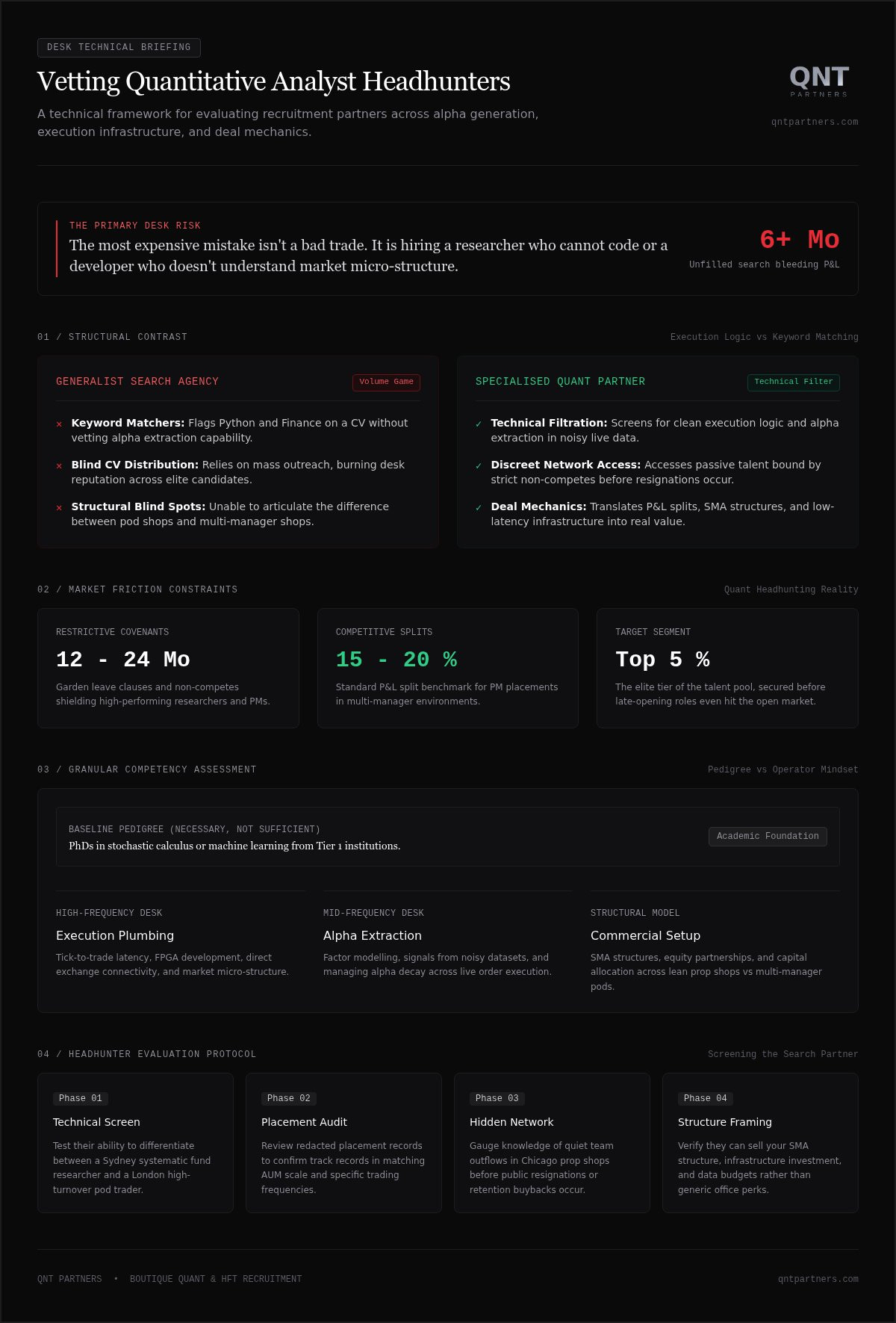
Most recruiters in the financial sector are essentially keyword matchers. They see "Python" and "Finance" on a CV and assume a candidate is a fit for your desk. True quantitative analyst headhunters operate as a technical filter. I have seen too many firms waste months interviewing researchers who can build a backtester but have no concept of how to extract alpha from a noisy dataset or manage execution risk in a live environment.
Successful candidates in this space typically possess a heavy academic pedigree, often PhDs in stochastic calculus or machine learning from Tier 1 institutions. However, the pedigree is only the baseline. A specialist headhunter looks for the "operator" mindset. This means finding someone who understands the plumbing of the market, whether that is the nuances of factor modelling for a mid-frequency pod or the extreme low-latency requirements of a HFT desk.
Generalist firms often apply traditional executive search methodologies to these roles, which is a mistake. They lack the depth to distinguish between a researcher who thrived in a well-resourced multi-manager shop and one who can build a strategy from scratch in a lean prop shop. Specialised headhunters understand that a 15 to 20 percent P&L split is only attractive if the infrastructure and data access are there to support it.
Key Responsibilities of Quantitative Analyst Headhunters
Our primary task is identifying talent that isn't actively looking. Most elite quants are shielded by 12 to 24-month non-competes and aggressive retention packages. We manage these timelines and provide a realistic view of when a candidate can actually sit at their desk. We also translate your technical stack, such as FPGA requirements or specific exchange connectivity, into a value proposition that resonates with high-performers who are more interested in your tick-to-trade latency than your office perks.
When to Engage a Headhunter
Engagement should happen the moment you decide to build out a new desk or spin out a sub-strategy. Waiting until you are desperate leads to compromising on quality. If you have been searching for a lead researcher for six months, you are already losing P&L. Specialist firms should be brought in early to benchmark the market and ensure your compensation structure, particularly the split between base and performance-linked bonus, is competitive for the specific niche you are targeting. Delaying this process often results in your competitors securing the top 5 percent of the talent pool before you even open the role.
Criteria for Selecting the Right Headhunter
A poor headhunter sends irrelevant CVs while simultaneously burning your reputation with the fifty people you actually want to hire. In a market where every elite researcher knows their worth, a recruiter who cannot explain your firm's specific alpha decay or risk limits is a liability. You need quantitative analyst headhunters who speak the language of your desk rather than the jargon of a generalist HR department.
I suggest starting with a technical screen for the headhunter themselves. If they cannot distinguish between a researcher suited for a Sydney-based systematic fund and one for a high-turnover pod in London, they won't find your hire. Look for a track record of placements in firms with similar AUM and trading frequencies. A recruiter who only places at retail banks will struggle to understand why you need a developer with specific exchange connectivity expertise.
Experience and Technical Expertise
Ask for a list of recent placements with the names redacted. Focus on the mechanics of the deal. Did they place a PM into a multi-manager structure with a 15 to 20 percent P&L split, or was it a junior analyst into a large-scale bank? You want to see they understand quantitative and financial analyst competencies at a granular level. They should know if your desk requires FPGA experience for tick-to-trade latency or if a Python-heavy researcher is sufficient for your mid-frequency strategies.
Reputation and the Hidden Network
The best talent isn't on LinkedIn. They are behind 12-month garden leave clauses and non-competes. Your headhunter needs a network deep enough to know who is unhappy at a Chicago prop shop before the resignation is even handed in. This level of access comes from years of discreet, peer-level conversations. I value headhunters who can tell me which teams are currently seeing talent outflows due to changes in their SMA structures or bonus pools.
Vetting a partner requires looking at their long-term standing in the community. Talk to your peers at other firms. If a recruiter has a reputation for "spraying and praying" CVs, avoid them. They will prioritise their commission over your firm's culture and specific technical needs. If you are struggling to find this level of technical alignment, it might be time to discuss your search strategy with specialists who actually understand your P&L drivers.
Assessing the Recruitment Process
A standard recruitment cycle for a senior researcher or PM often spans six to nine months. If your headhunter promises a three-week turnaround for a lead role, they are likely recycling the same candidates who have already failed technical screens at every other shop. Effective quantitative analyst headhunters begin by mapping the market based on your specific infrastructure and risk appetite.
There is no point in sourcing a researcher from a large-scale bank if your tech stack requires ultra-low latency execution expertise they haven't touched in years. We focus on the origin of their P&L. I want to know if their performance was a result of being in a high-capital pod shop with a massive data budget or if they actually built the signals and execution logic themselves. This distinction is critical for lean prop shops where every hire must be an "operator."
Vetting Candidates
Vetting goes beyond standard coding tests or verifying a PhD in stochastic calculus. I look for the ability to explain complex execution logic under pressure. A candidate might have a perfect academic record, but if they cannot articulate how they managed slippage during a high-volatility event, they won't survive on a live desk. Cultural fit in this context is about risk tolerance. A researcher used to the safety of a multi-manager's rigid risk limits will struggle in an environment where they are responsible for their own P&L split and drawdown management.
Communication and Feedback
Feedback loops must be technically specific. If we present three candidates and you reject them, "not a fit" is a useless response. I need to hear that their understanding of exchange connectivity was too shallow or their Sharpe ratio claims didn't hold up under scrutiny. This allows us to calibrate the search in real-time. We also manage the friction of non-competes. In this industry, a 12 to 18-month garden leave is common. You must account for this when organising your hiring roadmap. Starting a search too late usually results in settling for a second-tier candidate because you need a body on the desk. High-quality recruitment is about patience and technical alignment rather than speed.
Building a Long-Term Partnership with Your Headhunter
Hiring is a continuous process, not a series of discrete events. If you only talk to your headhunter when you have a seat to fill, you have already lost the talent war to shops that maintain a constant pipeline. The most effective quantitative analyst headhunters function as an external extension of your trading desk. This level of alignment requires more than a standard fee agreement.
Treat your recruitment partner like a strategic advisor. When we understand the specific P&L drivers of your desk, we can filter for the technical nuance that a generalist would miss. For instance, if your firm is shifting from equity market neutral strategies toward high-turnover commodities, that pivot changes the profile of the researcher you need. Sharing these internal shifts early prevents the resume spam that wastes your time.
Setting Expectations
Success in quant recruitment is not about the volume of CVs. It is about the precision of the technical screen. We define success through metrics like the interview-to-hire ratio and the retention rate of candidates past their first 24 months. Regular check-ins allow us to adjust the search parameters if the market is pricing talent out of your current 12 to 18 percent P&L split. If you don't communicate that your infrastructure now supports FPGA-based execution, we will keep sending you software-focused researchers when you actually need hardware specialists.
Leveraging Your Headhunter's Insights
A specialist partner provides market intelligence you cannot get from a Bloomberg terminal. We know which pods are unhappy at a Chicago prop shop and which researchers are nearing the end of their garden leave. This information allows you to be proactive. If we see a trend of talent leaving a specific Sydney-based systematic fund, we can alert you before the rest of the market catches on. Use this data to benchmark your own offerings.
Collaboration is the only way to secure the top 1 percent of talent in this niche. You should treat the data we provide on competitor compensation and SMA structures as a tool for your own growth strategy. If you are ready to build a more technical, data-driven approach to your hiring, you can contact us to discuss a long-term strategy. Constant churn in your recruitment partners leads to inconsistent talent quality and missed opportunities.
QNT Partners: Your Trusted Quantitative Analyst Headhunters
Hiring at the elite level requires a partner who understands the difference between a researcher who can talk about alpha and one who can actually code it. Most quantitative analyst headhunters rely on name recognition rather than technical vetting. I have seen firms hire the wrong lead because their recruiter didn't understand the nuances of tick-to-trade latency or the specific risk limits of a pod shop. We founded QNT Partners to fix that gap by acting as technical filters for our peers.
Our success isn't defined by the number of placements we make. It is defined by the P&L impact of the researchers and engineers we introduce to our clients. We have facilitated spinouts for systematic teams in Sydney and helped build entire desks for prop shops in Chicago that were previously unknown in the local market. We focus on these high-stakes build-outs because they require a deep understanding of market mechanics and the ability to manage complex garden leave negotiations.
Why Choose QNT Partners
We prioritise quality over broad-market appeal. Our network is composed of individuals who are often shielded by 18-month non-competes and heavy retention packages. We know how to navigate these hurdles because we understand the value of the talent we are moving. Our commitment is to find the 1 percent of candidates who possess both the academic pedigree and the operator mindset required to thrive on a modern trading desk.
- Specialised knowledge in quantitative trading and research recruitment.
- Proven track record of building out technical teams for elite firms.
- Strategic advisory on P&L splits and SMA structures.
- Access to high-frequency and AI specialists through deep industry connections.
Get in Touch
If your firm is ready to move beyond generic recruitment and needs a partner who understands your technical stack, we should have a coffee. We can provide a realistic assessment of the talent market and help you organise a search that respects your time and your firm's reputation. You can Contact Us to start a discreet consultation about your current or future hiring needs. Securing the right talent is a strategic execution rather than a volume game.
Securing the Technical Advantage
Hiring for your desk is a technical execution, not an administrative task. If you treat recruitment like a volume game, you'll inevitably end up with a researcher who cannot handle live risk or understand alpha decay. You need quantitative analyst headhunters who understand why a 12 to 18 percent P&L split matters or how FPGA connectivity changes a lead developer's profile. I have seen the P&L cost of a bad hire at a Chicago prop shop. It is about finding the one percent who can actually move the needle for your fund.
We specialise in headhunting for quantitative analysts. Our firm has a proven track record with high-frequency trading firms and maintains deep connections in the quant finance community to identify talent before they hit the open market. If you are ready to build a more technical, data-driven pipeline, Contact QNT Partners for expert quantitative recruitment services. We can help you organise a search strategy that respects your time and secures the technical competence your desk requires. I look forward to discussing your next build-out.
Frequently Asked Questions
What makes a quantitative analyst different from other finance professionals?
Quantitative analysts are defined by their ability to translate mathematical models into execution logic. Unlike traditional discretionary traders, their work is rooted in systematic alpha generation and rigorous backtesting. They are essentially technical operators who understand market microstructure and risk management at a granular level. A successful researcher doesn't just suggest a trade. They build the code and infrastructure to execute it at scale.
How long does the recruitment process typically take for quant roles?
A standard search for a senior PM or researcher often spans six to nine months from initial contact to a signed offer. You must also account for garden leave and non-compete clauses, which frequently range from 12 to 24 months in elite Chicago prop shops or Sydney systematic funds. Starting your search too late results in settling for second-tier talent because you need a body on the desk.
What should I expect in terms of fees when working with a headhunter?
Most quantitative analyst headhunters operate on a retained or contingent basis depending on the seniority of the role. You are paying for the headhunter's ability to access a hidden network of talent currently shielded by aggressive retention packages. Fees reflect the specialised nature of the search and the technical vetting required. A strategic partner provides market intelligence on competitor P&L splits and SMA structures that outweighs the cost of the placement.
Are there specific qualifications I should look for in a quantitative analyst?
Academic pedigree from Tier 1 institutions in fields like stochastic calculus or machine learning is the baseline. I look for candidates who can demonstrate an operator mindset, meaning they understand the plumbing of the market. For HFT desks, this includes specific expertise in FPGA development and exchange connectivity. A researcher who can't code their own signals is a liability in a lean prop shop environment.
How can I ensure my firm attracts top talent in a competitive market?
Elite talent is attracted to infrastructure and capital access rather than office perks. You need to offer competitive P&L splits, typically in the 12 to 18 percent range, and clear paths to equity partnership or SMA structures. High-performers want to know your tick-to-trade latency and your data budget. If your infrastructure is a bottleneck for their strategies, they will choose a better-resourced pod shop.
What are the common pitfalls in hiring quantitative analysts?
The biggest mistake is hiring based on keyword matching rather than technical competence. Many firms end up with researchers who look good on paper but fail when asked to explain their execution logic under volatility. Another pitfall is ignoring the cultural difference between a rigid multi-manager environment and a flexible prop shop. If a candidate is used to a massive support team, they might struggle in a lean build-out.
How can I assess the effectiveness of a recruitment agency for quantitative roles?
Test their technical depth by asking them to explain the difference between mid-frequency and ultra-low latency strategies. Effective agencies should be able to vet a candidate's grasp of market microstructure before they ever reach your desk. If a recruiter sends you a pile of irrelevant CVs, they aren't headhunting. They are just resume brokering. Look for a partner who understands your specific risk limits and alpha decay.