Quantitative Alpha Research Recruitment: Hiring for Research Quality

A persuasive backtest can make a weak research process look convincing. That is the central risk in quantitative alpha research recruitment: performance may depend on favourable data choices or execution assumptions, not a researcher’s ability to find signals that hold up in live conditions. I’ve seen hiring teams focus on headline returns when the better evidence lies in how the work was designed and tested.
A polished presentation isn’t enough. The mandate needs to reflect the strategy, market and implementation constraints, whether the hire is for a systematic pod, a prop shop or a low-latency team. Define the role around the work, then assess the decisions behind a candidate’s results. That keeps interviews focused on research quality rather than a backtest’s best-case assumptions.
Key Takeaways
- Define the research mandate around the strategy horizon, instruments and team structure before writing the role brief.
- In quantitative alpha research recruitment, assess how candidates formed and tested a hypothesis, not just the backtest result they present.
- Use role-relevant evidence to test research ownership, validation discipline and awareness of implementation constraints.
- Agree assessment criteria before mapping candidates, then calibrate the search against evidence from interviews.
- Specialist search can turn sensitive research priorities into a focused candidate brief while keeping the wider team plan discreet.
Why quantitative alpha research recruitment starts with the mandate
A job title won’t tell you whether a researcher can do the work your strategy needs. The mandate will. Quantitative alpha research recruitment should identify evidence of relevant research capability, not simply match a candidate’s previous title to a vacancy. A researcher from a slower systematic equities team may have little overlap with a short-horizon futures strategy, even if both roles carry the same title.
A research mandate defines the strategy, the researcher’s responsibilities and the evidence that shows they can meet those responsibilities. Keep proprietary details out of the brief, but be precise about the factors shaping the work: strategy horizon, instruments traded and where the researcher enters the research-to-production process. A high-level overview of Quantitative analysis (finance) offers useful background, but a hiring brief needs to describe your actual trading environment.
Turn the strategy into a research role
Specify whether the hire is expected to originate hypotheses, design validation, take signals through implementation or work across those stages. These are distinct mandates. A signal-discovery role may centre on feature design and out-of-sample testing. A role closer to production may also require turning a research result into code the team can maintain and monitor.
Set out the working interfaces, too. In a pod shop, research may sit close to a PM’s portfolio decisions. At a prop shop, the loop between research and trading can be more immediate. Clarify how portfolio management, trading and engineering contribute, and what the researcher owns when results disagree or a signal degrades.
Separate adjacent quant profiles
A trader’s execution record can show how they manage risk and realise opportunities, but it doesn’t establish how they form and validate a research hypothesis. An engineer’s systems work can demonstrate implementation skill, yet says little on its own about signal quality. Assess each profile against the work the role requires.
There can be genuine overlap. If the researcher is expected to implement and monitor signals, relevant coding experience matters. If the strategy depends on low-latency execution, the role may require close collaboration with engineers who understand exchange connectivity or tick-to-trade constraints. Don’t turn that collaboration into a vague demand for one hire to own every layer.
I’d settle these distinctions before mapping candidates. When assessing quant trading recruitment firms, use the same mandate-first approach: the right search depends on what the team needs the hire to deliver, not on labels alone.
Assess quantitative researchers beyond backtest performance
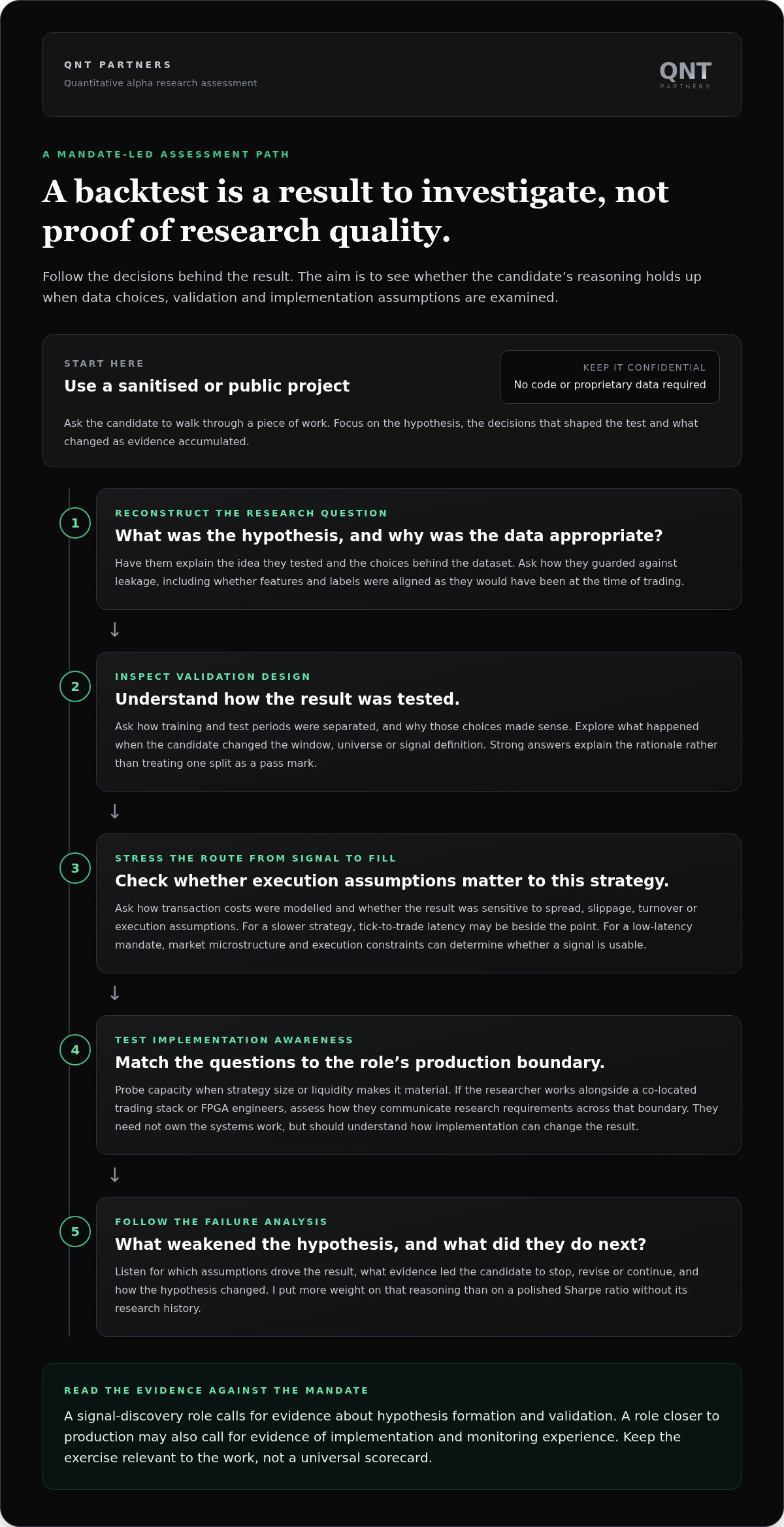
A strong backtest is a result to investigate, not proof of research quality. Historical returns can reflect a useful signal, but they can also depend on data selection, timing assumptions or execution conditions that won’t hold in production. In quantitative alpha research recruitment, assessment should reveal how the candidate reached the result and what they learned when the evidence changed.
A sound research process shows up in defensible choices and clear failure analysis, not a headline backtest in isolation. Ask the candidate to walk through a project using anonymised or public information. You don’t need their code or proprietary data. You need to understand the hypothesis, why the data was appropriate, and whether the apparent edge survived reasonable changes to the setup.
Probe the research process
Ask how they guarded against leakage, including whether features and labels were aligned as they would have been at the time of trading. Explore the validation design: how were training and test periods separated, and what happened when they changed the window, universe or signal definition? Strong answers explain the rationale behind those choices rather than treating a single split as a pass mark.
Failure analysis is especially revealing. A candidate should be able to describe what weakened a hypothesis, which assumptions drove the result and what evidence led them to stop, revise or continue. I put more weight on that reasoning than on a polished Sharpe ratio without its research history.
Test implementation awareness
Research conclusions depend on the route from signal to fill. Ask how transaction costs were modelled and whether the result was sensitive to spread, slippage, turnover or execution assumptions. For a slower strategy, detailed tick-to-trade latency may be beside the point. For a low-latency mandate, market microstructure and execution constraints may determine whether the signal is usable at all.
Capacity deserves the same mandate-led treatment. Test it where strategy size or liquidity makes it material, rather than adding a generic capacity question to every interview. If the researcher works alongside a co-located trading stack or FPGA engineers, assess how they communicate research requirements across that boundary. The researcher needn’t own the systems work, but should understand how implementation can change the result.
Keep the exercise relevant to the role and respectful of confidentiality. A discussion based on a candidate’s sanitised case study can test judgement without asking them to disclose a former employer’s research. QNT Partners’ quant recruitment work helps hiring teams translate a research mandate into relevant candidate criteria.
Compare candidate evidence against the alpha research mandate
A candidate comparison is useful only if it reflects the work you’re hiring for. In quantitative alpha research recruitment, I’d avoid a universal scorecard that gives every researcher the same weighting for coding, signal discovery and production experience. A role focused on originating ideas needs different evidence from one centred on taking existing signals into a live environment.
Use a simple evidence table tied to the mandate. Record the example discussed, then agree what it does and doesn’t demonstrate. Follow up on the candidate’s contribution, rather than rewarding confidence or familiarity with the interview format.
| Mandate requirement | Candidate evidence | Follow-up assessment |
|---|---|---|
| Research ownership | A specific project and the decisions the candidate personally made | Clarify their contribution versus the team’s work and attribution |
| Validation discipline | How they assessed a hypothesis beyond the initial result | Probe sensitivity to data choices and changes in the test design |
| Implementation awareness | Experience connecting research assumptions to production constraints | Test the understanding relevant to this strategy and team interface |
Match evidence to the work
Separate direct strategy experience from transferable methods. A researcher who has worked in a different asset class may still bring useful expertise in feature construction or validation, but that isn’t the same as having solved the same market problem. Record the distinction rather than treating adjacent experience as either a perfect match or irrelevant.
For each capability, capture a concrete example from the discussion. Establish what the candidate owned, what others contributed and how the work was evaluated. Team P&L or a published result can provide context, but neither establishes individual research attribution on its own.
Handle confidentiality without losing signal
Assessment shouldn’t require sensitive data, code, live signals or research artefacts. Keep the conversation bounded: discuss the candidate’s reasoning, choices and lessons using anonymised or high-level examples. Be clear about what the hiring team needs to assess and what the candidate can disclose.
Discretion matters on both sides. A candidate may be constrained by current obligations, while the hiring team may need to protect an unannounced build-out or strategy priority. State those boundaries directly and keep the brief consistent with the conversation. A careful record of mandate-relevant evidence gives the team concrete points to compare without asking either side to disclose proprietary work.
Structure a focused quantitative alpha research search
A focused search starts with a usable mandate, not a long list of preferred employers or technologies. In quantitative alpha research recruitment, I’d organise the work around four steps: define the mandate, agree what evidence counts, map relevant profiles, then assess and calibrate against what the market shows.
The brief should tell candidates what the research is for, what they’ll own and how the work connects to the PM or trading desk. Describe the strategy horizon and instruments at a level that lets relevant candidates recognise their experience without exposing proprietary priorities. State technical requirements only when they follow from the work. If researchers are expected to take signals into production, implementation skills may matter. If engineering owns that stage, make the collaboration boundary clear instead.
Build a brief candidates can evaluate
Explain whether the researcher originates ideas, owns validation, contributes to implementation or works across those stages. Set out how decisions are made with the PM or trading desk, including where the researcher has independent ownership and where the role is collaborative. Candidates need enough detail to judge fit without the firm disclosing its strategy.
Keep the search description discreet. Refer to the firm by a neutral description unless its identity is public, and avoid naming strategy priorities that could reveal a planned build-out. Precision and discretion can sit in the same brief.
Calibrate with market evidence
Map candidates against the agreed mandate, not employer prestige. A familiar firm name doesn’t establish ownership of relevant research, and a different market background may still bring transferable methods. Use consistent assessment themes across conversations, then adapt the technical discussion to the strategy. Early candidate feedback can expose an unclear requirement or an overly narrow profile. Refine the brief, but don’t lower the research bar simply to widen the pool.
We use our experience in quantitative trading and research to translate a team’s requirements into a focused search for relevant quant talent. That means keeping the mandate, candidate brief and assessment criteria aligned as the search develops. For a specialist hire, our search starts with the role the business needs filled, not a generic profile.
How QNT Partners approaches quantitative alpha research recruitment
A technically sound research mandate can still produce a poor search if it reaches candidates as a generic job description. At QNT Partners, we translate the team’s requirements into a focused search, aligning role scope and candidate evidence before outreach begins.
We specialise in quantitative trading, research and technology recruitment for hedge funds and high-frequency trading firms globally. Founded by former industry operators, QNT Partners can discuss research roles in terms of the work itself: where the researcher sits in the investment process, how the team is organised and what evidence makes a candidate relevant.
Connect the mandate to specialist search
We use the mandate to shape the candidate brief, distinguishing essential experience from skills that can transfer across strategies. A team hiring for signal research may prioritise evidence of hypothesis development and validation. A role that works closely with trading or engineering may need a different balance, but that doesn’t mean every researcher needs to own execution or systems work.
Market familiarity helps make the discussion specific. It gives us context to explore how a candidate’s responsibilities compare with the role, whether they worked independently or alongside a PM, and how their methods might transfer. We focus the search on those distinctions rather than using title or employer name as a shortcut.
Discuss the search discreetly
Some research hires sit within a new build-out or a team plan that isn’t ready for broad circulation. We frame the opportunity around its mandate and working context without putting sensitive priorities into a public-facing brief. Candidate conversations can establish fit through relevant experience and bounded discussion of research methods, without asking for confidential data or artefacts.
I believe a good search should leave both sides clear about the work, the ownership expected and the evidence being assessed. That clarity helps hiring teams compare candidates on relevant capability and gives researchers a credible basis for deciding whether the role fits.
If you’re hiring a quantitative researcher, we can discuss the mandate and shape a specialist search around the requirements. Explore our quant trading and research recruitment support.
Build your next research hire around evidence
A strong backtest deserves scrutiny, not an automatic offer. Effective quantitative alpha research recruitment starts with a precise mandate, then tests whether a candidate’s research decisions, validation discipline and implementation awareness fit the work the team needs done.
Anchor the assessment to concrete examples. Separate individual contribution from team results, and make the search brief clear about ownership, strategy context and collaboration. Candidates get a credible view of the role, while the hiring team can compare evidence rather than presentation style.
At QNT Partners, we specialise in quantitative research and trading recruitment. Founded by former industry operators, we work globally across hedge funds and high-frequency trading firms, bringing practical context to specialist searches while respecting discretion.
If you’re defining a research hire or ready to begin a search, discuss a quantitative research search with QNT Partners. Start with a clear mandate that spells out what the researcher will own.
Frequently Asked Questions
What does a quantitative alpha researcher do?
A quantitative alpha researcher develops and tests systematic ideas that may help explain or predict market behaviour. The work can include forming hypotheses, selecting and preparing data, designing validation and assessing whether a signal remains meaningful after relevant trading costs. Depending on the mandate, the researcher may also contribute to implementation or work closely with portfolio managers, traders and engineers. The exact remit varies by strategy and team structure.
How do firms assess quantitative research candidates?
Assess candidates against the work the role requires, not a generic checklist. Ask them to explain a research decision using examples they can discuss without sharing confidential material. Explore how they formed a hypothesis, chose data and validation methods, handled execution assumptions and interpreted results that didn’t hold up. Clarify which decisions they owned personally, especially when a project’s performance came from a larger team.
Can a strong backtest prove that a candidate can generate alpha?
No. A backtest is evidence to examine, not proof of future alpha. Results can depend on data choices, leakage, validation design or execution assumptions that may not reflect live conditions. Ask what changed when the candidate varied the test setup, and how they explain failed hypotheses. An account of the research process gives more useful evidence than a headline return presented without its assumptions or limitations.
What should a quantitative alpha research job description include?
A useful job description explains the strategy horizon and instruments at a level candidates can assess without exposing proprietary priorities. Define whether the researcher owns idea generation, validation or implementation, and describe how the role works with the PM, trading desk and engineering. Include technical requirements only when they follow from the actual work. This gives candidates a clearer basis for judging fit than a list of tools or preferred employers.
How can a firm recruit quantitative researchers confidentially?
Keep the brief focused on the role and its working context, using a neutral firm description if the search must remain discreet. Explain what candidates can discuss and don’t request proprietary data, code, signals or research documents as proof of ability. Assess reasoning through bounded, anonymised examples. Align the hiring team and search conversations on what can be disclosed, so sensitive priorities stay protected while candidates still receive enough detail to evaluate the role.
When should a quant fund use specialist research recruitment?
Specialist recruitment is useful when the mandate requires a narrow combination of strategy knowledge, research ownership and implementation context, or when a build-out needs to stay discreet. A specialist search can translate those requirements into a focused candidate brief and relevant market mapping. QNT Partners specialises in quantitative research and trading recruitment for hedge funds and high-frequency trading firms globally.