Quant Vacancies: What a Specialist Quantitative Trader Search Firm Assesses

A quant vacancy is defined by its mandate, economics and trading environment, not its title. A role labelled “quant trader” might sit at a market-making prop shop or in a pod at a multi-manager, with different P&L, risk limits and decision rights. A quantitative trader search firm should make those distinctions clear before a candidate commits time to the process.
Most experienced traders know titles are a poor guide. The harder question is whether the seat’s actual risk structure and reward model fit the way you want to trade. A P&L split, an SMA structure or the firm’s risk framework can matter more than the wording of the job description.
I’m James, co-founder of QNT Partners. We specialise in quant trading and research recruitment, and we assess vacancies through their trading context, not just their titles. This article looks at how prop shops, pod structures and quantitative asset managers differ, what to examine beyond the role name, and how a specialist search can clarify fit for candidates and hiring teams. Start with the mandate: what you’ll trade, how risk is allocated and how your contribution is measured.
Key Takeaways
- Separate trader, researcher, PM and low-latency engineering mandates by their actual ownership and responsibilities, not title alone.
- Assess strategy, instruments, holding period and execution environment to understand what the trading seat involves.
- Compare vacancies by risk ownership, desk structure and decision rights. Treat P&L splits or equity partnerships as relevant only when disclosed.
- A specialist quantitative trader search firm can translate a hiring mandate into a focused search while keeping the process discreet.
- Clarify the mandate first, then map relevant experience and assess the fit between the candidate’s strengths and the role’s trading context.
Quant vacancies cover distinct trading, research, and technology mandates
The same title can describe very different work. A quant vacancy is a mandate: the strategy and responsibilities a firm needs covered, the decisions the hire will own, and how the role connects to the desk. This is a guide to role families, not a list of live openings.
A quantitative trader typically works close to execution and risk, monitoring positions and adjusting trading decisions within the desk’s framework. A portfolio manager carries broader accountability for a strategy’s performance and risk, though the boundary between PM and trader varies by firm. A quantitative researcher develops or tests signals, while a low-latency engineer builds systems that support trading. The broad field of quantitative analysis spans these functions, but each vacancy has a specific remit.
Trading and portfolio-management vacancies
Firm structure shapes the job. A prop shop trades its own capital; a pod within a multi-manager platform usually operates with an allocation and defined risk controls. Those labels alone tell you little about day-to-day authority. One trader may execute a strategy designed and owned elsewhere, while another may make discretionary decisions within a defined mandate. A PM is generally accountable for strategy-level results, but the degree of autonomy depends on the platform.
Strategy ownership and P&L arrangements matter. A role may involve shared research and execution, or give the hire clearer ownership of a book. P&L splits, SMA arrangements or equity partnerships can affect the economics, but terms vary. Assess them from the specific mandate rather than assuming they come with a particular title.
Research and infrastructure vacancies
Research roles differ in how close they sit to production. Some focus on signal discovery and validation. Others work alongside traders to refine signals for live deployment, where capacity, turnover and execution costs can affect whether a signal remains useful.
Low-latency engineering mandates centre on the trading path, for example co-location, exchange connectivity or reducing tick-to-trade latency. C++ may be relevant for performance-sensitive systems, and FPGA experience may matter for particular hardware work. Neither is a universal requirement. I look at the system an engineer will own and its relationship to the strategy before treating a technology on a CV as a match.
That distinction is central to a quantitative trader search firm. At QNT Partners, we bring trading and technical context to the mandate, drawing on the experience of former industry operators. Our firm background and approach reflect that specialist focus. Without a clear account of ownership, responsibilities and desk structure, a hiring team can shortlist for the title and miss the person the strategy needs.
Read the mandate behind a quantitative trader vacancy
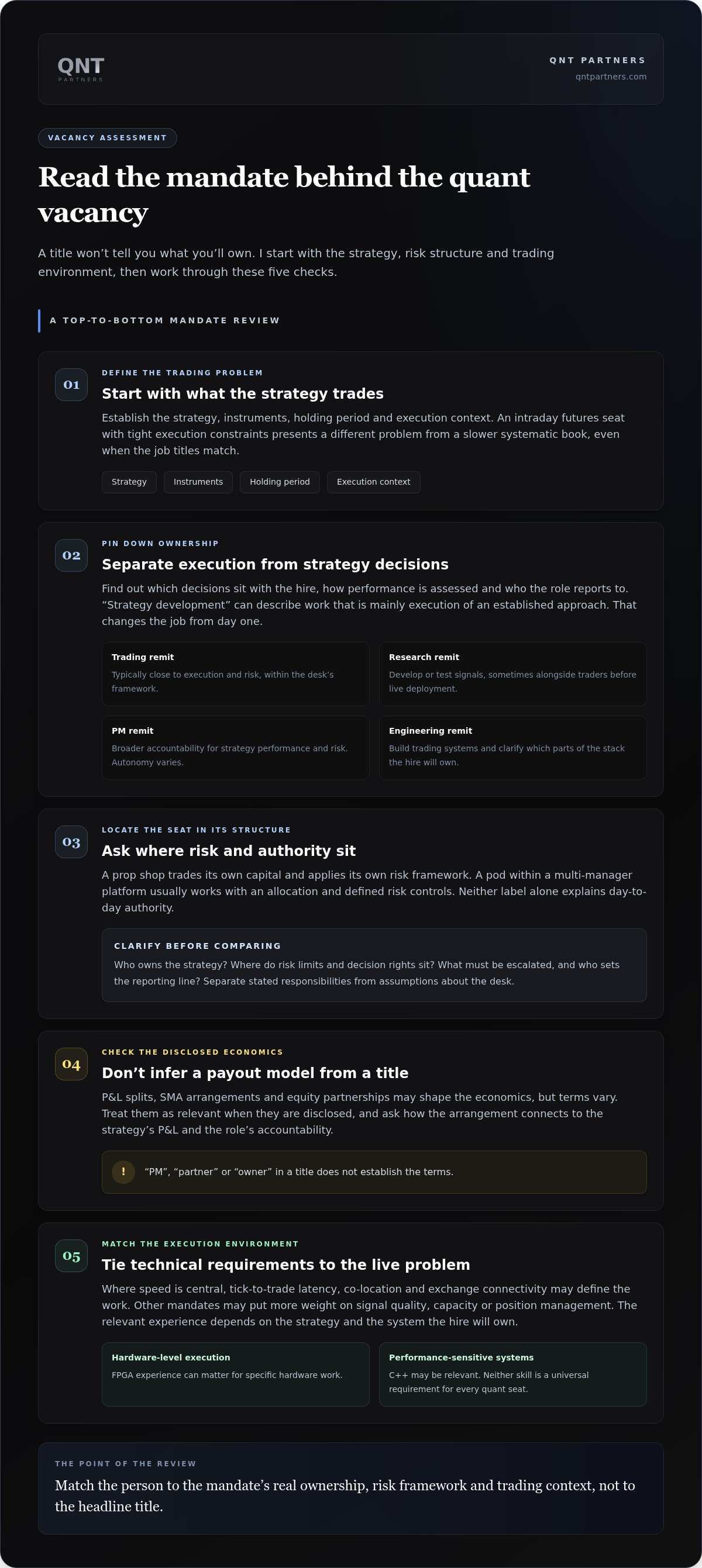
A job title won’t tell you what you’ll own. To assess a quantitative trader vacancy, start with the strategy, instruments, holding period and execution context. A trader working intraday futures with tight execution constraints faces a different problem from someone running a slower systematic book, even if both roles have the same title.
Mandate detail is essential to role fit because it shows where your decisions begin and end. Establish which decisions sit with the hire, how performance is assessed and which desk or manager the role reports to. A vacancy may describe “strategy development” while expecting the hire mainly to execute an established approach. That difference changes the work from day one.
Strategy, desk structure, and accountability
Systematic trading describes a method, not a universal desk structure. One team may have researchers develop signals while traders manage execution or intraday risk. Elsewhere, a trader may contribute directly to strategy design. Research-led roles can also sit close to live trading, with researchers iterating on signals in response to production results.
Firm structure affects how decisions are made. At a prop shop, a trader may work within the firm’s own capital and risk framework. In a pod shop, decision rights and risk limits may sit within a broader multi-manager platform. Neither setup tells you by itself how much autonomy the role carries. Separate responsibilities stated in the mandate from assumptions about the desk, then clarify ownership, escalation and reporting lines.
P&L splits or equity partnerships may shape the economics, but only where the terms are disclosed. Don’t infer a payout model from “PM”, “partner” or “owner” in a title. Find out how the arrangement connects to the strategy’s P&L and what accountability comes with it.
Execution and technical environment
Execution requirements depend on the strategy. Where speed is central, tick-to-trade latency, co-location and exchange connectivity may define the engineering or trading problem. In other mandates, those factors may be less important than signal quality, capacity or position management.
FPGA capability can matter when a role involves hardware-level execution work, but it shouldn’t be treated as a standard requirement for every quant seat. A quantitative trader search firm needs to establish which parts of the stack the hire will own and how closely that work connects to live decisions. Otherwise, a candidate can be screened for the wrong experience, or a hiring team can miss the specialist its desk needs.
Compare quant vacancies by fit, not headline compensation
Headline compensation can’t tell you whether a role gives you the decisions you want to own. Compare the mandate itself: strategy ownership, desk structure, technical environment and decision rights. Pay matters, but it’s one part of the trade-off, alongside how performance is measured and what the seat lets you build or run.
Mandate detail shows whether the day-to-day work matches your strengths and preferred risk structure.
| Dimension | What to establish |
|---|---|
| Strategy ownership | Will you develop signals, manage execution, own a book, or contribute across these areas? |
| Desk structure | Where do risk limits sit, and who sets priorities across the team? |
| Technical environment | Which parts of the research or trading stack will you work on directly? |
| Economics | Are P&L splits or equity partnerships part of the disclosed arrangement, and how do they relate to the mandate? |
Candidate-side questions that clarify fit
Focus on the work behind the title. Which strategy or instruments will you cover? What decisions will you make independently, and what sits with the PM, head of trading or central risk team? For a research-heavy seat, clarify how research reaches production and how its contribution is assessed. For a trading role, establish whether the remit centres on execution, risk management or strategy development.
Also account for the practicalities of a move. Garden leave or non-compete terms may affect timing and the scope of a transition, so handle those discussions carefully and seek appropriate advice where needed. Keep current positions, strategies and relationships confidential during early conversations. A quantitative trader search firm should treat discretion as part of the process, not an afterthought.
Hiring-team criteria for a focused search
A generic specification rarely gives a search enough precision. Define the capabilities the seat genuinely needs, whether that means live trading judgement, signal research or infrastructure experience. Set out the reporting line, decision rights and how the role interacts with the rest of the desk. A requirement for “strong quant skills” says little about what the hire must deliver.
At QNT Partners, we use those distinctions to focus the search on relevant experience rather than matching candidates to titles alone. Clear criteria reduce the chance of presenting someone whose background looks right on paper but doesn’t fit the desk’s ownership model.
Use a specialist search process to evaluate a quant vacancy
A useful search starts before anyone discusses CVs. The role needs a clear mandate, and candidates need enough context to judge whether the work is worth pursuing. I’d structure the process around four steps: define the mandate, map relevant experience, assess the desk context, then manage the conversation discreetly.
From role specification to focused search
We translate the hiring team’s requirements into the work the hire will actually do. That means establishing the strategy and desk context, then separating essential capabilities from preferences. A search for someone to own live trading decisions calls for different evidence from a role focused on research development or execution infrastructure.
Next, we map experience against the mandate rather than relying on titles or employer names. Relevant evidence might include responsibility for a particular strategy, collaboration between research and trading, or experience building systems for a defined execution environment. Targeted outreach keeps the search focused without requiring broad circulation or promises about who will be available.
Discretion matters throughout. We share the role’s substance clearly, without exposing sensitive information about the hiring team or asking candidates to disclose proprietary details about their current desk. Our work as a quantitative trader search firm is to give both sides enough clarity to assess fit while respecting those boundaries.
Assessing specialist technical requirements
Technical requirements should follow the trading environment. If the role concerns low-latency execution, clarify which part of the stack the hire will own and how it connects with exchange connectivity, co-location or other infrastructure. If those elements aren’t central to the mandate, they shouldn’t become default filters. The same applies to specific tools or languages: test their relevance to the work, not just their presence on a CV.
Candidates can test the role’s substance before committing to a full process. Establish who sets priorities, where the role sits between research and trading, and what decisions the hire will make. A good specialist search makes those details available early enough to prevent mismatched expectations.
For more context on the search itself, read our quant recruitment firm guide. Where infrastructure is central, the HFT infrastructure recruitment reference covers that specialist context. If you’re defining a quant mandate, discuss a quant search with QNT Partners. A precise brief gives the search a clear target and candidates a sound basis for deciding whether to proceed.
Work with QNT Partners on quantitative trader search
A quant search is useful when the firm understands the work behind the seat. QNT Partners is a boutique search and advisory firm focused on quantitative trading, research, technology and AI or ML talent for HFT firms and hedge funds. I co-founded the firm with an operator’s view of these roles. The distinction between a strategy’s research needs, its trading decisions and the systems supporting execution matters from the outset.
Our searches cover quantitative traders and researchers, alongside low-latency technology and AI or ML specialists. That range matters when a hiring need crosses disciplines, such as a trading build-out where research, execution and infrastructure must work together. Read more about our operator-founded firm and the experience behind our approach.
When a focused search is the right route
A specialist search is useful when a role depends on trading or technical context that a generic title won’t convey. A low-latency engineering mandate, for example, may hinge on the engineer’s relationship to exchange connectivity and the trading stack. A trader search may turn on strategy ownership and desk decision rights.
We use that context to shape focused outreach and explain the mandate clearly to relevant candidates. The process can be handled discreetly, with care around sensitive hiring plans and a candidate’s current relationships. A clear account of responsibilities gives both sides a better basis for deciding whether to proceed.
Start a confidential conversation
For hiring teams, a useful first discussion covers the mandate, desk structure and capabilities the hire must bring. For candidates, it starts with the work you want to own and the experience that best demonstrates your fit. We keep the conversation centred on relevant role details and avoid unnecessary disclosure about current strategies or employers.
If you’re considering a move, we can connect your experience with relevant role conversations. As a quantitative trader search firm, we focus on whether the mandate, technical context and candidate experience line up, rather than relying on title alone. Hiring teams can contact QNT Partners about a quant search to discuss the requirements. A clear brief helps keep the search focused on candidates who fit the desk’s actual needs.
Make the mandate your starting point
Assess a quant role by what you’ll own, how the desk makes decisions and how the strategy fits your experience. Titles and headline compensation can’t answer those questions on their own. The mandate can.
I’m James, co-founder of QNT Partners. QNT Partners is a boutique search and advisory firm founded by former industry operators, with focused search across quantitative trading, research and technology. We clarify the requirements behind a vacancy so candidates and hiring teams can assess fit on substance, not assumptions.
If you’re defining a search or weighing a move, start with the strategy, responsibilities and decision rights that matter to you. Discuss a quantitative search with QNT Partners and get a clearer view of the role before deciding whether to proceed.
Frequently Asked Questions
What does a quantitative trader search firm do?
A quantitative trader search firm connects specialist professionals with trading mandates and helps hiring teams define the experience a role requires. At QNT Partners, we focus on quant trading, research and technology recruitment for HFT firms and hedge funds. That means looking beyond job titles to the strategy, responsibilities and desk context, then communicating the opportunity clearly and discreetly to relevant candidates.
How do I assess whether a quant vacancy is the right fit?
Assess the work and decision rights, not just the title or headline compensation. Establish the strategy and instruments, your expected ownership, reporting line and how the role connects research, trading and execution. Clarify how performance is assessed and, if disclosed, how P&L splits or equity partnerships relate to the mandate. Consider practical move constraints, including garden leave or non-compete terms, and seek appropriate advice on their implications.
What is the difference between a quant trader and a quantitative researcher?
A quant trader is generally closer to execution, positions and trading decisions, while a quantitative researcher focuses on developing or testing models and signals. The boundary varies by desk: researchers may work closely with live trading, and traders may contribute to strategy design. For a specific vacancy, clarify who owns the signal, who makes trading decisions and how research moves into production.
Can a specialist search firm help recruit low-latency engineers?
Yes. Specialist search can help firms identify engineers whose experience fits the trading infrastructure mandate. Depending on the role, that may involve exchange connectivity, co-location, tick-to-trade latency or hardware such as FPGAs. These aren’t universal requirements. A useful search defines which systems the engineer will work on and how they support the desk, rather than treating a particular technology as a default filter.
What should a quant vacancy specification include?
A useful specification describes the strategy, instruments and responsibilities, then sets out the role’s ownership and reporting line. It should distinguish essential experience from preferences, explain how the position works with research, trading or infrastructure teams, and clarify the desk’s decision-making structure. If P&L arrangements or equity partnerships are relevant, include them only when terms can be shared. A generic title and skill list won’t define the mandate.
How does a specialist search firm protect candidate confidentiality?
Confidentiality starts with controlled, relevant communication. We keep outreach focused on the role’s substance and avoid sharing sensitive hiring details unnecessarily. Candidates can discuss their experience without disclosing proprietary strategies or confidential information about their current desk. A discreet process should respect existing relationships and make clear what information is being shared, with whom and for what purpose before conversations progress.
Are quant vacancies different at prop shops and multi-manager firms?
Yes, firm structure can shape capital, risk and decision-making. A prop shop trades the firm’s own capital, while a pod in a multi-manager platform typically operates within allocated capital and platform risk controls. The details vary by firm and mandate. Don’t assume a title reveals autonomy or economics; clarify who sets limits, who owns the strategy and whether any P&L arrangement is disclosed.