Quant Trading Talent Benchmarking: A Practical Framework for 2026

A larger quant team can still be short of the capability a strategy depends on. Quant trading talent benchmarking is useful when it tests whether roles, skills and decision rights match the work, not when it simply compares headcount.
I see firms compare titles across prop shops, pod shops and multi-manager platforms as if the labels describe the same jobs. They don’t. One researcher may take a signal from discovery through production monitoring; another may focus on research while a separate team handles implementation. The same differences apply to trading autonomy, P&L splits and access to co-location or exchange connectivity.
This framework helps identify strategy-specific gaps, separate team design from compensation comparisons and turn market observations into hiring priorities. Start with the work the team must deliver, then examine how structure and market access shape the roles required. A useful benchmark informs a decision, rather than making a team look larger on paper.
Key Takeaways
- Use quant trading talent benchmarking to test whether skills and role coverage match the strategy’s actual demands.
- Compare prop, pod and multi-manager structures by how decisions are made and work gets done, not by a universal ranking.
- Give current, role-specific evidence more weight than assumptions, anecdotes or stale market observations.
- Map the mandate to required capabilities before deciding whether a gap calls for a hire or a change in resourcing.
- Use specialist market insight to sharpen search priorities, while leaving operating decisions with the people responsible for the strategy.
What quant trading talent benchmarking should measure
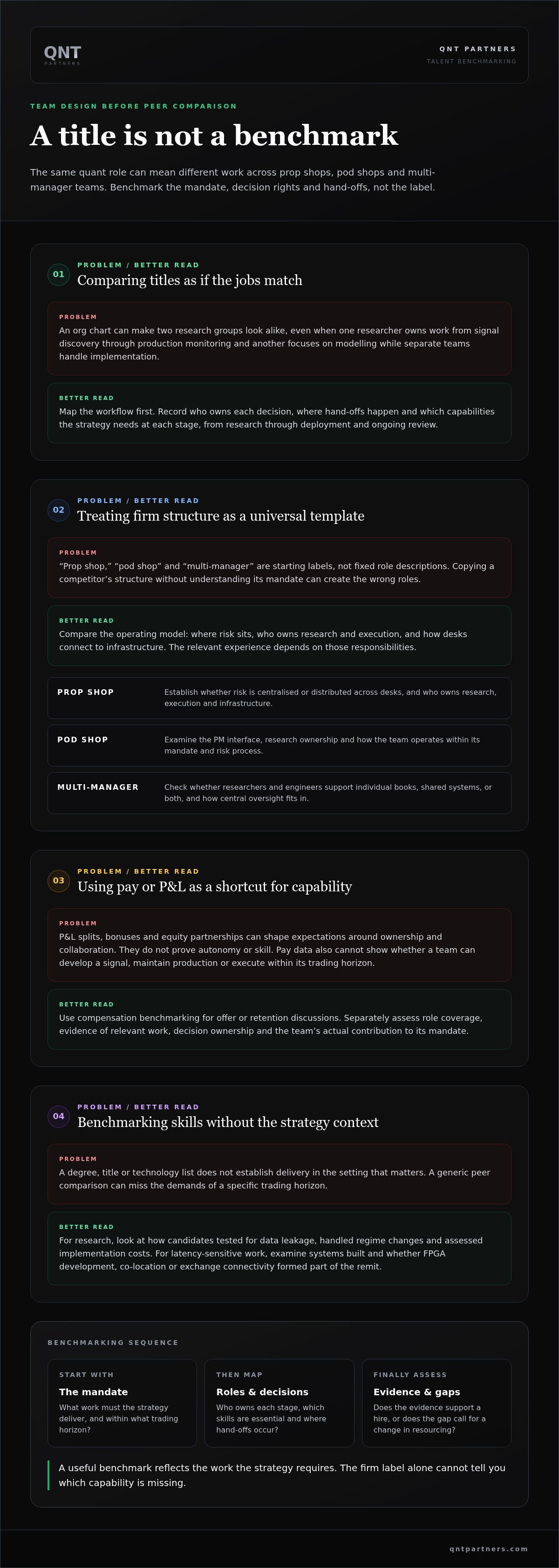
Team size and job titles reveal little about capability on their own. Two research groups can look similar on an org chart but differ in their ability to form hypotheses, validate signals and move research into production. Quant trading talent benchmarking is useful only when the comparison reflects the work the strategy requires.
A useful benchmark compares the skills, role coverage and team design required by a specific trading mandate. It shows where capability sits and where a hiring or structural decision may be needed. That is different from compensation benchmarking. Pay data can inform an offer or retention discussion, but it cannot show whether the team can develop a signal, maintain a production system or execute within its intended trading horizon.
Benchmark capabilities, not labels
The same title can describe different jobs. A quant researcher at one firm might own feature research through production monitoring. At another, the role may centre on statistical modelling, with engineering and deployment handled by separate teams. A quant developer might build research tooling, or work on execution systems where tick-to-trade latency and exchange connectivity are central.
Start with the strategy’s workflow, then assess evidence of relevant work. For research, ask how the person tested for data leakage, handled regime changes and assessed whether a signal survived implementation costs. For a low-latency engineering role, examine the systems built and the constraints involved, including whether FPGA development or co-location formed part of the remit. A degree, title or list of technologies provides context, but does not prove delivery in the setting that matters to your desk.
The broader discipline is outlined in Quantitative analysis in finance. For team benchmarking, keep the question specific: which methods and skills must be applied reliably within this firm’s research and trading process?
Keep the benchmark tied to the mandate
A benchmark has to reflect the strategy and its trading horizon. A team working on slower systematic signals may need depth in data research and portfolio construction. A latency-sensitive strategy may depend more on execution research, systems engineering and exchange connectivity. Neither profile is a universal template. Copying a competitor’s structure without understanding its mandate can create the wrong roles, even when the titles look comparable.
Map the work from research through deployment and ongoing review. For each stage, record who owns the decision, where hand-offs occur and which capabilities are essential. This helps separate a genuine skill gap from a different, but workable, division of responsibilities.
I’d apply the same discipline when reading Quant Trading Recruitment Firms: A Strategic Guide to Elite Talent Acquisition: define the work and team context before drawing conclusions from titles or market labels. A benchmark should inform operating judgement, not replace it.
How trading structure changes the relevant talent benchmark
A trader, researcher or engineer can have a different remit under the same title, depending on how a firm allocates risk and organises decisions. Compare the operating model first. Structure must come before peer comparison because the same capability can carry different responsibilities, incentives and measures of contribution across firms.
Prop shops, pod shops and multi-manager firms are not fixed templates. The labels are a starting point. The mandate, ownership and interfaces determine which experience is relevant. Quant trading talent benchmarking needs to account for team design, not just role descriptions.
| Structure | Typical mandate and interface to examine | Capabilities to benchmark |
|---|---|---|
| Prop shop | Risk may sit within a central trading operation or be distributed across desks. Establish who owns research, execution and infrastructure. | Assess the balance of trading judgement, research depth and technical capability against the desk’s actual responsibilities. |
| Pod shop | A PM-led team may own a defined book while relying on central functions for some tools or services. | Look at the PM interface, research ownership and ability to operate within the team’s mandate and risk process. |
| Multi-manager | Teams may combine distinct PM mandates with shared infrastructure or central oversight. | Compare how researchers and engineers support individual books, shared systems or both. |
Prop shop and pod shop comparisons
One prop shop might have a central group responsible for execution systems and exchange connectivity, leaving desk teams to focus on signals and risk-taking. Another might place more of that work directly with each desk. Neither setup makes a role inherently more senior or capable. Record the boundary: who designs the system, who implements it and who is accountable for the outcome.
P&L attribution matters. Where contribution is assessed at desk level, a role close to a strategy’s research or execution may be evaluated differently from one supporting several desks. P&L splits, bonuses or an equity partnership can shape expectations around ownership and collaboration. None proves autonomy or skill on its own. I don’t infer either from a firm label or compensation structure.
Multi-manager and systematic team design
In multi-manager and systematic teams, map the relationship between PMs, researchers and shared infrastructure. Does a PM set research priorities, or does a central research group own signal development? Do engineers build for a specific book, or maintain systems used across strategies? The answers change what evidence matters when assessing experience and role scope.
For practical context on assessing trader skills, Hiring and assessing quantitative traders can inform how capabilities are evaluated. The benchmark still needs to match your mandate. A discussion of organisational design for quantitative trading firms should start with decision rights and interfaces, not an assumed standard org chart.
If your team is reviewing role boundaries before a search, discussing the team structure with a specialist can help turn that map into a focused hiring brief.
Which evidence makes a quant talent benchmark useful?
A benchmark is only as sound as the evidence behind it. In quant trading talent benchmarking, a first-hand, role-specific observation is more useful than a broad market average, but it still needs context: when it was gathered, which strategy and structure it relates to, and whether it describes an actual remit or an assumption based on a title.
I separate evidence into direct observations from relevant market conversations, claims that need corroboration, and information that may be outdated or too general to guide a decision. A report that a firm is adding researchers, for example, does not show what those researchers own or whether the build-out resembles yours. Record the role, location, operating model and source context before drawing a conclusion.
Role and capability signals
Assess what a person or team has delivered and where responsibility sat. For research, distinguish signal discovery from ownership of validation and production hand-off. For infrastructure, a C++ keyword on a profile says little without details of the systems built, the constraints handled and the individual’s contribution. FPGA or exchange-connectivity experience matters when it maps to your technical requirements. Look for specific, explainable work rather than a list of tools.
Team interfaces provide evidence too. Clarify how research, trading and engineering collaborate, where decisions are made, and who supports a system once it is live. These details help show whether a candidate’s experience transfers to your environment. Similar titles alone do not establish similar scope.
Market evidence and its limits
Recent, role-specific observations are more useful than an undifferentiated average. A hiring process for a systematic research build-out may reveal demand for a particular combination of skills, but it does not automatically describe a latency-focused team or a different location. Keep compensation in its own column. It can inform a hiring discussion, but it does not measure team quality or technical depth.
Small samples call for restraint. A handful of conversations can surface a lead, but not establish a market-wide pattern. Firms may describe their structures differently, and confidentiality can limit what is shared or compared. Label the confidence behind each conclusion instead of turning incomplete evidence into a precise-sounding ranking.
Before acting on a market observation, test whether it is comparable to your mandate. Check whether the roles have similar ownership, seniority and interfaces, then note what remains unknown. If those conditions do not hold, use the observation as a prompt for further investigation, not as a hiring specification.
The practical output should be a short evidence record, not a league table: the capability observed, the context it came from and its relevance to the role you need to fill. You can revisit the judgement when the mandate changes or stronger evidence emerges.
Turn benchmark findings into focused hiring priorities
A benchmark earns its keep when it changes a decision. Turn observations into a hiring brief, while checking whether the apparent gap is really about capability, workload, ownership or team design.
Use this sequence:
- Identify the mandate. State what the strategy must deliver and which work is essential.
- Map the capabilities. Record where those skills sit today and who owns the relevant decisions.
- Find the gap. Pinpoint a missing capability or a dependency that limits execution.
- Set the priority. Decide whether the response is a hire, a clearer remit or a change in how work is allocated.
Order matters. A role that sounds fashionable is not automatically the next hire. Prioritise capabilities that are critical to the mandate and sit on the path to execution. If a strategy build-out depends on productionising research, clarify who owns that hand-off before adding another researcher or engineer.
Separate hiring gaps from design questions
Look for work with no clear owner, overlapping responsibilities or a hand-off that repeatedly stalls. A genuine capability gap exists when the required work is understood but the team lacks the skill or experience to do it. A temporary resourcing issue is different: the capability may be present, but workload leaves too little capacity.
For an infrastructure need, define the system problem before specifying a profile. If the requirement involves low-latency execution, identify whether the constraint sits in C++, FPGA work, exchange connectivity or another part of the stack. The HFT infrastructure recruitment reference can help frame the search, but the brief still needs to reflect your architecture and ownership boundaries.
Sometimes the fix is a new role. Sometimes it is a clearer remit for an existing engineer or a decision about which team owns production support. Quant trading talent benchmarking should not become a headcount-growth exercise. Link each proposed hire directly to the mandate.
Set a benchmark review cadence
Revisit the assessment when the strategy, technology or team structure changes. A new execution venue, a shift in trading horizon or a spinout from a larger platform can change the capabilities the team needs, even if the org chart stays the same.
Keep a short record of the evidence behind each priority: source, date, role context and confidence. Mark assumptions clearly. That makes future reviews easier to audit and stops one anecdote from hardening into a hiring rule.
Keep compensation analysis separate. Use it to inform offer design after the capability and role requirements are clear, not as a proxy for technical quality or team effectiveness. If you’re turning a capability map into a quant search brief, QNT Partners combines specialist recruitment with talent strategy advisory.
How QNT Partners applies quant talent benchmarking
Benchmarking is useful when it sharpens a decision, not when it produces a league table. At QNT Partners, we use quant trading talent benchmarking as an input to talent strategy, connecting specialist market context with the roles a firm needs to build or fill. It supports operating judgement; it does not replace it.
I find the most useful conversations start with a specific decision. Is the firm building a research function, adding a PM-led team or strengthening low-latency infrastructure? Without that context, market observations can be interesting but hard to apply. With it, we can focus on the responsibilities, experience and team interfaces relevant to the mandate.
Where specialist market perspective adds value
Quant research, trading and technology roles need to be read in context. A researcher’s experience depends partly on whether they owned a signal through implementation or worked within a specialised research remit. An infrastructure engineer’s background means something different when the requirement is exchange connectivity than when it centres on research systems.
Consider a Chicago prop shop assessing a new execution build-out. A useful discussion would clarify what engineers are expected to own and how their work connects to traders and researchers. A Sydney-based systematic fund may be weighing a different question, such as which research capabilities its strategy needs to add. These are illustrative situations, not templates. Frame market conversations around the firm’s actual decision instead of inferring a hiring plan from another organisation’s structure.
We bring specialist recruitment and talent strategy advisory together so market context can inform search priorities. That can mean refining a role’s scope before a search begins, or distinguishing a missing capability from a responsibility that needs clearer ownership. A market observation is a reason to investigate, not proof that a firm needs another hire.
A practical next step for leadership teams
Before reviewing external benchmarks, write down the mandate and the decision the comparison should support. Specify what work must be done, where ownership sits today and what evidence would change your view. Keep assumptions visible. This gives a market conversation a clear purpose and makes it easier to turn findings into a focused search brief or team-design discussion.
As a boutique firm founded by former industry operators, we work across quantitative trading, research and technology talent. Our perspective helps leadership teams sharpen questions about role scope and market fit. The people accountable for the strategy make the final decisions on structure and priorities.
If you’re weighing a specific build-out or role, bring the mandate and the decision you need to make. Discuss your quant talent priorities with QNT Partners to define the next hiring question.
Make the next team decision with confidence
A benchmark should give leadership a clearer basis for action, not a score to defend. Treat quant trading talent benchmarking as a working hypothesis: test it against the strategy’s next demands, then update it as the mandate or build-out changes. That keeps hiring tied to the work ahead rather than to a snapshot of the market.
Name the decision you need to make. It might be whether to add a specialist, reshape a remit or strengthen a dependency between research and production. Keep the question specific so the benchmark focuses the discussion without taking operating judgement away from the team.
At QNT Partners, we provide specialist recruitment and talent strategy advisory to quant trading, research and technology teams. Start with the mandate and the decision in front of you. Talk through a team benchmark and identify a practical next move for your hiring plan.
Clear priorities make the next build-out easier to shape. Start with the decision that matters most.
Frequently Asked Questions
What does quant trading talent benchmarking measure?
It measures whether a team has the expertise and role coverage its trading process requires. A firm testing a new signal pipeline, for example, might assess who can validate data, review implementation assumptions and monitor the signal after deployment. Benchmarking can also expose key-person dependencies, such as a production system understood by only one engineer. The aim is to inform a decision, not assign individuals a score.
How do prop shops and multi-manager funds benchmark quant talent differently?
A prop shop may assess how closely a role connects research, trading and execution within a desk or central function. A multi-manager fund may focus more on how a hire works with a PM’s book and interacts with shared teams. Compare decision rights and dependencies before comparing skill profiles. Experience from one model may transfer, but first establish the remit and interfaces.
Can headcount be used to compare quant trading teams?
Headcount describes capacity, but cannot establish capability on its own. A larger team might include central engineering or shared research support, while a smaller desk may own more of its work directly. Separate people by function and scope, then note which responsibilities sit outside the team. A simple staff count can otherwise make materially different operating models look equivalent.
How should a firm benchmark quantitative researchers against traders?
Assess each role against its contribution to the strategy rather than forcing both into one ranking. For researchers, examine how they formulate and test hypotheses, evaluate data quality and communicate uncertainty. For traders, focus on how they interpret signals, make execution decisions and respond to changing market conditions. Some roles span both areas. Assess that overlap directly instead of assuming a hybrid title means equal depth in each.
Is compensation benchmarking enough to assess a quant team?
No. Compensation benchmarking can inform hiring or retention decisions, but it does not show whether the team has the right research ownership, production expertise or trading judgement. A high offer may attract a candidate without resolving unclear responsibilities or a technical dependency. Keep pay comparisons separate from capability assessment: one asks what expertise is needed, the other how the role should be positioned.
What evidence should firms use for quant talent benchmarking?
Use evidence tied to actual work: role descriptions with clear responsibilities, technical discussions about systems built, and market conversations that establish the context behind a role. A C++ requirement could mean research tooling in one team and performance-critical infrastructure in another. Record the source and date of each observation. Treat a repeated, comparable signal differently from an isolated anecdote or a profile keyword.
How often should a quant fund review its talent benchmark?
Review it when a change could alter the work or skills the team needs, rather than relying only on a fixed calendar. A new strategy, a shift to a different trading horizon or a change in production ownership can make earlier assumptions stale. Keep the previous assessment and mark what changed. That helps leadership distinguish a genuine capability shift from a temporary change in workload.