Quant Trading Recruitment Firms: A Strategic Guide to Elite Talent Acquisition

The difference between a standard software developer and a low-latency HFT engineer isn't just a matter of degree; it's a fundamental difference in how they perceive and interact with hardware. Most generalist quant trading recruitment firms fail to grasp this distinction, leading to a cycle of poorly vetted candidates and wasted technical interviews. You've likely experienced the frustration of recruiters who don't understand the math behind your models or the specific constraints of your execution stack. It's a costly inefficiency that leads to talent leakage and missed opportunities in a market where technical precision is the only currency that matters.
This guide allows you to navigate the specialized landscape of quant recruitment and discover how an operator-led approach secures the industry's most elusive technical talent. We'll examine how this strategic methodology reduces time-to-hire for niche roles like Machine Learning researchers and provides access to the elite, passive talent pool that remains invisible to traditional search methods. By the end of this article, you'll understand how to secure the technical mastery required to sustain your firm's competitive edge and drive consistent alpha generation.
Key Takeaways
- Identify why traditional volume-based metrics are obsolete in the current market and how to prioritize precision over candidate quantity to protect your execution stack.
- Master the technical benchmarks necessary for vetting low-latency C++ engineers and AI researchers, ensuring candidates possess deep mathematical and infrastructure-level proficiency.
- Avoid the "generalist trap" by understanding the subtle but critical distinctions between standard fintech developers and high-performance systematic trading talent.
- Discover how elite quant trading recruitment firms utilize an operator-led model to bridge the gap between human capital acquisition and strategic capital allocation.
- Access sophisticated market intelligence for benchmarking compensation and alpha generation trends, allowing your firm to stay competitive in the global search for elite talent.
The 2026 Quant Trading Recruitment Landscape: Beyond the Resume
The "War for Alpha" has entered a more complex phase. In a post-LLM environment, the barrier to entry for basic signal generation has dropped, making the hunt for genuine, non-correlated alpha more aggressive. Traditional quant trading recruitment firms that rely on high-volume candidate delivery are increasingly out of sync with the needs of systematic funds. Success in 2026 requires more than a database; it requires an understanding of how quantitative analysis (finance) intersects with cutting-edge infrastructure. The current market is defined by a convergence of high-frequency trading (HFT), crypto-native funds, and traditional quant research, all competing for the same narrow band of elite talent.
The Rise of the Quantitative Operator
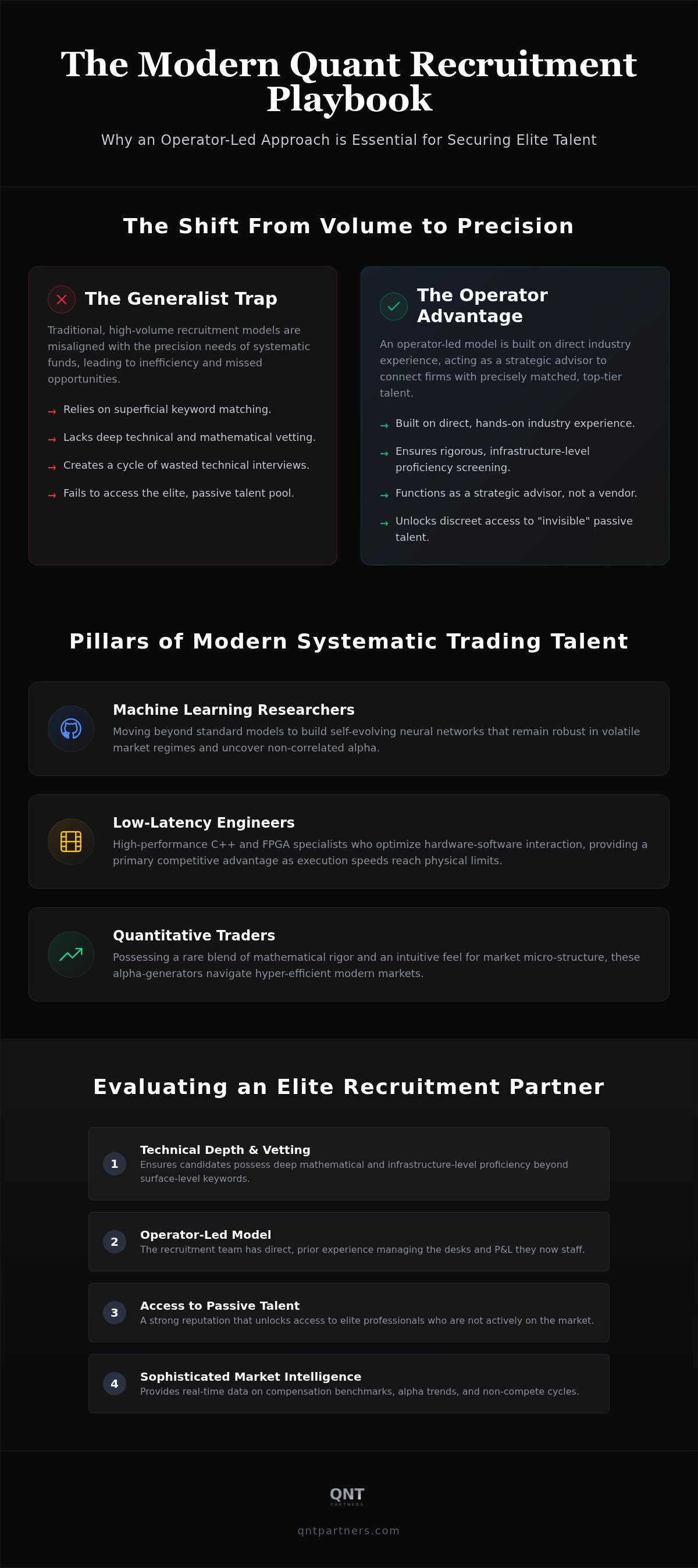
The legacy agency model is broken. It prioritizes speed and keyword matching over technical vetting and strategic alignment. An operator-led search model, by contrast, is built on the foundation of direct industry experience. These recruiters have managed the very desks they now staff, providing a level of professional gravity that ensures the firm acts as a strategic advisor rather than a mere vendor. This shift is essential because elite candidates no longer respond to cold calls from generalists. They engage with peers who understand the nuances of their execution stack and the specific challenges of their research environment. Discretion is the primary currency in these circles, where a recruiter's reputation determines their access to "passive" talent that never appears on public job boards.
Key Talent Segments in Modern Systematic Trading
Technical mastery has become highly specialized, moving away from broad financial knowledge toward deep-tech expertise. Quant trading recruitment firms must now navigate three critical talent segments that define the modern landscape:
- Machine Learning Researchers: The focus has shifted from standard predictive modeling to deep learning and neural network architecture. Firms need researchers who can build self-evolving models that remain robust in volatile regimes.
- Low-Latency Engineers: The demand for high-performance C++ and FPGA specialists remains at an all-time high. As execution speeds reach physical limits, the ability to optimize hardware-software interaction is a primary competitive advantage.
- Quantitative Traders: Sourcing alpha-generators requires a discerning eye for those who can navigate hyper-efficient markets. These individuals must possess a rare blend of mathematical rigor and the intuitive "feel" for market micro-structure.
This convergence means that a researcher from a top-tier HFT firm may now be the ideal candidate for a crypto-native fund or a multi-strategy hedge fund. Identifying these cross-pollination opportunities requires a partner with global connectivity and a deep-rooted understanding of the evolving technical requirements across all systematic trading venues.
Criteria for Evaluating Top Quant Recruitment Firms
Selecting a recruitment partner in the systematic trading space is a high-stakes decision. It's not about who has the largest database. It's about who has the deepest technical understanding. Elite quant trading recruitment firms must demonstrate more than a passing familiarity with financial terms; they need to grasp the underlying mathematics and infrastructure that drive your fund's performance. This requires a firm to understand the rigorous technical standards and evolving skill sets, such as those outlined in Cornell University's Quantitative Finance Certificate, to accurately vet for AI, ML, and low-latency proficiencies.
Technical Benchmarking and Market Data
Market intelligence is your primary defense against talent leakage. You need a partner who provides real-time benchmarking on compensation, ensuring your offers remain competitive without overextending. Beyond simple salary figures, effective firms track non-compete cycles and move-windows with surgical precision. They know when a key researcher's constraints are expiring and can facilitate introductions at the exact moment of maximum opportunity. This level of data allows you to anticipate competitor moves and secure talent before it ever hits the open market.
The Search Methodology: Retained vs. Contingent
The methodology quant trading recruitment firms employ says everything about their commitment to your brand's reputation. Contingent recruitment often leads to "spray-and-pray" tactics. This creates false positives and risks exposing your fund's hiring needs to the entire street. For senior PM and ML Lead roles, the retained search model is objectively superior. It ensures professional discretion and a methodical outreach process that protects your investment mandate. A retained partner acts as your dedicated ambassador, engaging only the most qualified passive candidates who aren't active on job boards.
Vetting is where the true operators separate themselves from the generalists. A keyword search on a resume is worthless in a field where C++ proficiency can range from standard application development to hardware-level optimization. Your recruitment partner must act as a strategic advisor, understanding your fund's specific investment mandate and the technical hurdles your team faces daily. For firms requiring a more integrated approach, engaging a partner for talent strategy advisory ensures that every search aligns with long-term capital objectives and operational excellence.
The Generalist Trap: Why Broad Finance Recruiters Fail Systematic Funds
Systematic funds operate on the edge of technical possibility. When a fund engages generalist finance recruiters, they often encounter the "generalist trap," a cycle of high-volume candidate delivery that lacks mathematical and technical rigor. False positives are expensive. Interviewing candidates who lack the required stochastic calculus or low-latency C++ expertise wastes the time of your senior researchers and engineers. Most quant trading recruitment firms with a generalist background struggle to distinguish between a standard fintech developer and an engineer capable of optimizing an HFT execution stack. This fundamental misunderstanding results in a misalignment that can stall critical project timelines.
Precision over Volume
Elite quants are elusive. They're often inundated with low-quality outreach from recruiters who don't understand the complexities of their work. This creates a psychological barrier; a researcher at the top of their field will likely ignore a message that feels like a generic template. High-volume agencies frequently fail in sourcing niche ML specialists because they cannot vet for the specific deep learning architectures or neural network optimizations required for modern alpha generation.
Specialized firms avoid this by building long-term, peer-to-peer relationships with the top 1% of talent. They don't rely on "spray-and-pray" tactics. Instead, they leverage deep technical mastery to engage in meaningful dialogue that commands respect. This methodical approach ensures that every candidate presented has been evaluated against the rigorous standards of systematic trading, significantly reducing the burden on your internal hiring teams.
Preserving Firm Reputation
Your recruitment partner is the first touchpoint for a high-value candidate. If that contact is aggressive or uninformed, it reflects poorly on your fund. In a highly connected industry, aggressive outreach quickly earns a "spam" label, causing lasting brand damage. Discretion is the primary currency in elite circles. An authoritative approach ensures that your fund is perceived as an elite destination for talent rather than just another employer in a crowded market.
Professional gravity and discretion are non-negotiable. A recruiter who understands the stakes of the industry acts as a sophisticated ambassador for your brand. They manage expectations, handle sensitive negotiations, and maintain the level of secrecy required for high-impact hires. This level of care is rarely found in broader recruitment models where volume is prioritized over the integrity of the search.
Many firms fear that choosing a boutique partner limits their reach, but the opposite is true. Global connectivity in the quant space isn't about the size of a database; it's about the depth of the network. A specialized firm provides access to a global pool of passive talent that generalists simply cannot reach, proving that elite quant trading recruitment firms offer far greater effective reach than their larger, less focused competitors.
Advanced Technical Vetting for AI, ML, and Low-Latency Roles
Technical vetting in systematic trading requires a shift from identifying skills to assessing depth. Many quant trading recruitment firms provide candidates who pass basic coding tests but fail when faced with real-world execution constraints. In 2026, the distinction between a researcher with an elite academic pedigree and one with a proven industrial track record has blurred. Funds now prioritize the latter's ability to translate complex theory into profitable signals. Mathematical intuition remains the foundation, but the ability to navigate the nuances of alpha-generation potential in fragmented markets is what separates the elite from the average. Alpha matters most.
Sourcing for High-Frequency Infrastructure
Identifying talent for HFT infrastructure requires looking beyond the traditional finance pool. Top-tier engineers often reside in hardware-adjacent software roles within the aerospace or high-end gaming sectors. These individuals possess a native understanding of performance-critical systems and kernel-level programming that is rare in generalist fintech. Traditional quant trading recruitment firms often miss these 'under-the-radar' profiles because they lack the technical depth to recognize the crossover value of non-finance experience. Vetting these candidates involves probing their knowledge of specific architectural constraints:
- Cache-locality and memory management in C++20/23.
- Kernel bypass techniques and PCIe bus optimization.
- Lock-free concurrency and hardware-level performance tuning.
It's about finding those who treat the operating system as a hurdle to be bypassed rather than a framework to be followed.
Machine Learning and Artificial Intelligence
The current demand for AI and ML specialists focuses on "production-ready" capabilities. It's no longer sufficient to understand predictive modeling in a vacuum. Funds require researchers who can integrate LLMs for alternative data analysis and apply signal processing techniques to noisy datasets. Vetting must focus on the candidate's ability to build robust, self-correcting models that survive the transition from backtest to live markets. This requires a recruiter who can discuss neural network architecture and stochastic gradients with the same level of authority as the fund's CTO.
Strategic talent acquisition in these niches isn't a volume game. It's a precision exercise that requires a partner who acts as an extension of your technical team. For firms looking to secure specialists in Deep Learning or Neural Networks, engaging with AI & ML specialist search services ensures that every candidate has been vetted by an operator who understands the stakes of modern alpha generation.
The Operator Advantage: Bridging Human Capital and Investment Capital
Success in systematic trading requires a synthesis of technical mastery and strategic capital allocation. Talent strategy cannot be decoupled from capital allocation because the caliber of a firm's human capital directly dictates its capacity to deploy investment capital effectively. Unlike traditional quant trading recruitment firms that view search as an isolated transaction, an operator-led model recognizes that a new PM or research lead represents a fundamental shift in a fund's risk profile and alpha potential. This integrated approach ensures that every hire serves the broader investment mandate of the firm, rather than just filling a headcount requirement.
Talent Strategy as a Competitive Edge
Scaling a high-performance quant team requires more than just hiring the right people; it involves consulting on organizational structures that sustain alpha. We advise systematic managers on how to expand their technical capabilities without diluting the core culture that drives their success. By using talent advisory to optimize alpha generation, firms can ensure their research and execution teams are aligned with long-term risk management goals. It's about building a resilient architecture where human capital and technology work in total synchronization. This strategic alignment prevents the friction that often occurs when technical teams grow faster than their operational framework can support.
Capital Advisory and SMA Sourcing
The rise of Separately Managed Accounts (SMAs) has fundamentally changed the demand for specialized talent. Institutional investors now demand deeper transparency and more rigorous due diligence, which makes human capital a primary factor in manager selection. We facilitate growth by connecting institutional investors with vetted systematic managers who possess the technical infrastructure to succeed. This capital advisory role involves performing deep human capital due diligence, ensuring that the team behind the algorithm has the rigor required to manage institutional mandates. By facilitating capital raising through structured advisory and established industry relationships, we act as a bridge between high-performance talent and the capital that fuels it.
Conclusion: Selecting Your Strategic Partner
The industry is moving away from generalist recruitment toward an operator-led, integrated model. Securing elite technical talent requires a partner who understands the math, the tech, and the capital markets with equal depth. For funds looking to maintain a competitive edge, the next step is to align with a firm that acts as a strategic advisor rather than a service provider. Precision, discretion, and technical mastery are the only ways to navigate the specialized landscape of modern finance. Discover the QNT Partners approach to elite quant search.
Securing the Future of Systematic Advantage
The evolution of financial markets has transformed recruitment from a volume-based service into a critical strategic necessity. Success in this landscape requires moving beyond the generalist trap and adopting a methodology rooted in technical mastery and professional discretion. By prioritizing an operator-led approach, funds can access the elusive talent pools required for sustained alpha generation in increasingly efficient markets. Selecting the right partner among quant trading recruitment firms is the single most important decision for your fund's long-term scaling strategy.
QNT Partners provides this specialized edge. As an operator-led firm with deep roots in HFT and systematic trading, we offer a unique perspective on AI, ML, and low-latency infrastructure. Our integrated capital advisory and SMA sourcing capabilities ensure that your talent strategy remains perfectly aligned with your investment objectives. It's time to move beyond standard search and embrace a partnership built on technical precision and market intelligence. Partner with QNT Partners for Elite Quant & Tech Search to secure the expertise that drives your firm's success.
Frequently Asked Questions
What makes a quant trading recruitment firm 'specialized'?
A specialized firm is defined by its deep immersion in the technical and mathematical requirements of systematic trading. Unlike generalists, these firms employ operators with direct experience in HFT or quantitative research. This allows them to engage in peer-to-peer technical discussions rather than simply matching keywords on a resume. Their networks are built on technical credibility and deep-rooted industry relationships that generalist recruiters cannot access.
How do quant headhunters vet technical skills like low-latency C++?
Vetting for low-latency roles involves assessing a candidate's understanding of hardware-level constraints and memory management. Recruiters look for proficiency in cache-locality, kernel bypass techniques, and lock-free concurrency. It's about evaluating how an engineer optimizes the interaction between software and silicon to minimize execution jitter in high-frequency environments. This process requires a recruiter who understands the code at a machine level.
Is it better to use a boutique firm or a global recruitment agency for quant roles?
Boutique firms are generally superior for niche quant roles due to their network exclusivity and technical depth. While global agencies offer volume, they often lack the specialized knowledge required to vet elite researchers. A boutique partner provides a discreet, high-touch service that resonates with passive talent who avoid broad-market recruiters. This selectivity ensures a higher quality of vetting and a more precise strategic alignment for the fund.
How much do quant trading recruitment firms typically charge?
Fees for quant trading recruitment firms typically follow a retained or contingent model based on the seniority and complexity of the search. Retained models are standard for executive and lead researcher roles, ensuring dedicated resources and professional discretion. Pricing structures generally reflect the high-stakes nature of the talent being acquired and the technical expertise required for vetting. These structures are designed to incentivize long-term alignment between the firm and the fund's strategic objectives.
Can a recruitment firm help with capital raising or SMA sourcing?
Certain operator-led firms provide integrated capital advisory services alongside traditional search. This includes facilitating capital raising through SMAs and connecting institutional investors with vetted managers. This dual approach ensures that human capital strategy is perfectly aligned with the fund's capital allocation and growth objectives. It bridges the gap between hiring talent and securing the capital they'll manage.
How do I identify the top quant recruitment firms in the US and UK?
Identifying top quant trading recruitment firms in the US and UK requires looking for those with a proven track record in specific hubs like New York, Chicago, and London. Focus on firms that demonstrate a deep understanding of local regulatory environments and have established relationships within the systematic trading community. Reputation in these circles is built on successful executions in high-performance technical roles.
What is the role of market intelligence in quant recruitment?
Market intelligence provides the data necessary to benchmark compensation and track talent movement across competitors. It allows funds to anticipate non-compete expirations and stay competitive with total package structures. This real-time data is essential for preventing talent leakage and making informed decisions during high-stakes negotiations. Without this intelligence, funds risk losing elite talent to more informed competitors who understand current alpha generation trends.
How do specialized firms handle candidate non-competes and NDAs?
Specialized firms manage non-compete cycles by maintaining long-term relationships and tracking move-windows with precision. They provide guidance on navigating complex NDAs and contractual obligations to ensure a seamless transition for elite talent. This discreet management protects the reputation of both the candidate and the hiring fund throughout the search process. It's a methodical approach that respects the legal and professional boundaries established within the industry.