Quant Trading Infra Talent Search: HFT Operator Guide

A recruiter who can’t discuss kernel bypass may struggle to distinguish clean C++ code from experience building a low-latency trading system. That distinction sits at the centre of quantitative trading infrastructure talent search, where software, FPGA logic and exchange connectivity all shape tick-to-trade performance.
You already know the challenge isn’t finding engineers who can write C++. It’s finding people who have worked through the constraints of a live trading environment and can explain where latency enters the stack. Generalist searches often miss that. Meanwhile, crypto firms can attract the same candidates with substantial equity packages, and garden leave or non-competes can delay a build-out even after you find the right person.
I’m James, co-founder of QNT Partners. We specialise in HFT infrastructure search, with global reach across prop shops and hedge funds. In this guide, I’ll cover how to assess experienced C++ and FPGA talent, focus a search for specialised low-latency roles, and benchmark compensation against market conditions. I’ll also look at how to plan around candidate restrictions without letting them dictate the pace of your team build.
Key Takeaways
- Quantitative trading infrastructure talent search works best when role criteria reflect how software interacts with hardware, not just which languages appear on a CV.
- Map the stack before opening a search, including where C++, FPGA logic, kernel bypass and custom network components matter to the system.
- Use production debugging experience to assess whether a candidate can diagnose failures when market conditions put systems under pressure.
- Factor garden leave and non-compete terms into hiring plans early, and assess each candidate’s restrictions individually.
- An operator-led search can help teams reach specialist engineers across prop shops and hedge funds globally.
Why generalist search fails for low-latency engineering
Matching “C++” or “Python” on a CV to the same terms in a job brief is not infrastructure search. A candidate can write clean application code and still lack experience with how software behaves alongside the operating system, network interface and exchange connection within a tight latency budget.
That distinction defines high-frequency trading (HFT). In a live system, code and hardware interact across the tick-to-trade path. A recruiter who can’t hold a technical conversation about that path may send profiles that look relevant on paper but don’t match the actual engineering problem.
The keyword trap in infrastructure search
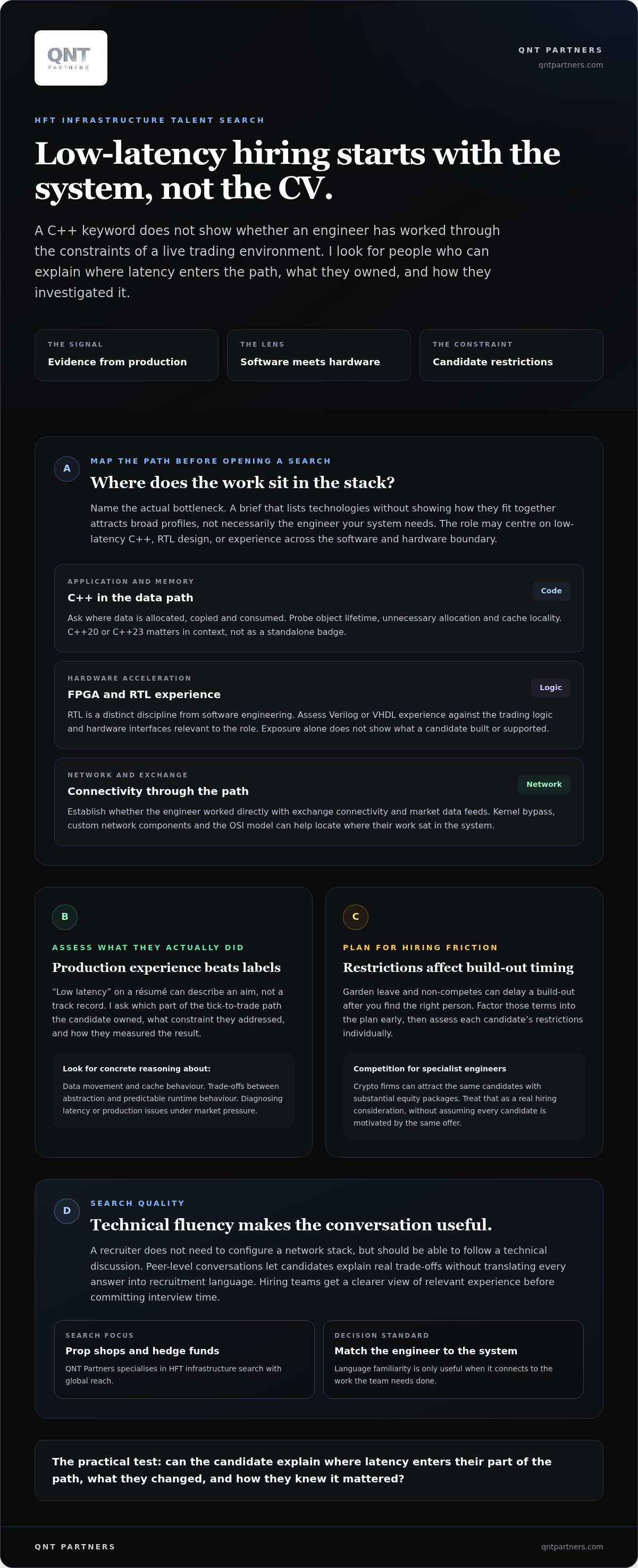
“Low latency” on a résumé can describe an engineer’s goal, not their track record. I look for specific evidence of work on tick-to-trade optimisation: which part of the path they owned, what constraint they were addressing, and how they measured the result. Those details matter more than the label.
Clean code is readable and maintainable. High-performance code must also meet the system’s operational constraints. An engineer may be strong in C++ yet lack experience with the code, hardware and network interactions that matter in a latency-sensitive trading stack. The same applies to FPGA work: exposure to the technology alone doesn’t establish what a candidate built or supported.
I’ve seen firms spend months interviewing candidates who could discuss languages but not systems-level trade-offs. That delay can hold up a build-out or leave an engineering bottleneck in place. In my view, the cost of lost capacity can outweigh the placement fee.
Operator-led vetting vs. HR screening
A recruiter doesn’t need to configure a network stack, but they do need enough technical fluency to follow the conversation. Understanding the OSI model helps locate where a candidate’s work sits, from application behaviour through the transport and network layers. Without that frame, “worked on networking” is too vague to qualify a specialist.
Vetting should establish whether the engineer has worked directly with exchange connectivity and market data feeds, and what their responsibilities covered. Did they build or maintain part of the path? How did they investigate latency or production issues? These prompts help distinguish hands-on experience from familiarity with the terminology.
Peer-level discussion improves the quality of the search. Candidates can explain real trade-offs without translating every answer into recruitment language, while hiring teams get a clearer view of relevant experience before committing interview time. At QNT Partners, we specialise in HFT infrastructure search across prop shops and hedge funds globally. That focus keeps the assessment centred on the system the engineer will actually need to support.
Defining the technical stack for elite infrastructure hires
A strong infrastructure hire can explain how a software change moves through the machine, not only how they would implement it in C++. In modern HFT teams, the relevant boundary often runs from application code and memory behaviour down to the NIC, FPGA and exchange connection. A search brief that names technologies without describing where they sit in that path will attract broad profiles, but not necessarily the engineer the system needs.
For quantitative trading infrastructure talent search, define the role around the actual bottleneck. Is the team reducing copies in the data path, moving logic onto an FPGA, or tuning how packets reach the application? The answer helps determine whether the right profile is a low-latency C++ developer, an RTL engineer, or someone who can work across both sides of the interface.
C++ and the pursuit of zero-copy
Ask candidates to explain where data is allocated, copied and consumed in the path they owned. C++20 or C++23 proficiency is useful only in context: probe how they manage object lifetime, avoid unnecessary allocation and reason about cache locality. An engineer optimising at the L1 or L2 cache level should be able to describe the data-access pattern they changed and why it mattered to the workload.
Template metaprogramming can support compile-time decisions in performance-sensitive code, but it isn’t a proxy for sound systems judgement. Test whether a candidate can explain the trade-off between abstraction and predictable runtime behaviour, rather than treating complex templates as evidence of low latency by themselves.
FPGA and hardware acceleration
RTL design is a distinct discipline from software engineering. Assess Verilog or VHDL experience against the trading logic and hardware interfaces the role actually involves, rather than inferring it from a general C++ background. For a software-focused hire, the key question may instead be whether they’ve integrated FPGA-accelerated components into a broader systematic trading architecture and understand the boundary between host code and programmable logic.
Set explicit criteria for the surrounding stack, too. If the role touches kernel bypass or a custom network stack, establish what the candidate implemented or operated. For a hardware-facing remit, probe their familiarity with PCIe, InfiniBand and the specific NIC architecture in use. These aren’t interchangeable keywords. Candidates should connect each technology to the system’s data path and explain their own contribution.
That level of detail makes the search more useful than a list of fashionable tools. We specialise in low-latency C++ and FPGA recruitment across prop shops and hedge funds globally. Before opening a search, write down the component boundaries and the engineering ownership required. That gives candidates a precise account of the role and gives the hiring team a better basis for assessing fit.
Vetting for performance under pressure
Strong technical credentials are the entry point. The harder question is whether an engineer can diagnose a live failure without making a bad situation worse. In HFT, a fault at market open can affect order flow, market data handling or risk controls while the desk is actively trading. I prioritise engineers who’ve supported production systems through volatile markets, not only built them in controlled conditions.
The production debugging mindset
Use a concrete incident in the interview. Ask the candidate to walk through a failure during market open: what first signalled a problem, how they isolated the component, and how they communicated with trading while investigating. Listen for a disciplined sequence of diagnosis and recovery, rather than a heroic story about changing code under pressure.
Good engineers also explain what happened after service was restored. A useful post-mortem identifies the failure mode and leads to changes that reduce the chance of recurrence. In a low-latency system, that might mean reviewing monitoring, recovery behaviour or deployment testing. Speed matters, but a release that destabilises the trading path can erase the benefit it was meant to deliver.
Ownership matters, too. By “on-call mentality”, I mean taking responsibility for the systems an engineer builds and being willing to engage with production incidents through the team’s agreed support arrangements. It shouldn’t be shorthand for assuming unlimited availability.
Commercial awareness in engineering
An infrastructure engineer doesn’t need to promise a Sharpe improvement. They should understand the connection between system behaviour and trading outcomes. For a strategy targeting a sub-5-microsecond tick-to-trade path, a 5-microsecond delay can materially change the operating assumptions. The effect on P&L depends on the strategy and market conditions, but latency, execution quality and system stability are commercial concerns, not abstract engineering metrics.
That understanding is especially useful in a prop shop or multi-manager structure, where teams may have different risk limits and performance incentives. A candidate should understand how their work supports the trading desk and how P&L splits or bonus structures shape priorities, without confusing engineering responsibility with direct control of trading results.
In quantitative trading infrastructure talent search, I look for evidence of production ownership alongside technical depth. Ask about the candidate’s role in an incident, what they changed afterwards, and how they balanced a quick recovery against a controlled fix. For engineers considering a move into HFT infrastructure, QNT Partners’ candidate resources provide a starting point for understanding the search process and relevant roles.
A polished interview performance can’t prove how someone will respond to a production fault. A clear, specific account of diagnosis, recovery and follow-up gives the hiring team better evidence to assess.
Managing the friction of garden leave and non-competes
A signed offer doesn’t mean an engineer can start next month. Notice, garden leave, restrictive covenants and deferred compensation can all affect the start date, but a claimed 12 to 18 month non-compete shouldn’t be treated as a universal HFT standard. The relevant terms depend on the contract and jurisdiction. For senior quant finance roles, Strong Search reports that garden leave periods commonly run from 6 to 12 months, which can materially alter a team’s hiring sequence.
Treat the restriction as a planning input, not a detail to resolve after the offer. Get the candidate’s actual contractual position early and have qualified employment counsel assess it, particularly for a London-to-Chicago move. Don’t assume that paying a bonus or buyout removes a restriction, or that the same approach applies across borders.
Structuring the transition
Map the candidate’s notice, garden leave, non-compete language, deferred bonus dates and any equity terms before finalising the offer. If they’ll forfeit deferred compensation by leaving, consider how the offer accounts for that loss, subject to the terms and appropriate legal advice. A buyout may address a financial gap, but it doesn’t by itself settle contractual or jurisdictional questions.
There’s also a relationship to maintain during a long quiet period. Keep communication professional and focused on the future role. Don’t ask for confidential information, trading logic or details that belong to the current employer. Restriction periods can create talent leakage of a different kind: a candidate may lose connection with the hiring team, reconsider the move or accept another opportunity before their start date.
The cost of waiting
Estimate the operational cost of the vacancy in terms the desk recognises: delayed deployment work, an unfilled ownership gap, or added pressure on the engineers already supporting the system. Avoid assigning a speculative P&L figure to one hire. The useful comparison is between the expected start date and the build-out milestones that depend on that person.
Staggering the team can keep a project moving. Hire engineers whose restrictions allow an earlier start to handle work they can own independently, then sequence the specialist hire around the actual end date of their restrictions. Keep architecture decisions and hand-offs clear so the later arrival can contribute without relying on information they weren’t entitled to receive.
Cross-market moves can also reflect broader shifts in candidate priorities. Our insights on TradFi-to-crypto moves examine how those transitions can shape hiring conversations. For a specific London-to-Chicago move, have the contract reviewed before committing to a start date or buyout structure. That can prevent a signed offer from becoming a delayed seat.
Scaling your HFT infrastructure with operator-led search
A hiring brief for an HFT build-out should start with the system constraint, not a generic list of engineering credentials. The hire needed to optimise a co-located C++ execution path may differ from the FPGA specialist required to implement trading logic. Search quality depends on defining that distinction before approaching candidates.
At QNT Partners, we specialise in low-latency C++ and FPGA search, informed by experience with trading systems and talent moves between prop shops and hedge funds. The aim is a focused conversation with relevant engineers, including people who aren’t actively applying to advertised roles.
Specialised search for systematic desks
For a systematic desk, pin down the engineering problem first: the latency target, the component the hire will own, and how that component connects to market data, execution and the wider research stack. That helps distinguish an engineer who has worked on the relevant part of the system from someone whose experience overlaps only on keywords.
Passive candidates require a different approach from job-board applicants. A credible discussion needs to explain the mandate without exposing confidential strategy or infrastructure details. We organise searches around that balance, then assess interest against the role’s technical scope, team structure and practical constraints such as garden leave.
Our search options for clients outline how QNT Partners works with hiring teams.
Talent strategy as a competitive advantage
Market positioning affects whether a strong engineer will take a first conversation, let alone move. Compare the role’s ownership, compensation structure and technical remit with relevant teams in Chicago and Sydney. A pod inside a multi-manager platform may offer a different environment from a prop shop or a new systematic fund, even when the job titles look similar. Make the comparison specific to the candidate pool you need to reach.
For longer-term planning, treat infrastructure capability as part of the team’s ability to develop and operate its strategy, not as a proxy for alpha on its own. A hiring plan should account for the skills the desk needs now, where knowledge sits within the team, and which hires depend on one another.
Quantitative trading infrastructure talent search is specialised because the cost of a mismatch is measured in time, system ownership and delayed build-out, not just an empty seat. If your role depends on a particular point in the tick-to-trade path, define that ownership before the search begins. Otherwise, you risk interviewing for the wrong engineer.
Build the team your trading system needs
A competitive infrastructure build-out depends on hiring for the system you’re actually running, not a generic checklist of languages and job titles. Define the ownership gap, assess how candidates have handled production responsibility, and factor contractual restrictions into the hiring timeline before making an offer.
That is the work behind effective quantitative trading infrastructure talent search. The right search connects technical requirements with the realities of a trading desk while keeping candidate conversations focused on the role. QNT Partners specialises in HFT infrastructure recruitment, with former industry operators leading the search and global access to HFT and prop trading talent.
If you’re planning a build-out or adding a specialist engineer to an existing desk, discuss your infrastructure build-out with QNT Partners. A clear brief is a practical first step towards finding the person who can take ownership of the system’s next constraint.
Frequently Asked Questions
What is the typical salary range for a low-latency C++ developer in 2026?
There isn’t a single defensible range for low-latency C++ developers across markets and seniority levels. Compensation depends on location, experience, role scope and how the package combines salary, bonus and any equity or partnership component. The 2026 figures available for quant researchers and traders don’t establish a reliable benchmark for infrastructure engineers. For a useful comparison, match candidates by market and responsibility, then assess the full package rather than base salary alone.
How long do non-compete clauses usually last in the HFT industry?
There is no universal HFT duration, and a 12 to 18 month restriction should not be treated as standard for every role. Contract terms and enforceability depend on jurisdiction and individual circumstances. In the UK, there is no statutory duration cap, and courts have enforced clauses of up to 12 months for senior roles. In the US, the federal ban is not in effect, and enforcement varies by state.
Do HFT firms prefer FPGA over GPU for trade execution?
For latency-sensitive execution, FPGA is often favoured where a firm needs specialised hardware logic in the trading path. That doesn’t make GPUs obsolete: the choice depends on the workload and where computation sits in the architecture. The important hiring question is whether the engineer has delivered against the system’s actual latency and throughput constraints. Assess experience with the firm’s execution path rather than assuming one technology is right for every strategy.
What are the key differences between infrastructure roles at a pod shop vs a prop shop?
At a pod shop, infrastructure work may sit within a shared platform and support a portfolio manager’s particular strategy, subject to the firm’s systems and processes. At a prop shop, engineers may have broader ownership of the trading stack, though structures vary. Clarify who owns exchange connectivity, market data and deployment decisions, and how closely the role works with traders. The shop label alone won’t tell you the scope of the job.
How does garden leave work for a senior infrastructure engineer?
Garden leave is a period when an employee remains subject to their employment terms but is not required to perform their usual duties. For senior quant finance roles, reported periods commonly run from 6 to 12 months, though the contract determines the actual position. Check notice, garden leave and any restrictive covenants separately. For a planned hire, confirm the candidate’s obligations early and seek advice from qualified employment counsel on the specific contract.
What technical certifications actually matter for HFT infrastructure roles?
No single certification is a reliable proxy for HFT infrastructure ability. Hiring teams need evidence tied to the role: production C++ work, kernel bypass or custom networking experience, or hands-on FPGA design using relevant hardware description languages. Ask candidates to explain what they built, operated or debugged, and how they evaluated system behaviour. A certificate can support a profile, but it won’t replace demonstrated systems-level ownership.
Can a developer move from a general tech firm like Google to an HFT firm?
Yes. Experience from a large technology firm can transfer, particularly in performance-sensitive C++, networking or production systems. The candidate still needs to show how that experience applies to trading infrastructure, including exchange connectivity, market data handling and latency constraints. Assess specific projects and operational ownership rather than relying on the employer name. A move may also require learning the trading context and checking any contractual restrictions before agreeing to a start date.
What is the standard P&L split for infrastructure teams in systematic funds?
There is no standard P&L split for infrastructure teams, and PM profit-sharing figures shouldn’t be applied to engineering roles. A firm may set infrastructure compensation through salary and discretionary or performance-related bonuses, with the details varying by organisation. Ask how the role is evaluated, whether incentives reflect individual, desk or firm results, and whether any equity or partnership terms apply. Clarify the package directly rather than inferring it from a PM’s split.