Quant Trading Compensation Analysis: Benchmarking Alpha in 2026

The difference between a 12 percent and an 18 percent P&L split in a Chicago prop shop signals the level of risk the firm permits you to carry. I've spent the last decade watching traders focus on base salaries while ignoring the structural decay of their bonus formulas. This quant trading compensation analysis focuses on the mechanics of what you actually take home after desk overhead and co-location fees are stripped out.
You likely feel the pressure as junior base salaries hit $375,000 at top-tier HFT firms, which compresses the upside for mid-level researchers and PMs. A frustrating situation when your P&L grows but your payout ratio stays stagnant. I will break down the current base salary floors for 2026 and the actual cost of those lengthy non-competes that keep you locked out of the market. We will examine the difference between formulaic and discretionary structures and provide tactical advice for negotiating buy-outs when moving between pod shops or systematic funds.
Key Takeaways
- Entry-level compensation for top-tier STEM PhDs has reached a $500,000 floor, driven by base salary inflation that creates specific compression risks for mid-level talent.
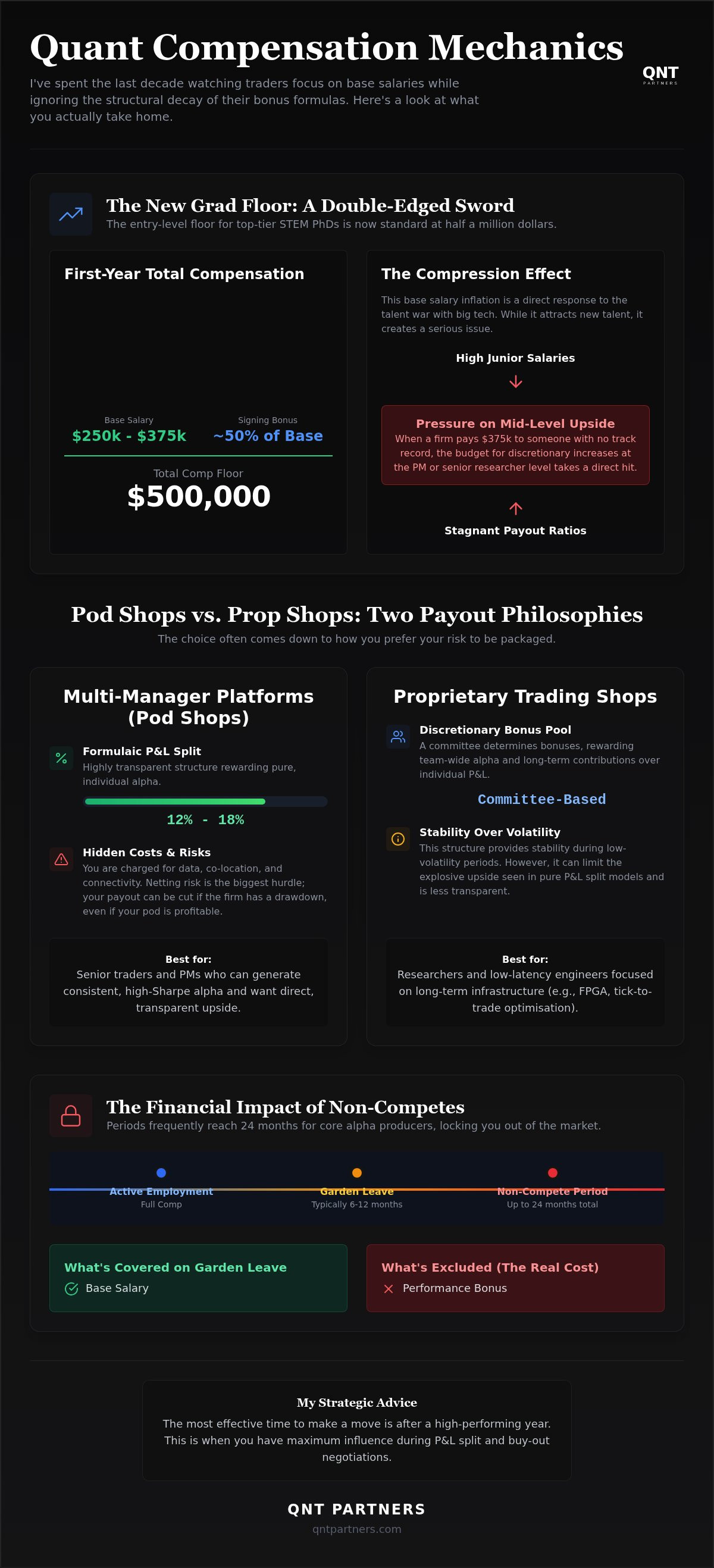
- Multi-manager platforms favour formulaic P&L splits between 12 and 18 percent, while traditional prop shops utilise discretionary pools to reward team-wide alpha.
- Non-compete periods frequently reach 24 months for core alpha producers, with garden leave typically covering only base salary and excluding the performance bonus.
- This quant trading compensation analysis highlights how boutique firms use equity partnerships and tiered vesting to counter the massive balance sheets of global platforms.
- Strategic moves are most effective when executed after a high-performing year, ensuring you maximise leverage during P&L split and buy-out negotiations.
Benchmarking the $500,000 New Grad Floor in 2026
This quant trading compensation analysis shows that the entry-level floor for top-tier STEM PhDs at Chicago prop shops has stabilised at half a million dollars in total first-year compensation. I've seen this figure move from an outlier to the industry standard for elite talent coming out of Stanford or MIT. This base salary inflation is a direct response to the aggressive talent war with big tech and the surviving crypto whales. Firms are forced to pay a premium just to keep the brightest minds from building LLMs or decentralised exchanges.
I view this floor as a double-edged sword. While it attracts high-quality juniors, it inevitably compresses the upside for mid-level researchers. When a firm is paying $250,000 to $375,000 in base salary to someone without a track record, the budget for discretionary increases at the PM or senior researcher level often takes a hit. The evolution of quantitative analysis in finance has turned what used to be a niche mathematical pursuit into the primary driver of market liquidity. I define quant trading compensation as the sum of base salary and formulaic bonuses plus deferred equity.
The Role of Guaranteed Signing Bonuses
Signing bonuses frequently reach 50 percent of the year-one base. These payments are often necessary to offset forfeited bonuses or unvested equity from previous employers. I favour structures that tie these payments to long-term performance milestones rather than simple sign-on triggers. It aligns the trader's interests with the firm's survival over a multi-year horizon. If you are evaluating your current position, I suggest looking at our candidates page to start a discreet benchmarking conversation.
Base Salary vs Total Compensation Volatility
Base salaries are sticky and provide a safety net during periods of low volatility. Total compensation remains highly sensitive to Sharpe ratios. A 2.0 Sharpe ratio is often the threshold where we see meaningful bonus acceleration. I have observed firms moving toward higher bases to reduce turnover during drawdown periods. This shift provides stability but can limit the explosive upside seen in pure P&L split models. High-performing pods still prefer the volatility of a lower base paired with a 15 percent split, knowing their alpha justifies the risk.
Pod Shops vs Prop Shops: Divergent P&L Split Structures
The choice between a multi-manager platform and a proprietary trading house often comes down to how you prefer your risk to be packaged. Any serious quant trading compensation analysis must distinguish between these two fundamentally different payout philosophies. While the headline numbers in a pod shop look attractive, the underlying mechanics can erode your actual take-home pay if you don't account for netting risk and infrastructure costs.
Multi-Manager Formulaic Splits
Multi-manager platforms, or pod shops, have popularised the formulaic split model. You typically see payouts between 12 and 18 percent of your individual P&L. This structure rewards pure alpha and provides total transparency. However, you are often charged for every line item, including market data and co-location fees alongside exchange connectivity.
I've noticed that netting risk remains the biggest hidden hurdle in these structures. If your pod is profitable but the firm as a whole suffers a massive drawdown, your payout can be significantly reduced depending on the specific agreement. I recommend looking for firms with 'pass-through' structures. These models pass the costs directly to the investors, which offers better transparency for the PM. Senior traders often favour this despite the overhead because they know exactly where they stand at any given tick. A granular quant trading compensation analysis reveals that the 'cost of doing business' in a pod can sometimes exceed 5 percent of your gross P&L.
Prop Shop Discretionary Pools
Proprietary trading shops operate on a different logic. Instead of a strict percentage, they maintain discretionary pools where bonuses are determined by a committee. This approach rewards team-wide alpha rather than just individual performance. It provides a level of stability that pod shops cannot match during low-volatility regimes.
This structure suits researchers and low-latency engineers who focus on long-term infrastructure, such as FPGA development or tick-to-trade latency optimisation. You aren't just a line item on a P&L sheet. Your value is recognised in the context of the firm's total technological edge. If you are questioning whether your current split reflects your contribution to the firm's Sharpe ratio, it might be time to discuss your options discreetly with us.
Bonuses in prop shops are often less volatile but have a lower ceiling than the high-teens splits found in multi-managers. The trade-off is often access to the firm's own capital without the immediate pressure of an investor-led redemption cycle. You gain a longer runway to develop signals that might take eighteen months to reach fruition.
The Financial Impact of Non-Competes and Garden Leave
I have observed 24-month non-competes becoming the default for anyone touching core alpha at a Chicago prop shop or a Sydney-based systematic fund. This duration is no longer an outlier. It is a calculated barrier to entry that competitors must now price into their hiring budgets. While garden leave payments usually cover your base salary, they almost always omit the bonus component. This creates a massive financial hole for that calendar year. Any thorough quant trading compensation analysis must account for the net present value of this lost income against the projected upside of the new role.
Buy-out Mechanics and Negotiations
Negotiating a buy-out is the most critical part of a 2026 move. I have seen firms pay 100 percent of an expected bonus to secure a key researcher early, especially when the hire is for a business-critical build-out. New employers often offer 'make-whole' payments to cover lost deferred compensation. These are typically structured as forgivable loans over a three-year period. I always advise candidates to get these specific figures in writing before they hand in their resignation. Relying on a verbal promise for a seven-figure buy-out is a mistake I've watched too many seniors make. We often assist with these discreet benchmarking conversations to ensure the numbers align with market reality.
These loans often include a strict clawback provision if you leave before the three-year mark, effectively turning your new firm into a golden cage. It is a strategic trade-off. You trade immediate liquidity for long-term stability, but you lose the ability to move again if the desk's Sharpe ratio collapses or the internal culture shifts. Getting the vesting schedule right is as important as the total dollar amount.
The Opportunity Cost of Sitting Out
Two years away from the live markets will degrade your knowledge of exchange connectivity and tick-to-trade latency. The underlying technology moves faster than the legal proceedings. I suggest using your garden leave to upskill in areas like FPGA development or deep learning. This ensures you remain relevant when you eventually walk onto the new floor. The financial hit of sitting out is often mitigated by a significantly higher starting base at the new firm, but the real cost is the lost P&L split during those dormant months. A 24-month gap can cost a high-performer millions in performance upside. If you want to see how your current non-compete stacks up against the competition, review our insights on market shifts. Firms are increasingly willing to pay for your time to ensure your signal doesn't leak into the market elsewhere.
Beyond Cash: Equity Partnerships and Deferred Comp
Boutique firms are increasingly using equity partnerships to neutralise the massive balance sheets of global multi-managers. I prefer equity structures that provide a real seat at the table, rather than the shadow equity often offered to non-partners. A granular quant trading compensation analysis reveals that cash is only half the story in 2026. Retention is now managed through sophisticated deferred compensation packages vested over three to five years.
I have observed that clawback provisions in Sydney and London systematic funds are becoming noticeably more aggressive. These clauses aren't just for 'bad leavers' anymore. Some firms now trigger them based on significant drawdown events or failure to hit specific Sharpe ratio targets over a rolling twelve-month period. It effectively ties your past earnings to your future performance in a way that can be difficult to escape.
Shadow Equity in Private Shops
Shadow equity tracks the firm's valuation without granting voting rights or legal ownership. This tool is frequently used to retain AI and ML specialists who might otherwise be tempted by big tech. I find these arrangements less attractive than direct P&L participation for active traders. You are essentially betting on the firm's exit valuation rather than your own performance. For those wanting a deeper look at how these entities operate, our Insights page covers various firm structures in detail.
Vesting Schedules and Clawbacks
Standard vesting has shifted toward a back-loaded model. You typically see 33 percent per year starting only after year two. This keeps you locked in for a minimum of five years if you want to realise the full value of your initial grant. Bad leaver provisions can void your entire unvested balance if you move to a direct competitor.
If your current equity agreement feels more like a golden cage than a partnership, you should contact us to discuss how boutique firms are structuring more equitable deals. The goal is to align your long-term wealth with the firm's growth without sacrificing your mobility entirely. Waiting for a five-year vest is only rational if the underlying alpha is sustainable and the firm's leadership remains stable.
Executing a Strategic Move in the 2026 Market
Timing your exit from a desk is a tactical decision that impacts your lifetime earnings as much as the P&L split you negotiate. A well-timed move during a peak performance year provides the leverage needed to demand substantial "make-whole" payments and aggressive base salary increases. I've seen traders wait too long, trying to squeeze one last bonus out of a decaying signal, only to find their market value diminished when the drawdown finally hits. Your leverage is highest when your Sharpe ratio is at its peak and your current firm is most desperate to retain you.
Partnering with a specialised firm allows for a discreet quant trading compensation analysis without alerting your current desk. This level of professional discretion is vital when you are managing a 24-month non-compete or a complex deferred equity schedule. We focus on the underlying mechanics of the deal, ensuring that the transition doesn't result in a net loss of liquidity over the first three years of the new role.
Timing the Market for Maximum Leverage
The Q1 bonus cycle remains the traditional window for the largest talent shifts in the industry. It is the period when firms have the most clarity on their headcount budgets and candidates have their cash in hand. However, I see an increasing trend in 'off-cycle' hires for elite ML researchers and low-latency engineers. Firms are willing to bypass standard recruitment windows to secure individuals who specialise in transformer models or FPGA-based execution. If you are a high-performer, you don't necessarily need to wait for the February payout to start a conversation.
Avoid moving during a significant drawdown unless the firm's infrastructure is the primary bottleneck. If your performance is suffering because of poor co-location or outdated exchange connectivity, you have a valid narrative for a move. If the issue is your signal, a new firm will likely discount your buy-out valuation. You want to walk into a negotiation with a clean track record and a clear explanation of how their capital will scale your existing alpha.
Partnering with QNT Partners
We provide the market intelligence that public forums and Reddit threads lack. Those platforms often generalise compensation data, whereas we track the specific P&L splits and bonus formulas of boutique build-outs and major systematic funds. My team focuses on spinouts that offer higher equity potential and a real seat at the table. If you want to explore these opportunities, you can start a confidential discussion on our Candidates page. You can also learn more about our approach to search and our global reach by visiting our Firm page. Firms that fail to match the transparency of these new spinouts will continue to lose their top researchers to more agile structures.
Securing Your Market Value in a Bifurcated Industry
The market for elite talent is no longer a simple auction. It's a complex negotiation involving netting risk and the long-term viability of your specific alpha. My quant trading compensation analysis suggests that while base salaries have hit record levels, the real wealth is still found in the tail of the P&L split. You must decide if you favour the transparency of a pod shop or the stability of a prop shop discretionary pool.
We specialise in these specific negotiations and maintain direct access to HFT and pod shop leadership globally. Our team provides the insider knowledge of 2026 compensation floors that you won't find in public data. If you're ready to evaluate your current trajectory against the broader market, you should book a confidential benchmarking session with our team. We can help you organise a move that accounts for the full cost of your garden leave and deferred equity. I look forward to discussing how we can optimise your next strategic step.
Frequently Asked Questions
What is the average P&L split for a senior quant trader in 2026?
Senior quant traders at multi-manager platforms typically see formulaic P&L splits ranging from 12 to 18 percent. This figure is often net of desk costs and co-location fees. In traditional proprietary trading houses, the payout is often discretionary and determined by a committee rather than a fixed percentage. Your take-home pay depends heavily on the netting risk across the firm's various pods and the specific pass-through structure in place.
How do non-compete payments work in HFT firms?
Non-compete payments, or garden leave, usually involve the firm paying your full base salary while you are sitting out of the market. I find that these payments almost never include the performance bonus component, which can lead to a significant drop in annual income. Most HFT firms in Chicago or London enforce these for 12 to 24 months to protect their core alpha. Negotiating a buy-out from your new employer is essential to bridge this gap.
Is a pod shop or a prop shop better for total compensation?
The answer depends on your risk tolerance and the consistency of your signal. Pod shops offer the highest compensation ceilings through formulaic 15 percent splits, but they also carry the highest volatility and netting risk. Prop shops provide more stability and better infrastructure support during drawdowns, though the discretionary bonus pools often have a lower absolute cap. A detailed quant trading compensation analysis shows that pod shops suit traders with high Sharpe ratios and portable strategies.
What is a typical signing bonus for a quant researcher moving firms?
Signing bonuses for experienced quant researchers frequently reach 50 percent of their new base salary. These are often used as "make-whole" payments to compensate for unvested deferred equity or forfeited bonuses at their previous firm. I've seen these structured as forgivable loans that vest over a three-year period. Elite researchers coming from top-tier systematic funds can often negotiate seven-figure sign-on packages if their research directly impacts a high-priority build-out.
How does garden leave affect my total annual compensation?
Garden leave creates a bifurcated compensation year because you only receive your base salary while prohibited from trading. Since the bonus component often makes up 60 to 80 percent of a senior trader's total package, sitting out can be financially taxing. I advise candidates to negotiate "guaranteed" minimum bonuses at their new firm to offset this loss. This ensures that your total earnings don't collapse while you are waiting for your non-compete to expire.
Are equity partnerships common in boutique quant firms?
Equity partnerships are becoming the primary tool for boutique firms to retain senior talent against the massive balance sheets of multi-manager platforms. These structures provide a real seat at the table and a share in the firm's long-term growth. I distinguish between direct partnership equity and "shadow equity," which tracks firm valuation without giving you voting rights. Direct equity is far more effective for aligning the interests of PMs and founders in a systematic fund.
What are the common clawback provisions in quant trading contracts?
Clawback provisions allow firms to reclaim unvested bonuses or signing payments if you leave before a specific date. In 2026, we are seeing more aggressive clauses that trigger clawbacks during significant drawdown events or breaches of non-solicitation agreements. These are often labelled as "bad leaver" provisions. It is vital to review the vesting schedule of any deferred compensation to understand how much of your earned bonus is actually at risk if you move.
How has AI recruitment impacted quant compensation ranges?
The demand for AI and machine learning specialists has pushed the compensation floor for top-tier STEM PhDs to $500,000 in total first-year pay. This talent war with big tech has forced HFT firms to increase base salaries significantly to remain competitive. I've observed that this inflation at the junior level is causing compression issues for mid-level researchers. Firms are now specialising their search efforts to find specialists in deep learning or transformer models for signal generation.