Quant Talent Succession Planning: Mitigating Alpha Decay and Team Leakage

If your alpha depends on a single lead researcher, you don't have a strategy; you have a ticking clock. Most funds treat quant talent succession planning as a peripheral HR task until a lead researcher hands in their notice and triggers a 12-month garden leave period. By then, the decay has already started.
I've seen pods in Chicago and London lose 40 per cent of their Sharpe within six months because the remaining researchers lacked the technical depth to maintain the signal or manage exchange connectivity shifts. It's a common failure in multi-manager platforms where the focus stays on the P&L owner rather than the bench. You know the cost of a seat sitting empty for a year, and it usually exceeds the base salary of a backup hire.
You can structure your team to survive these transitions by building a pipeline of talent ready for P&L ownership. I'll show you how to organise your research pods to mitigate the 12-month non-compete gap and stop team leakage to competing platforms. We'll look at the mechanics of bench-building that keep the models running when the lead walks out.
Key Takeaways
- Treat succession as a risk management exercise to prevent alpha evaporation. A lead researcher's departure shouldn't result in a sudden drop in your Sharpe ratio.
- Implement quant talent succession planning by standardising your research framework. This reduces reliance on individual stars and makes the code base accessible to the remaining team.
- Adapt your strategy to your specific fund structure. Pod shops require a different approach to bench-building than centralised prop shops in Chicago or Sydney.
- Plan for the 12-month garden leave vacuum before it happens. Ensure junior researchers are technically equipped to manage exchange connectivity and model maintenance.
- Utilise discrete, operator-led search partners to maintain a pipeline of candidates. Internal HR teams rarely have the technical background to vet talent for P&L ownership.
Succession as a hedge against alpha evaporation
I've watched too many heads of trading treat talent as a plug-and-play resource until their lead researcher walks out. In the context of a systematic fund, Succession planning is not a career development exercise; it is a tail-risk hedge. When a lead researcher leaves, they don't just take their seat. They take the intuition behind the feature engineering and the specific knowledge of why certain signals were discarded during backtesting.
Small research pods are particularly vulnerable to this single point of failure. If your entire mid-frequency strategy relies on one person's understanding of the code base, you are one resignation letter away from a 12-month alpha hiatus. I've seen funds lose 10 to 15 per cent of their annual returns simply because they couldn't adapt their models to a market regime shift while their lead was sitting out a non-compete.
Standard HR mentoring fails here because it ignores the P&L-driven reality of our industry. You aren't just looking for someone to manage a team. You need someone who can step into a 15 to 25 per cent net P&L split and maintain the Sharpe ratio from day one. That requires technical mastery, not just leadership potential.
The cost of the star researcher dependency
A dependency on a single star researcher leads to immediate code base stagnation. During a 12-month garden leave, the market evolves while your models remain static. Institutional memory vanishes the moment the badge is handed in. Without a junior or mid-level researcher who has been groomed to take over the specific nuances of the exchange connectivity or the signal weights, the strategy begins to decay.
Succession vs replacement
Hiring a replacement is a reactive move that usually comes six months too late. Effective quant talent succession planning involves building a bench before the resignation arrives. It means having a Number Two who is already familiar with the production environment and the research pipeline. We specialise in this type of proactive bench-building at QNT Partners, focusing on finding individuals who can bridge the gap between research and P&L ownership. Waiting for a vacancy to appear before looking for talent is a guaranteed way to ensure your alpha evaporates while you wait for a new hire to clear their non-compete.
Structural dynamics: Pod shops versus prop shops
Your fund's architecture determines whether a lead researcher's departure is a minor hurdle or a systemic collapse. In my experience, the friction of quant talent succession planning varies wildly depending on whether you operate as a multi-manager platform or a centralised prop shop. The incentive structures that drive alpha generation also dictate how easily that alpha evaporates when a key seat becomes vacant.
The pod shop succession trap
Multi-manager platforms often fall into a succession trap where alpha ownership is siloed within a specific pod. When a Portfolio Manager managing a 15 to 25 per cent net P&L split decides to move, the entire team often follows. This team leakage is a direct result of incentive structures that favour individual performance over firm-wide continuity. To mitigate this, some funds are using internal mobility as a retention tool, allowing junior quants to see a clear path to P&L ownership within the firm rather than waiting for a seat to open elsewhere.
Prop shop stability
Prop shops in Chicago or Sydney often have more inherent stability because they institutionalise the research pipeline. They use shared libraries and collaborative alpha generation to make individual researchers part of a larger machine. While this reduces the risk of a single point of failure, it requires a disciplined approach to code documentation and version control. An academic analysis of succession planning within the investment sector highlights that technical firms often struggle with the transition from founder-led research to institutionalised systems. This is where strategic organizational design becomes a competitive advantage.
P&L ownership remains the ultimate arbiter of who stays and who goes. In London and Singapore, I've seen firms use equity partnerships to align long-term interests, turning researchers into owners rather than just high-paid contractors. This moves the focus away from the next bonus cycle and toward the long-term value of the firm's IP. If you are struggling to retain talent in a competitive pod environment, it might be time to evaluate your team structure. Transitioning from a star-based model to a systemic one is the only way to ensure your alpha survives the next 12-month garden leave gap.
Managing the 12-month garden leave vacuum
The moment a resignation letter hits your desk, the 12-month garden leave clock starts ticking against your strategy's decay rate. This period is often treated as a cooling-off phase, but for a systematic fund, it is a high-risk vacuum. You have a lead researcher who is legally barred from the office but whose intellectual property still powers your P&L. Managing this gap requires an immediate pivot from research expansion to operational preservation, a core component of effective quant talent succession planning.
Junior researchers are your primary defence during this window. They must maintain the code base and manage exchange connectivity shifts without the lead's oversight. If your quant talent succession planning didn't include a 3-month handover protocol, you'll find your juniors struggling to debug legacy signals when the market regime shifts. I've seen funds lose significant ground because they didn't document the specific reasons behind feature selection before the lead was escorted from the building.
Investors will notice the shift in team dynamics. Managing their expectations during a 12-month sit-out is about demonstrating that the "key man" risk was already mitigated. You need to show that the research pipeline is institutionalised and that an interim lead has already taken over the strategy's day-to-day management. Legal and operational limits of the non-compete must be strictly observed, but that doesn't mean your models have to go into hibernation.
The transition protocol
The first 90 days after a resignation are critical. You must ensure all research threads are documented and that the interim lead is fully integrated into the production environment. This isn't just about code; it's about the "why" behind the signal logic. If the handover is handled poorly, the strategy will likely drift or fail to adapt to tick-to-trade latency changes.
External sourcing during the gap
You cannot wait for garden leave to expire before looking for a permanent replacement. Given that total sit-out periods, including non-competes, now frequently reach 18 to 24 months for senior PMs, you must trigger an executive search immediately. We often evaluate candidates who are currently on their own garden leave, as this can align their start date with your needs. For a deeper look at how to find these individuals, consult our quant trading recruitment firms guide. Finding a researcher with the right technical depth who is also 6 months into a 12-month non-compete is the most efficient way to fill the vacuum.
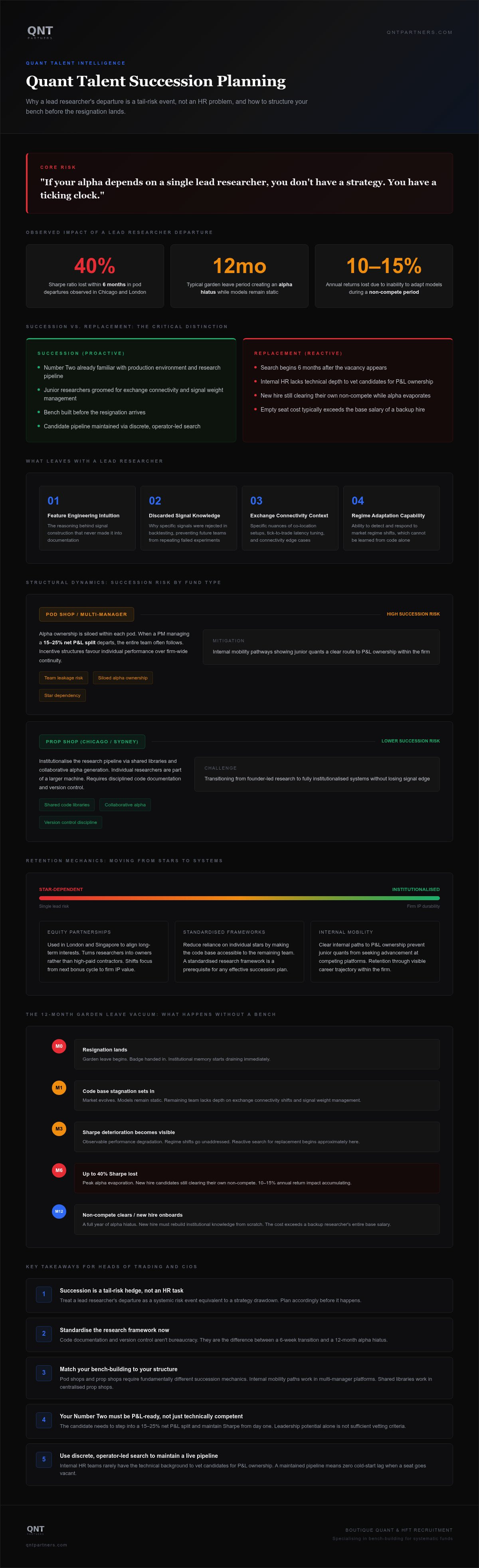
Institutionalising alpha: Moving from stars to systems
Individual brilliance is a structural liability in a high-frequency environment. I've seen funds where the lead researcher's personal Python library was the only thing standing between the strategy and a total shutdown. When that person leaves, the alpha doesn't just decay; it vanishes because no one else can debug the logic or handle the exchange connectivity shifts. Effective quant talent succession planning is about shifting the weight from the individual to the architecture.
Reducing reliance on "star" researchers requires a commitment to institutionalising your research IP. This means moving away from siloed pods where only one person understands the signal generation process. You can share knowledge without diluting alpha by using shared libraries and standardised documentation. It's about ensuring the firm owns the logic, even if the researcher owns the initial idea.
Systemic research frameworks
Standardising the research framework is the most efficient way to decrease the time-to-market for new researchers. When you use automated backtesting and signal validation, a new hire can be productive in weeks rather than months. Shared data pipelines ensure that everyone is working from the same source of truth. This structure makes the departure of a lead researcher a manageable transition rather than a catastrophic event. If the framework is sound, the next researcher can step into the production environment and maintain the Sharpe ratio without reinventing the wheel.
The role of technology in succession
Your FPGA and exchange connectivity infrastructure are the true constants in your business. Researchers and PMs are transient; they move for higher P&L splits or better equity partnerships. The hardware and the low-level code that manages your tick-to-trade latency are your firm's moat. This is why I often argue that your engineers are your real succession plan. They build the environment that allows researchers to succeed, and they are the ones who keep the lights on during a 12-month garden leave gap.
Infrastructure should be treated as the constant variable in your talent strategy. If you want to build a team that survives individual turnover, you need to focus on HFT infrastructure recruitment alongside your research search. A strong engineering bench provides the stability that allows your research pods to iterate without fear of collapse. If you are looking to build a more resilient structure, you should start by evaluating how much of your alpha is trapped in individual heads versus your firm's systems.
Strategic bench-building via external advisory
Internal HR departments are designed for scale. They are not built for the precision required in quant talent succession planning. A recruiter who doesn't understand the difference between FPGA-based execution and a standard software stack can't effectively vet a successor for a high-frequency pod. They lack the technical vocabulary to challenge a candidate on their signal validation or their approach to transaction cost analysis.
Succession in this industry requires mapping the market 12 months in advance. You need to know who is coming off garden leave in London or Chicago before they even hit the open market. This proactive approach allows you to build a bench of talent that is ready to step in when a resignation letter arrives. You shouldn't be starting your search the day a seat becomes empty; by then, the alpha decay has already begun.
The operator-led search
We speak to heads of trading as peers because we understand the mechanics of the business. When I discuss Sharpe ratios or tick-to-trade latency with a candidate, I'm not reading from a script. I'm evaluating their technical depth and their ability to own a P&L. This level of vetting is impossible for generalist recruiters who don't have direct experience in systematic environments.
Discretion is paramount in such a tight-knit market. A peer-level approach ensures that sensitive information remains confidential while we identify the right fit for your firm's specific culture and technical requirements. We focus on build-outs and spinouts that often fly under the radar of larger firms, ensuring you have access to a unique talent pool.
Testing the waters with SMAs
Sourcing managers to fill talent gaps doesn't always require a permanent direct hire immediately. SMAs offer a way to test new talent pipelines and fill immediate research gaps without the long-term commitment of a full pod build-out. You can use SMA SVA Partnerships to access external alpha while you build your internal bench.
If you want to understand where your current vulnerabilities lie, you can contact James and the team for a confidential talent audit. Relying on a standard recruitment process to manage the succession of your most valuable IP is a risk that most systematic funds can't afford to take.
Securing your firm's technical continuity
Succession isn't about finding a like-for-like replacement after a resignation letter arrives. It's about ensuring your infrastructure and research frameworks are resilient enough to withstand the inevitable rotation of lead researchers. You've seen how pod structures can lead to team leakage and how a 12-month garden leave period can freeze a strategy's evolution. By standardising your research pipeline and focusing on institutional memory, you turn individual brilliance into a systemic asset.
Effective quant talent succession planning requires a 12-month forward view of the market and a bench that's ready to own a P&L from day one. We founded QNT Partners as former industry operators to address these specific risks. We specialise in HFT and systematic research across Chicago, Sydney, and London, providing the global reach and technical depth that generalist firms lack. Protecting your alpha from unnecessary decay starts with a proactive approach to talent mapping.
Consult with QNT Partners on your talent succession strategy to ensure your team is built for the long term. Your next lead researcher is already out there; you just need the structure to integrate them effectively.
Frequently Asked Questions
What is the typical garden leave for a lead quant researcher?
Senior portfolio managers, partners, and heads of research in the UK and US commonly face garden leave periods of 6 to 12 months. During this time, the employee remains on the payroll but is barred from accessing the code base or contacting clients. This fully paid sit-out serves as the primary mechanism for protecting firm IP while the broader non-compete restrictions, often totalling 24 months, are enforced.
How do pod shops handle succession differently than prop shops?
Pod shops typically face higher risk because alpha is siloed within individual teams, often leading to team leakage if a PM departs. In contrast, centralised prop shops in Chicago or Sydney usually own the underlying research libraries and data pipelines. This structure makes individual departures easier to manage, as the firm can transition the strategy to a new researcher who is already familiar with the production environment.
Can I hire someone who is currently on a non-compete?
You can sign a hire while they are restricted, but they cannot perform work until their covenants expire. Following the 2024 block of the federal ban, US non-competes are enforced on a case-by-case basis. Successful quant talent succession planning involves identifying these individuals early in their garden leave. This allows you to map their eventual integration into your team while the 12-month sit-out period runs its course.
How much alpha is typically lost when a lead researcher leaves?
Funds can lose 10 to 15 per cent of annual returns if a strategy isn't maintained during a lead's departure. Alpha decay occurs because models aren't adjusted for market regime shifts or exchange connectivity changes. Without a successor to handle feature engineering and signal logic, the strategy's Sharpe ratio often degrades. This evaporation of alpha is the main reason why strategic bench-building is a risk management priority.
Is succession planning relevant for a small, three-person pod?
It is critical for small teams where a single departure represents a total loss of institutional memory. A three-person pod has significant key man risk; if the lead researcher leaves, the remaining juniors may lack the technical depth to maintain the model. Small pods should prioritise cross-training and documenting research threads to ensure the strategy survives a 12-month sit-out period without a drop in performance.
How do equity partnerships impact talent succession?
Equity partnerships align a researcher's long-term interests with the firm's growth, reducing the likelihood of sudden departures for higher P&L splits. When a lead has skin in the game, they are more likely to engage in quant talent succession planning and mentor their eventual successor. This structure shifts the focus from the next bonus cycle to the terminal value of the firm's IP and technical architecture.
What is the difference between replacement and succession in systematic trading?
Replacement is a reactive hire made after a resignation, which often leaves a trading seat empty for 12 months. Succession is a proactive strategy where you build a bench of talent before a vacancy exists. It involves identifying researchers who can step into P&L ownership and ensuring the infrastructure is institutionalised. Succession focuses on the continuity of alpha, while replacement is simply a task of filling headcount.
How do I maintain my code base during a lead researcher transition?
You must institutionalise your IP by using shared libraries and standardised documentation across the team. Junior researchers should be trained to manage the production environment and debug signals before the lead researcher departs. If the research framework is automated and the data pipelines are shared, the strategy can remain functional during the transition. This prevents the code base from stagnating while you wait for a replacement.