Quant Research Talent Search: Guide for Hiring Teams

A technically strong researcher can still be the wrong hire if their work doesn’t fit the desk’s P&L model. A Quantitative research firm talent search should start with that distinction, not a list of impressive employers or familiar modelling techniques.
Most hiring teams know they need research depth. The harder question is what a candidate has actually owned: forming a hypothesis, building and testing signals, taking research into production, or supporting a trader who owns the risk. I’ve found those distinctions matter more than a shortlist that looks good on paper.
This guide shows how to define the mandate before outreach, then assess technical contribution against the firm’s strategy and operating structure. A researcher joining a pod at a multi-manager platform may face different incentives and decision rights from one joining a prop shop or a systematic fund using an SMA structure.
It also covers how to run a discreet search without exposing a build-out or spinout, and how to account for constraints such as garden leave. At QNT Partners, we conduct specialist searches across quantitative research, trading and technology. The aim is a brief precise enough to identify relevant experience, and a process that keeps sensitive plans contained.
Key Takeaways
- Start a Quantitative research firm talent search with a precise mandate, not a broad list of job titles.
- Assess how candidates form and test ideas, then trace their contribution through implementation and trading decisions.
- Calibrate the role to the firm’s structure. Research ownership and P&L attribution can differ between a pod shop, prop shop and multi-manager platform.
- Set disclosure boundaries before outreach, and account for each candidate’s garden leave or non-compete constraints.
- Use specialist search to connect technical depth with the realities of HFT and hedge fund teams.
Why quantitative research firm talent search starts with the mandate
A precise mandate matters more than a broad list of quant titles. A Quantitative research firm talent search should be mandate-led: define the work the hire must do, then identify and assess people whose evidence matches it. Without that first step, keyword overlap can produce a shortlist that looks relevant but misses the desk’s research ownership, operating constraints or commercial model.
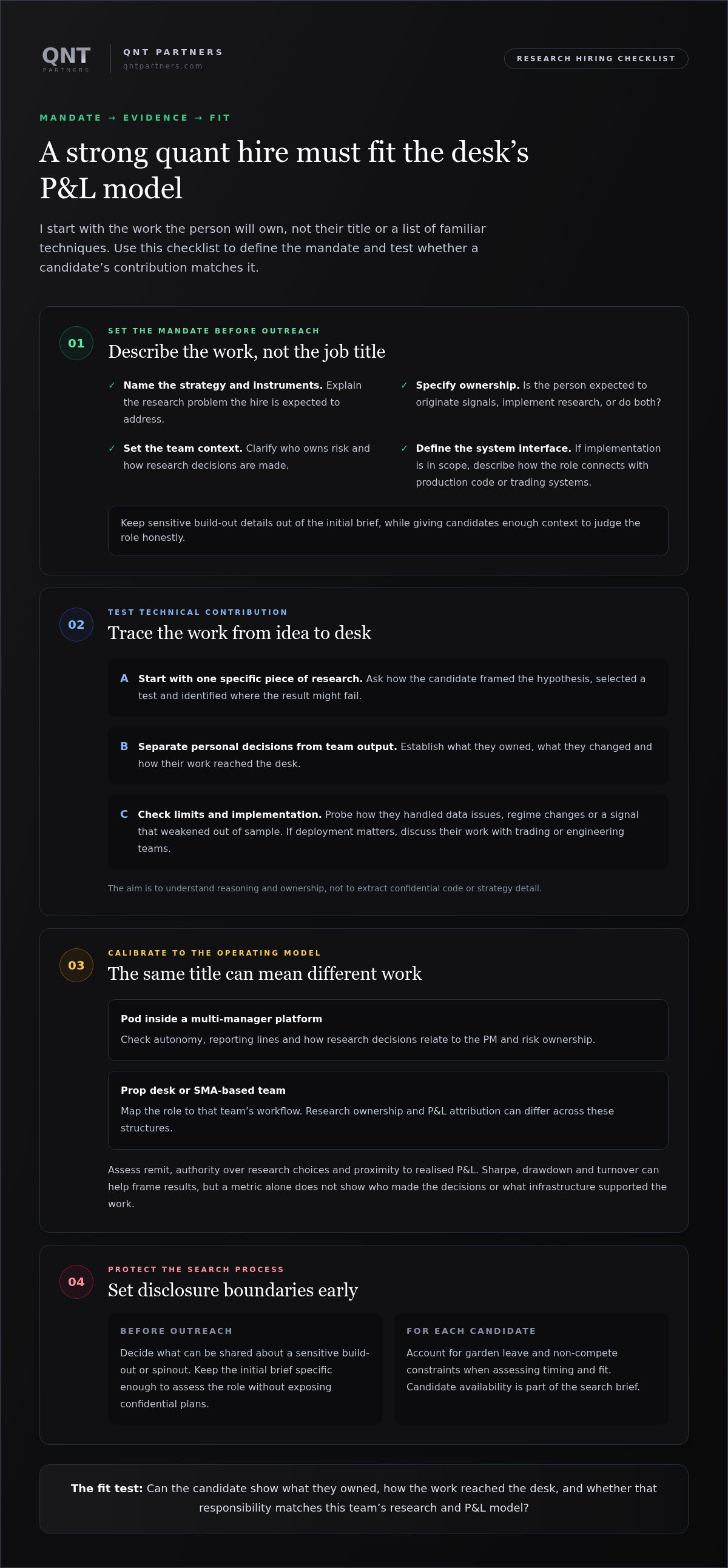
I start by separating four decisions that often get bundled together: the strategy the hire will support, the desk structure, the seniority required and the level of research ownership. Each shapes a different part of the search. A researcher expected to originate signals and carry them into production needs a different profile from someone hired to extend an existing research stack under a PM’s direction.
What the hiring brief needs to make explicit
Describe the strategy and instruments first, then define the research problem the hire will address. Is the work focused on signal discovery, execution, portfolio construction or another specific part of the process? Be clear about whether the person owns research, implementation or both. If implementation is part of the mandate, specify the interface with production code or trading systems. Avoid turning the brief into a generic list of languages and tools.
Then give the team context. Set out who owns risk, how research decisions are made and where the new hire fits into that workflow. A pod inside a multi-manager platform may have different autonomy and reporting lines from a prop desk or an SMA-based team. Keep sensitive build-out details out of the initial brief, but include enough about the role for candidates to judge it honestly.
Why a title is a weak proxy for fit
“Researcher”, “trader” and “PM” describe different responsibilities, but titles don’t establish what someone has contributed. A researcher may have owned a signal from hypothesis through validation, while another may have maintained models built elsewhere. A trader may have shaped execution logic or supplied feedback that changed the research process. Assess the evidence: what decision did the candidate make, what part did they own, and how did the work reach the desk?
Academic background and employer names can help frame a conversation, but neither guarantees performance in a different strategy or team. Even firms using quantitative methods can organise the work differently. WorldQuant, for example, provides public context on a firm associated with quantitative investment and data-driven research. That context still doesn’t tell you whether a particular candidate owned the work your mandate requires.
For broader partner-selection context, refer to our guide to quant trading recruitment firms. The search itself needs a brief built around this desk’s requirements. QNT Partners’ firm background reflects our operator-founded focus on quant hiring, where these distinctions shape candidate criteria from the outset.
How a quantitative research search tests technical and commercial fit
Technical depth matters in relation to the strategy and the work the hire will own. In a Quantitative research firm talent search, move from evidence to relevant profiles, then assess contribution and role fit. That order keeps interviews focused on whether the candidate can solve the desk’s problem, rather than simply demonstrate fluency in familiar methods.
- Define the evidence. Translate the mandate into observable work: research decisions, implementation responsibilities and the interfaces the role must manage.
- Map relevant profiles. Look for candidates whose experience reflects comparable research problems and operating constraints, not just matching terms on a CV.
- Assess contribution. Trace the candidate’s work from initial hypothesis through testing and, where relevant, deployment.
- Calibrate fit. Compare their decision rights and results with the proposed role’s ownership, team interfaces and relationship to P&L.
Assessing research ownership and implementation
A useful technical discussion starts with a specific piece of research. Ask how the candidate framed the hypothesis, chose a test and identified where the result might fail. Probe the decisions they personally made, including how they handled data issues, regime changes or a signal that weakened out of sample. The aim isn’t to extract confidential code or strategy detail. It’s to understand their reasoning and the limits they recognised.
Separate model development from production ownership. Someone may have built and validated a model without deploying it; another may have owned the path into a live system. If implementation sits within the mandate, explore the candidate’s work with trading or engineering teams and how they handled production constraints. C++, FPGA, exchange connectivity and tick-to-trade latency belong in the discussion only when those mechanics matter to the role.
Reading results in context
A performance metric doesn’t show who made the key decisions or what infrastructure supported the work. Establish the candidate’s remit, their authority over research choices and their proximity to realised P&L. In a team setting, distinguish direct ownership from a contribution made alongside a PM, trader or execution specialist.
Sharpe, drawdown and turnover can help frame a discussion, but none is sufficient evidence of fit on its own. A result depends on the strategy, capacity assumptions, execution environment and the candidate’s role in producing it. A researcher who improved signal quality may have had no responsibility for sizing or risk; another may have carried a broader remit. Assess each contribution against the job on offer, including the autonomy the team expects.
That context turns technical evidence into a hiring decision. If you’re defining a search around a specific research remit, discuss the mandate with QNT Partners before screening begins.
How firm structure changes quantitative researcher fit
A researcher’s fit depends partly on where decisions sit: with a PM, a trading team or the researcher themselves. The same candidate can thrive in one structure and struggle in another, even when the strategy and instruments look familiar. In a Quantitative research firm talent search, firm labels help frame the discussion, but they don’t replace a clear view of the actual desk.
Pod shop, prop shop and multi-manager expectations
In a pod shop, research may sit close to a PM who controls risk and sets the book’s priorities. The researcher could have meaningful ownership of signal development while having limited authority over sizing or portfolio construction. Clarify how ideas move from research to the PM’s decision, and how quickly the team expects the researcher to respond to live results.
At a prop shop, the research-to-trading interface may be tighter. A researcher could work directly with traders and engineers on strategies where execution behaviour or system constraints shape the research itself. The relevant question is how decisions are divided: who tests the idea, who owns implementation, and who can change the trading logic once it is live?
A multi-manager firm can contain different operating models under one roof. Some teams may closely connect research and trading; others may define responsibilities more narrowly or share infrastructure across groups. Broad labels won’t tell you whether a particular researcher has autonomy, access to the PM or ownership of production decisions. Establish those details at desk level.
Matching incentives to the role
Research ownership and P&L attribution affect expectations. A candidate whose work informs a PM’s decisions may have less direct control over the book’s realised results than someone whose mandate includes trading decisions. If compensation includes a P&L split, the search brief should clarify what contribution the arrangement recognises and which outcomes the role can influence. The same applies to an equity partnership: it matters only if it is part of the specific opportunity and relevant to the candidate’s remit. There’s no standard term to assume.
I’d also separate the stated incentive from day-to-day authority. A role can reference team performance while giving the researcher little control over deployment, risk or capital allocation. That gap matters for someone who expects to own a strategy end to end. A researcher who prefers a defined remit may instead value a clear interface with the PM over broader but less specific responsibility.
No structure is the right fit for every researcher. For the hiring team, the useful comparison is between the candidate’s preferred decision rights and the desk’s actual ones. Set that out before discussing incentives, and the search can distinguish genuine alignment from a title or compensation structure that merely sounds familiar.
How to run a discreet search for a quantitative research hire
Build confidentiality into the search before the first candidate is approached. A Quantitative research firm talent search may involve a new pod, a spinout or a sensitive change to an existing team. The brief must give candidates enough substance to assess the opportunity without exposing the firm’s identity, strategy or hiring plans too early.
I’d run the process in four stages:
- Define disclosure boundaries. Agree what can be shared at each stage, including the firm’s identity, strategy, team structure and hiring timeline.
- Set the profile. Align on the required research contribution, relevant experience and decision rights before approaching candidates.
- Approach selectively. Share only the agreed level of detail, and keep the candidate’s interest and identity confidential within the search process.
- Recalibrate. Use early conversations to test the brief, then adjust the target profile or disclosure level where needed.
Set boundaries before candidate outreach
Decide which details are safe to disclose at first contact and which belong in a later conversation. A firm can be described as a Chicago prop shop building a new systematic team, for example, without naming the organisation or outlining its signal logic. The description should still be accurate enough to establish the role’s broad context. Keep candidate details and expressions of interest within the agreed search group.
For a build-out or spinout, avoid clues that identify the project indirectly, such as a distinctive strategy description or a named team lead. Agree how the opportunity will be described, who can receive candidate updates and when the firm’s identity can be disclosed. Discretion depends on consistent handling at every stage, including internal discussions and interview scheduling.
Account for mobility constraints
Garden leave and non-competes can affect when a candidate might be available, but their relevance depends on the person’s circumstances. Surface these as practical timing considerations early enough to inform the search plan. Don’t assume that two candidates with similar titles will have the same start date or mobility constraints.
Build expected availability into interview sequencing and the hiring timeline. A candidate serving garden leave may be able to discuss a future move while remaining unable to start immediately; another may have different restrictions or none. Avoid making assumptions about enforceability. Where interpretation is needed, the candidate and firm should obtain appropriate legal advice.
We run specialist searches with the mandate and disclosure boundaries agreed before outreach. If you’re planning a confidential build-out or team change, discuss a confidential search with QNT Partners.
What QNT Partners brings to a quantitative research firm talent search
A search partner needs to understand the work behind the title. QNT Partners focuses on quantitative research and trading recruitment for HFT firms and hedge funds, where hiring criteria often depend on how a researcher’s work connects with the desk’s operating model.
A search shaped around the work
We help hiring teams turn the role into a practical search brief, with technical requirements and team context reflected in the candidate criteria. The aim is to assess relevant experience against the actual remit, rather than rely on job titles or broad credentials. Our work covers specialist recruitment and talent advisory, with the search shaped around the hiring team’s requirements.
For a confidential build-out or spinout, the first description can give candidates enough context to understand the opportunity while keeping the firm’s identity or strategy details private. The hiring team can set disclosure boundaries for each stage of the process. QNT Partners’ firm profile gives more background on our focus.
When to begin the conversation
You don’t need every detail ready for circulation. Start once you can explain the hiring need, the role’s main responsibilities and any constraints on disclosure. We can work from that starting point to shape the search and clarify which experience matters most, even while sensitive details remain private.
Bring the hiring lead’s view of the role and its operating context into the first discussion. A clear brief gives candidate outreach a defined purpose and keeps early conversations relevant to the position. Discuss your quantitative research search with QNT Partners to set that process in motion.
Turn the mandate into your next hiring decision
A search brief shouldn’t become fixed once outreach begins. Treat it as a working decision document. As candidate conversations develop, note where the role attracts interest, where expectations diverge and which parts of the remit need sharper definition. That feedback can help the hiring team distinguish a genuine gap in the market from a brief screening for the wrong evidence.
For a Quantitative research firm talent search, agree who owns those decisions internally. A hiring lead, PM and technical interviewer may each read the role differently. Align on what must be demonstrated, what can be learned in the role and which constraints are firm. That gives each interview a purpose and keeps changes to the mandate deliberate rather than reactive.
I’d start the conversation once you can describe the problem the hire needs to solve, even if parts of the opportunity must stay confidential. Put your hiring brief into action with QNT Partners. A well-framed search gives the team a stronger basis for its next hiring decision.
Frequently Asked Questions
What does a quantitative research recruitment firm do?
A quantitative research recruitment firm helps hiring teams define and fill roles where research, trading and technical responsibilities overlap. A Quantitative research firm talent search can include translating a desk’s needs into candidate criteria, identifying relevant experience and coordinating discussions with researchers, traders or PMs involved in hiring. The firm should understand the distinction between contributing to a model and owning its path into a live trading environment.
How is a quantitative research search different from general finance recruitment?
A specialist quant search weighs evidence of technical contribution, not just financial-sector experience. For example, a candidate with a banking title may have strong analytical skills but no experience testing signals against execution costs or working with trading systems. Search criteria should reflect the actual work, such as research design, coding responsibilities or interaction with a trading desk. That focus helps hiring teams avoid shortlists built mainly around broad finance credentials.
How do firms assess a quantitative researcher’s technical fit?
Hiring teams can ask candidates to explain a past project at a level that reveals their decisions without requesting confidential code or proprietary data. Probe how they selected inputs, tested for leakage and decided whether an apparent result was actionable after costs. For a role close to execution, explore how they reason about market data or order handling. The discussion should test practical judgement, not reward jargon or memorised methods.
Can a quantitative research search be conducted confidentially?
Yes. A search can begin with an anonymised description, such as a systematic fund adding research capacity, while the firm’s name and sensitive strategy details remain undisclosed. Before sharing a candidate’s identity with a hiring team, agree the appropriate consent and information-sharing process. Confidentiality also depends on careful handling of interview logistics and internal updates. No process should imply absolute secrecy, but clear boundaries can limit unnecessary exposure.
How do pod shops and prop shops differ when hiring quantitative researchers?
A pod may place research within a team whose PM directs the book, while a prop environment may bring researchers into closer contact with trading decisions or execution work. Those are broad patterns, not guarantees about every desk. For a specific role, establish who sets research priorities, who can alter a live strategy and how research interacts with engineering. Those details give candidates a clearer picture than the firm label alone.
When should a firm engage a specialist quantitative research search partner?
Engage one once there is a defined business reason to hire and a hiring lead who can explain the role’s core responsibilities. That may be before a new team is public, or when an existing desk needs a replacement with a distinct skill set. Early alignment is especially useful if interviewers have different views of seniority or ownership. A specialist can help turn those differences into agreed criteria before candidate conversations begin.