Quant Developer Recruitment London: 2026 Search Guide

Most systematic desks fail to hire top-tier execution talent because their process evaluates textbook algorithms rather than hardware architecture and cache coherency. Effective quant developer recruitment London demands vetting low-level systems engineering from day one, not sorting CV buzzwords. You shouldn't have to waste desk time interviewing generic engineers who crumble the moment you ask about memory barriers, lock-free queues, or kernel bypass.
You already know the frustration of battling aggressive counter-offers and waiting out six- to twelve-month garden leave terms while critical infrastructure builds stall. This guide provides a direct playbook for identifying elite C++ and Python talent, structuring formulaic desk P&L splits that pry top performers loose, and insulating your desk against hiring delays.
I break down verified London compensation benchmarks, technical evaluation filters for C++20 and C++23 execution paths, and the operational mechanics required to secure tier-one developers before competitors buy them out.
Key Takeaways
- Filter candidates on C++20 and C++23 production code, cache line alignment, and kernel bypass rather than abstract algorithm puzzles.
- Structure offers around desk architecture, using formulaic 2 to 5 percent net P&L splits in pods or uncapped balance-sheet bonuses in prop shops.
- Manage UK employment friction by planning around active 6 to 12 month non-competes and negotiating unvested bonus buyouts.
- Upgrade your quant developer recruitment London strategy by using peer-level technical vetting rather than sorting keyword-stuffed CVs from contingent agencies.
The Technical Bar for London Quant Developers in 2026
Most resumes claiming modern C++ experience fall apart under five minutes of real systems questioning. In quant developer recruitment London, generalist recruiters routinely submit candidates whose background ends at standard enterprise applications. They pass simple coding puzzles on a whiteboard, yet they have never touched cache line alignment or reasoned about memory ordering in multi-socket environments.
Our focus at QNT Partners is filtering for engineers who build deterministic, production-grade systems. London trading desks cannot afford execution jitter caused by hidden dynamic allocations or unoptimised kernel context switches.
Core Systems Programming and Modern C++ Expectations
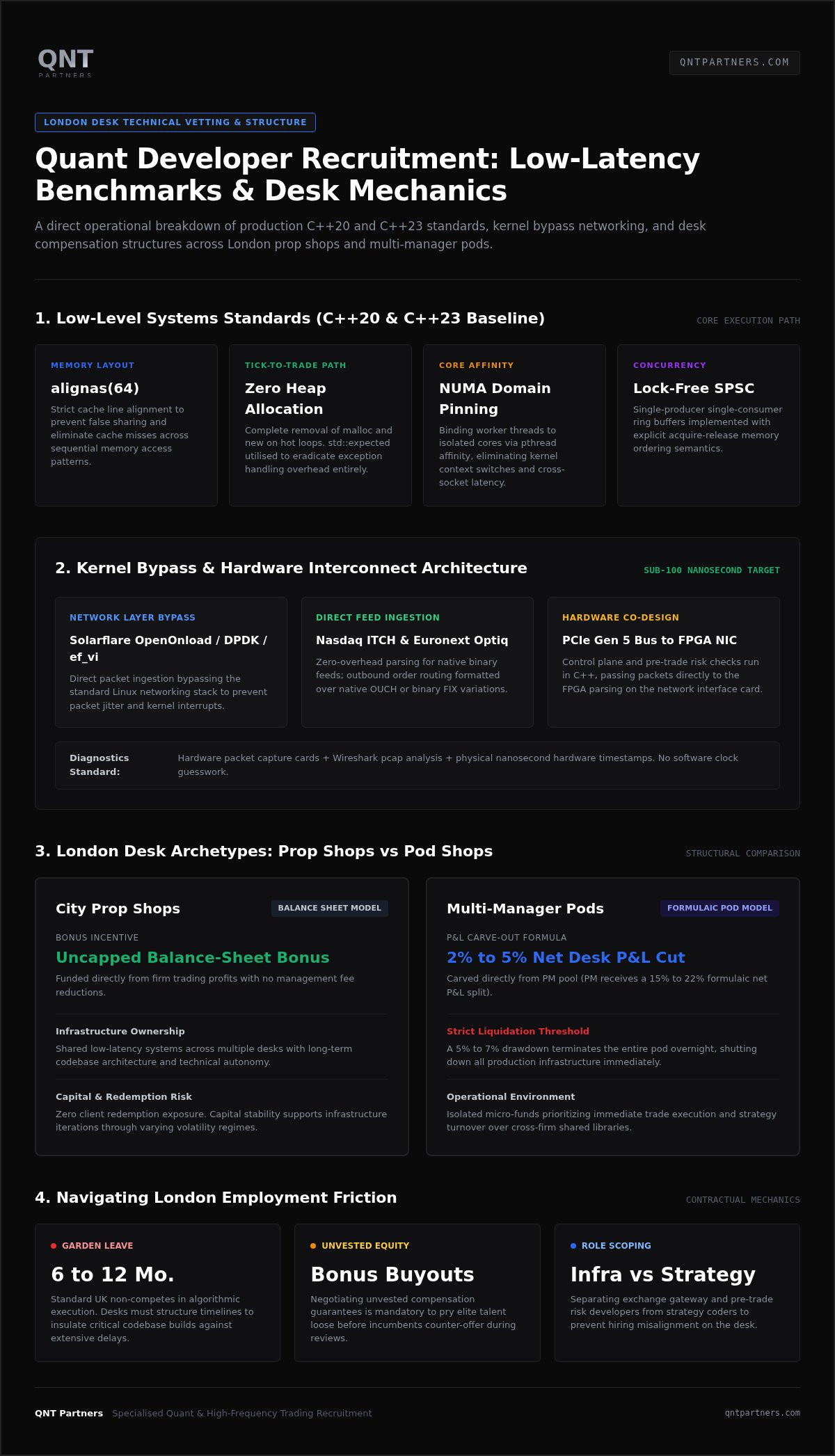
C++20 serves as the absolute baseline across City trading desks, with modern shops migrating latency-sensitive execution paths to C++23. We look for developers who use concepts for template constraints and apply std::expected to eradicate exception overhead on zero-allocation paths.
A capable low-latency engineer understands CPU mechanics as intimately as software syntax:
- Eliminating cache misses via proper cache line alignment (alignas(64)) and sequential memory access patterns.
- Eliminating all dynamic heap allocation (malloc, new) from the hot tick-to-trade path.
- Managing non-uniform memory access (NUMA) domains, binding threads to isolated cores via pthread affinity.
- Deploying lock-free single-producer single-consumer (SPSC) ring buffers with acquire-release memory semantics.
Understanding these low-level realities separates execution specialists from standard software engineers in quantitative finance and developer roles. Desks rely on this distinction to keep order routing predictable during severe market swings.
Hardware Acceleration and Kernel Bypass Protocols
Writing clean C++ is only half the battle when sub-microsecond latency is the desk baseline. Top-performing candidates demonstrate hands-on production work with kernel bypass networking. They bypass standard Linux socket layers using Solarflare OpenOnload, DPDK, or ef_vi to ingest direct market data feeds.
They know how to parse binary market data protocols (such as Nasdaq ITCH and Euronext Optiq) and format outbound orders over OUCH or native binary FIX variants without parsing overhead. For sub-100 nanosecond execution, software developers must interface directly with hardware engineers. The C++ developer writes the control plane and risk checks, communicating across PCIe Gen 5 buses to an FPGA parsing packets directly off the network interface card.
When investigating latency spikes, these engineers do not guess. They inspect physical traffic using hardware packet capture cards, analysing pcap files in Wireshark alongside hardware timestamps to isolate bottlenecks down to the nanosecond.
Evaluating London Desk Archetypes: Prop Shops, Pods, and Funds
A senior developer who excels at a City prop shop will often suffocate inside a Mayfair multi-manager pod. The operational dynamics, risk limits, and compensation incentives differ completely. Matching technical skill to the wrong desk archetype is where most quant developer recruitment London mandates fall apart.
Proprietary Desks versus Multi-Manager Platforms
Proprietary trading firms trade off their own balance sheet. Because there is no client redemption risk, developers typically work on shared low-latency infrastructure across multiple strategies. Bonuses are discretionary but uncapped, backed by trading P&L without external management fee cuts. If you run an engineering desk at a prop shop, you sell candidates on technical autonomy, long-term codebase ownership, and deep balance sheet backing.
Multi-manager platforms operate differently. Pods function as isolated micro-funds where the portfolio manager receives a formulaic net P&L cut (usually 15 to 22 percent). A lead quant developer inside a pod might negotiate a direct 2 to 5 percent carve-out of that pool. The upside is transparent and lucrative, but the risk is immediate liquidation. A 5 to 7 percent drawdown often terminates the entire pod overnight. We detail these structural tradeoffs across our insights on quantitative team structures.
Infrastructure Engineers versus Strategy Developers
Desk heads often fail to separate core infrastructure specialists from strategy developers when scoping seats. Core infrastructure developers maintain exchange gateways, binary feed handlers, and hardware interconnects. They spend their time eliminating microseconds, pinning CPU cores, and adhering strictly to FCA algorithmic trading compliance guidelines around pre-trade risk controls and kill-switch architecture.
Strategy developers sit on the other side of the boundary. They collaborate with quantitative researchers, translating Python backtests into lean C++ execution algorithms. They care about market impact, slippage, and signal decay rather than PCIe transport latency. If you are struggling to calibrate this balance on your desk, consider reaching out to our team to discuss talent mapping across current London desks.
Structuring London Compensation Packages and P&L Splits
Base salary gets a senior developer to take an introductory call, but variable mechanics close the deal. In quant developer recruitment London, we regularly see desks lose top candidates because their offer letters treat high-frequency execution specialists like back-office engineering managers. The market demands clear upside tied directly to desk economics.
Across the City and Mayfair, standard base salaries establish a living floor: mid-level developers (three to five years) sit between £105,000 and £150,000, while senior engineers command £150,000 to £200,000 or more. Above £125,140, the UK additional tax rate bites at 45 percent, alongside the 60 percent marginal trap between £100,000 and £125,140. Candidates know this arithmetic well. Consequently, their focus shifts entirely to total compensation and bonus structure.
Formulaic Bonus Pools versus Discretionary Allocations
How you award variable pay determines which candidates will sign. Proprietary trading houses lean toward discretionary allocations funded directly by balance-sheet revenue. Total comp for a senior developer at an active prop firm typically lands between £300,000 and £600,000. In exceptional volatility years, bonuses easily reach multiples of base pay without bureaucratic hurdles.
Multi-manager pods require a different mechanism. Lead execution engineers embedded in a single pod negotiate explicit, formulaic cuts of the portfolio manager's net P&L, standardly carved out at 2 to 5 percent. While this creates total compensation potential exceeding £1,000,000 for top-performing desks, it ties the engineer's livelihood to that specific strategy's Sharpe ratio. For more on allocating capital across teams, read our strategic framework on quantitative finance talent strategy via our insights section.
Structuring Sign-On Buyouts and Deferred Capital Terms
Extracting an elite engineer almost always requires buying out unvested compensation. Many established systematic funds stagger discretionary bonuses over two- or three-year deferral schedules, complete with clawback provisions. When poaching from a competitor, you must bridge this gap cleanly.
- Structure guaranteed sign-on payments in staged tranches across the developer's first twelve months to offset forfeited deferred cash.
- Tie secondary buyout tranches to measurable execution milestones, such as successful exchange gateway migration or measurable tick-to-trade latency reductions.
- Account for contractual restrictions defined under UK statutory guidance on notice periods and garden leave, ensuring the candidate remains financially covered while serving out their notice.
Failing to match unvested capital upfront simply guarantees the candidate stays put or accepts a counter-offer from their current desk.
Navigating UK Employment Restrictions and Garden Leave
If you expect to hire a senior execution developer and have them committing code within thirty days, you have already miscalculated. In quant developer recruitment London, legal friction dictates your deployment runway far more than your technical interview loops. Top talent across the City and Mayfair comes wrapped in aggressive contractual protections designed specifically to stall rival desks.
Auditing Non-Compete Scope and Enforceability
Despite persistent rumours in recent years regarding government intervention, the proposed three-month statutory cap on non-competes was not enacted following the Department for Business and Trade consultation in early 2026. English common law still governs. Restrictive covenants stretching between six and twelve months remain legally enforceable for senior developers holding sensitive algorithmic and connectivity knowledge.
You must separate garden leave from post-termination restrictions during the offer stage. During garden leave, the developer remains an employee, receives 100 percent of their base salary, and owes strict fidelity duties to their current firm. Post-termination non-competes kick in after the notice period concludes. We regularly advise desks to scrutinise the covenant wording alongside legal counsel. Restraints drafted too broadly across asset classes or geographic regions can often be challenged, whereas narrow, strategy-specific non-competes almost always hold up in court.
Managing the Transition and Project Runway
A six-month garden leave coupled with a three-month notice period creates a nine-month void. Attempting to bypass these terms through informal consulting or off-the-books research invites immediate injunctive action and damages claims from aggressive proprietary trading desks. Instead, you need to sequence your build-out defensively.
- Hire supporting infrastructure and tooling engineers who carry shorter, one-month notices first to prepare underlying hardware and build pipelines.
- Stage sign-on buyout tranches so the incoming lead developer remains committed through lengthy idle windows.
- Maintain compliant check-ins that do not breach the candidate's active fiduciary obligations.
We break down detailed timelines for sequencing critical technical hires in our operational guide to hft infrastructure recruitment. If you need to map notice periods across competing desks and protect your hiring timeline, contact our specialist team to structure your next desk acquisition cleanly.
Executing the Search: Partnership with Specialised Headhunters
The engineers who can strip forty nanoseconds off an exchange gateway do not browse job boards or respond to generic recruiter InMails. In quant developer recruitment London, relying on volume-based contingent agencies simply burdens your senior engineers with unvetted CVs. Internal talent teams, while capable with corporate hiring, rarely possess the technical background required to test candidates on cache hierarchies or memory fence semantics.
Our search model at QNT Partners focuses strictly on precision matching for high-performance desks. We operate as technical peers who understand systems architecture, ensuring every candidate put forward has already cleared low-level engineering hurdles.
Technical Peer-to-Peer Candidate Engagement
Elite developers engage when you talk about code, hardware, and latency profiles rather than corporate platitudes. They want to know the compute architecture, compiler configurations, and whether they will have direct autonomy over execution paths.
We approach candidates by talking through actual production problems: eliminating context switches, tuning ring buffers, and managing tick data across Equinix LD4 or Slough data centres. Our clients rely on this peer-level engagement to initiate serious conversations with passive developers who would otherwise ignore recruitment approaches.
Protecting Market Reputation and Strategic Discretion
Broadcasting a sudden hiring push for ultra-low-latency C++ talent signals your strategic plans to competing City desks. If you flood public boards with mandates for an Eurex or CME execution specialist, competitors immediately deduce your expansion plans and adjust their positioning.
Discretion protects your edge. We run targeted searches confidentially, approaching verified performers without leaking desk strategy or alerting rival market makers. When you need to scale deterministic trading infrastructure without public noise, discuss your technical hiring mandates directly with our team at QNT Partners.
Building a Deterministic Execution Pipeline
Scaling a systematic desk comes down to engineering credibility. Sourcing developers who shave nanoseconds off an execution path requires treating talent acquisition with the exact rigor you apply to order routing. You need to vet low-level systems competency early, align incentives through clear P&L splits or balance-sheet bonuses, and build realistic timelines around standard six- to twelve-month restrictive covenants.
At QNT Partners, we run searches as former industry practitioners who understand execution code and desk economics. We specialise in placing low-latency C++, FPGA, and algorithmic execution engineers through targeted, confidential networks that protect your desk strategy from competing market makers. When you are ready to elevate your quant developer recruitment London strategy and build out your infrastructure, discuss your quant developer hiring needs with QNT Partners. The right low-latency hires will protect your margins and keep your execution deterministic when volatility returns.
Frequently Asked Questions
What technical skills define a top-tier quant developer in London?
Top-tier quant developers master modern C++ (C++20 and C++23 standards) alongside low-level Linux systems programming. They write deterministic execution code without dynamic memory allocations, understand cache line alignment, and pin threads to NUMA cores. They also know kernel bypass frameworks like OpenOnload or DPDK, and understand exchange protocols like ITCH and OUCH. In statistical arbitrage, they often pair systems C++ with high-throughput Python libraries like Polars for research pipeline integration.
How much garden leave is standard for London quant developers?
Standard garden leave terms for senior execution developers in London range from three to six months, frequently coupled with post-termination non-competes extending to twelve months. Because the UK government did not pass statutory caps limiting non-competes in 2026, common law protections remain fully enforceable. Incoming desks must either pay out the candidate's base salary and unvested bonuses while they sit out, or time their desk build-out sprints around this mandatory idle period.
How do London prop shops and multi-manager funds structure developer bonuses?
Multi-manager platforms offer formulaic net P&L cuts between 2 and 5 percent carved directly from the pod's trading pool, while proprietary shops rely on discretionary bonuses tied to balance-sheet returns. Pod contracts provide absolute transparency but expose engineers to immediate desk liquidation during drawdowns. Prop shops provide greater capital stability and uncapped upside during volatile regimes, often pushing senior total compensation to £300,000 to £600,000 without management fee drag.
Can software engineers from Big Tech transition into London quant development?
Yes, but only engineers from systems, distributed infrastructure, or compiler teams make the transition successfully. Generalist web developers and application engineers struggle because big tech platforms abstract away the hardware layer. Desks look for candidates who understand memory ordering, branch predictors, and lock-free concurrency. Those coming from database internals, operating systems, or hyper-scale low-latency services typically pass technical screens and adapt quickly to market mechanics.
What is the difference between a quant researcher and a quant developer?
Quantitative researchers design the mathematical signals and predictive models, whereas quant developers engineer the software and execution infrastructure that turns those signals into filled orders. Researchers live in Python, PyTorch, and historical tick data analysing statistical edges and Sharpe decay. Quant developers take those mathematical formulations and build low-latency C++ engines, manage exchange gateways, optimise memory layout, and ensure pre-trade risk controls run deterministically without execution slippage.
Why do London trading desks use specialised recruitment firms over job boards?
Successful quant developer recruitment London requires technical peer-to-peer vetting that job boards and general contingent recruiters cannot deliver. The strongest systems developers in the City and Mayfair rarely update public profiles or apply to job postings. Partnering with a specialised search firm like QNT Partners ensures candidates are screened on cache coherency, memory layouts, and networking stacks before desk heads spend interview time. It also keeps strategic desk expansions confidential from rival market makers.
How long does it take to complete an executive search for a senior quant developer?
Sourcing and signing a senior quant developer typically takes eight to twelve weeks, though total time to seat arrival often extends beyond six months due to UK notice and non-compete periods. The initial search involves mapping passive talent, conducting peer-level technical screens, and structuring buyout terms. Once an offer is signed, managing the candidate through their contractual three-month notice period and six-month non-compete requires consistent communication to prevent counter-offers from their current desk.