Python Quant Developer Search: Finding Engineers Who Understand the Bottleneck

Most Python developers believe optimisation involves adding a Redis cache to a Flask endpoint. In our world, that line of thinking is a liability. If you are currently conducting a Python quant developer search, you are likely buried under resumes from generalist software engineers who cannot explain the overhead of object boxing or why a 10-millisecond execution window makes standard garbage collection a non-starter.
You probably find it exhausting to filter for candidates who understand that Python should only ever be the orchestration layer for a C++ or FPGA-driven execution path. I have seen too many desks fail because they hired a lead who treats the Global Interpreter Lock as a minor inconvenience rather than a fundamental architectural constraint.
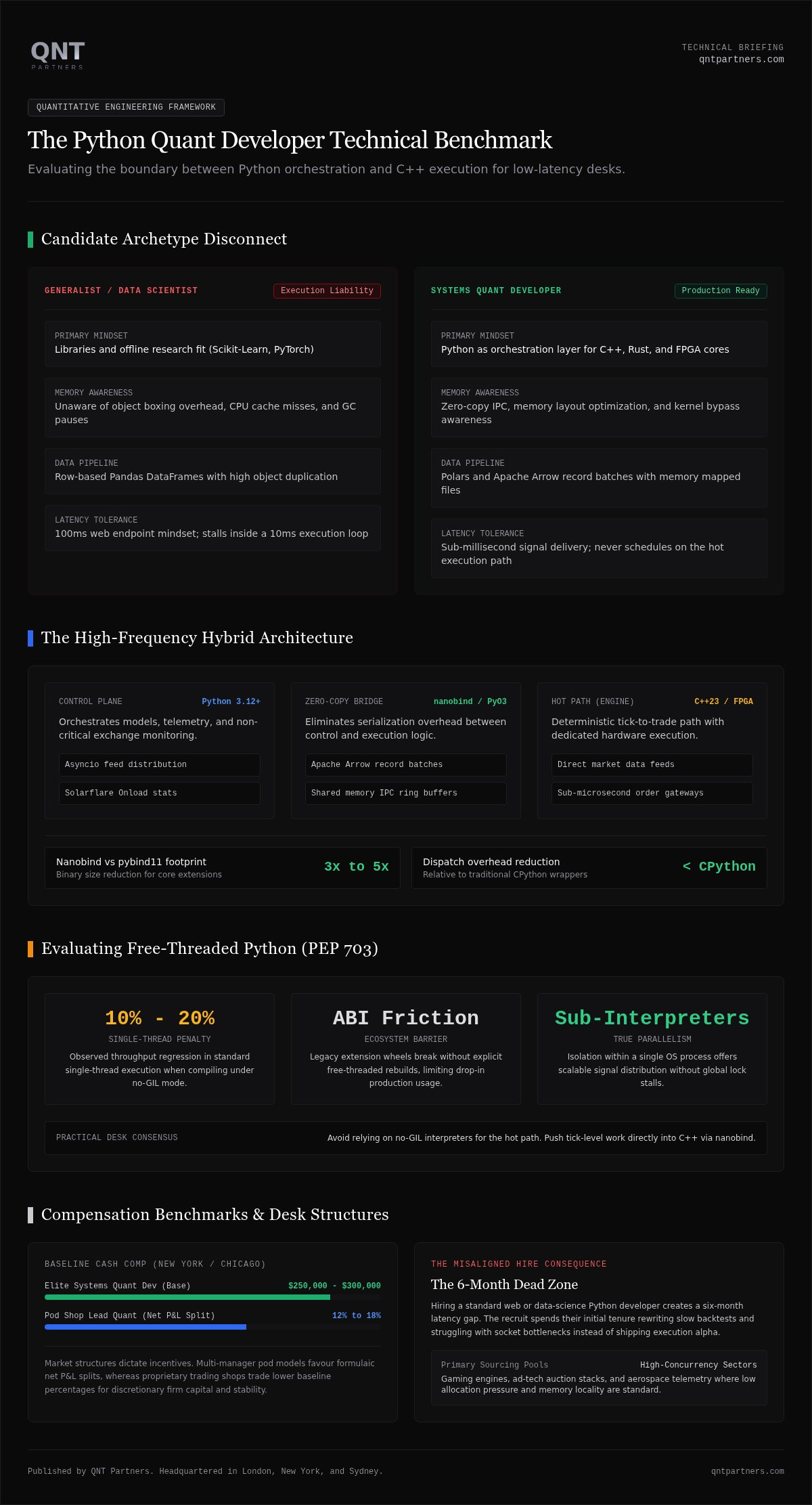
I will provide a peer-level framework for identifying engineers who actually understand low-latency constraints and high-frequency data structures. This guide examines how to vet for C++ interop using nanobind and the adoption friction of free-threaded Python 3.14. I have also included the current base salary benchmarks that sit between $250,000 and $300,000 for elite talent in New York or Chicago.
Key Takeaways
- Distinguish between Python users and engineers who treat the language as an orchestration layer for high-frequency data structures and memory management.
- Modernise your technical requirements to include zero-copy interoperability with Apache Arrow and nanobind rather than standard row-based Pandas workflows.
- Optimise your Python quant developer search by sourcing talent from high-concurrency sectors like ad-tech or gaming where memory locality is a primary concern.
- Quantify the risk of a misaligned hire, specifically the six-month dead zone where a candidate fails to contribute to the tick-to-trade lifecycle.
- Benchmark your compensation models against current market structures, where lead quants in pod shops often negotiate a 12 to 18 percent net P&L split.
Python is the bottleneck, not the solution
Most firms fail their Python quant developer search because they interview for library knowledge rather than memory management. If a candidate spends the first ten minutes talking about scikit-learn, they've already lost the room. I see this constantly in London and Chicago hubs; funds hire a senior developer who can't explain why their backtester crawls when processing a week of tick data. The distinction between a Python user and a Python engineer is found in how they handle data at the socket level.
In a 2026 HFT environment, Python is rarely the engine. It's the high-level wrapper for modern C++ or Rust components. A generalist backend developer from a tech startup will fail your tick-data processing test because they don't understand object boxing or cache misses. They're used to web environments where a 100ms response is acceptable. In algorithmic trading systems, that's an eternity. You need someone who knows how to bypass the GIL, not just work within it.
The myth of the 'Data Science' Quant
Proficiency in scikit-learn or PyTorch is a remarkably low bar. It's fine for offline research where the Sharpe ratio is the only metric that matters, but it's useless for production execution code. The failure point occurs the moment a researcher's model hits a 10-millisecond execution window. If your developer can't explain how the Global Interpreter Lock will stall their signal generation, they're a liability. Production-grade code requires an understanding of how to vectorise operations to keep the heavy lifting in the C++ layer.
Vetting for systems-level Python
You need engineers who understand memory layout and zero-copy data structures. We prioritise candidates who have moved past row-based Pandas workflows in favour of Polars and Apache Arrow. These tools allow for high-performance paths that avoid the overhead of Python object allocation. Look for someone who can write their own C extensions using nanobind to bridge the gap between research and the execution gateway. Even with the official support for free-threading in Python 3.14, the real performance gains still come from avoiding the Python interpreter entirely for the critical path. A candidate who doesn't understand the 10 to 20 percent single-threaded throughput regression in no-GIL binaries isn't ready for a lead role.
The technical stack of a 2026 Python Quant
The modern quant stack has effectively discarded the row-based overhead of legacy libraries. If you are conducting a Python quant developer search, you should prioritised candidates who have transitioned from Pandas to Polars for production API stability. In 2026, the baseline requirement includes proficiency in nanobind or Cython to bridge the gap to the execution engine. Python serves as the management layer, orchestrating FPGA-based execution logs and handling the telemetry of exchange connectivity without sitting in the hot path.
Efficiently managing multiple exchange feeds requires deep expertise in asynchronous programming. We see developers using asyncio not for the speed of execution, but for the concurrency required to monitor disparate liquidity pools simultaneously. A candidate must demonstrate they can handle high-throughput telemetry without blocking the event loop. They should also understand the nuances of kernel bypass logic when Python is used to monitor Solarflare OpenOnload statistics.
Beyond the Global Interpreter Lock
Testing a candidate on concurrency is the quickest way to separate researchers from engineers. You need to verify their understanding of multi-threading versus multi-processing, specifically regarding shared memory for low-latency inter-process communication. While the PEP 703 specification for optional GIL has introduced supported free-threading in Python 3.14, real-world adoption remains complex due to ABI incompatibilities across legacy extension wheels. Sub-interpreters now allow for true parallelism within a single process, fundamentally changing how we evaluate a candidate's ability to scale signal processing across multiple cores.
Integration with C++ and Rust
A competent Python dev in this space must be comfortable reading C++ headers. They are essentially systems engineers who happen to use Python for the control plane. We are seeing a significant rise in Rust-based tooling, particularly with PyO3, which offers safer memory management than traditional C extensions. Cross-language data transport now relies heavily on Apache Arrow record batches to ensure zero-copy efficiency. Nanobind has largely superseded pybind11 because it reduces dispatch overhead below standard CPython function execution. It also offers a significant reduction in binary footprints, often by a factor of 3 to 5. If you need help identifying candidates who can navigate these specific interop requirements, you might want to discuss your specific technical needs with us.
Market structures: Pod shops vs Prop shops
I've noticed that most candidates don't actually care about your firm's global AUM. They care about their proximity to the risk-taker. When you refine your Python quant developer search, you need to be clear about which side of the P&L your hire will sit on. The structural divergence between pod shops and prop shops has never been more pronounced. This is particularly evident in the Bank of England keynote on multi-manager market structures, which details how these models have reshaped the competition for technical talent.
A senior developer at a London-based pod shop isn't looking for a stable salary. They are looking for a carve-out. In these environments, we see senior developers negotiating a contractual 12 to 18 percent split of net P&L. This is often tied to a specific pod or a Separately Managed Account (SMA) structure. It is an 'eat what you kill' culture that prioritises speed to market over long-term architectural purity.
The Pod Shop developer profile
Engineers in this space are focused on alpha generation support. They specialise in building bespoke tooling that allows a Portfolio Manager (PM) to iterate faster than the desk next door. The pressure is immense. If the pod hits a 10 percent liquidation stop-out, the developer is out of a job along with the PM. You can find more context on how these structures are funded in our SMA sourcing insights. These candidates value autonomy and direct financial upside over firm-wide equity.
The Prop Shop infrastructure builder
Proprietary trading firms operate differently. They favour long-term scalability and shared libraries. A developer at a Chicago prop shop is likely working on a unified, high-performance backtester that serves the entire firm. They are currently winning the war for C++-heavy Python talent because they offer the chance to build world-class infrastructure. For some, an equity partnership in a smaller Sydney-based systematic fund is more attractive than a higher cash split in a siloed pod. It offers a stake in the firm's intellectual property rather than just a one-year bonus cycle.
Regardless of the structure, the non-compete situation has hardened. A 12-month garden leave is now the floor for top talent. For core algorithm engineers, we are seeing 24-month restrictions paid at base salary. This makes the cost of a bad hire even higher. You aren't just losing six months of productivity; you are paying a competitor's future hire to sit on the sidelines for a year.
Sourcing strategy: Where the best quants hide
Elite talent doesn't apply for jobs. If your Python quant developer search relies on active candidates from generalist boards, you've already lost. The engineers who actually understand memory locality and the overhead of object boxing are usually sitting in a 12 to 18-month garden leave or working for a boutique fund you haven't heard of yet. These individuals are often passive and require a peer-level technical engagement to even consider a move. This is where specialized quant recruitment firms provide access that internal HR teams cannot replicate.
We often find the most capable systems engineers outside of the traditional finance bubble. I have seen remarkable success in sourcing from the gaming and ad-tech sectors. These industries face the same fundamental bottlenecks as systematic trading: high-concurrency, low-latency data processing and the need for zero-copy memory management. A developer who has spent three years optimising a real-time bidding engine understands tick-to-trade constraints better than a generic backend engineer from a major tech firm.
The Ad-Tech to HFT pipeline
Real-time bidding (RTB) developers operate in a world where a 50-millisecond delay results in a lost opportunity. This mindset translates perfectly to the 10-millisecond execution windows we see in systematic pods. When interviewing these candidates, I focus on how they handle socket-level TCP logic and kernel bypass. You can bridge the industry gap by asking how they manage state across distributed auctions. Their answers usually reveal a deep grasp of the same concurrency issues that plague a misconfigured execution gateway.
Identifying talent in quiet spinouts
I spend a significant amount of my time tracking departures from the major systematic hubs. When a senior PM leaves a Chicago prop shop to start a new fund, they rarely go to a major platform immediately. They often build a lean team of fewer than 50 employees to maintain agility and higher P&L splits. These quiet spinouts are the primary hunting ground for elite Python quants. We prioritise reaching out to these teams during their non-compete periods. It's the only way to secure a lead engineer before they are bid up by the larger multi-manager platforms. If you are struggling to find engineers who can actually build a production-grade backtester, you should contact us to discuss a bespoke search strategy.
The consequence of missing these windows is severe. You end up hiring a researcher who writes clean code but cannot implement it. In a production environment, that results in a six-month dead zone where no alpha is actually captured. Finding the person who understands the bottleneck is the only way to avoid that outcome.
The consequence of a misaligned search
A misaligned Python quant developer search is a direct tax on your desk's performance. If you hire a developer who treats memory management as an abstraction, you risk a memory leak in your execution gateway. These leaks often stay hidden until a high-volatility event occurs. I have seen instances where a slow garbage collection cycle during a market spike led to stale prices and significant slippage. This is a P&L event, not merely a matter of technical debt. A direct hit to the bottom line.
The 6-month dead zone represents a substantial sunk cost. Most elite quants require half a year to fully integrate into a modern HFT stack and begin contributing. If you realise at month seven that your hire cannot handle the C++ interop requirements I discussed earlier, you have lost a massive window of opportunity. You also face the risk of talent leakage. Crypto prop shops are currently aggressive, often offering P&L splits 20 percent higher than traditional systematic funds. Without a rigorous vetting process, you are likely training developers for your competitors.
The true cost of garden leave
Calculating the opportunity cost of a 12-month non-compete is essential for any lead role. If a critical position sits vacant for a year while a candidate sits on garden leave, the lost alpha often dwarfs the base salary. I often observe that paying a buy-out is the only logical move for a senior role. This is particularly true when talent moves between sectors. You can read about these shifts in our Tradfi to Crypto insights.
Closing the gap with QNT Partners
We avoid these pitfalls by operating as a peer-level search firm. We vet for specific Python-C++ interop skills, ensuring candidates can work with nanobind and Apache Arrow before they even reach your desk. Our approach involves discreetly mapping talent across Chicago, London, and Hong Kong to find quants who are currently in non-compete or at under-the-radar spinouts. If you need to secure a lead developer who actually understands the bottleneck, you should contact QNT Partners for a targeted quant search. Relying on an operator-led search is the only way to ensure your hire contributes alpha from day one.
Securing the technical lead for your desk
Hiring for these roles is a systems engineering challenge, not an administrative task. If you treat your Python quant developer search like a standard software engineering hunt, you will end up with a candidate who fails the first time your backtester hits a memory-intensive data set. We have explored why you must prioritise engineers who understand the overhead of object boxing and the specific interop mechanics of nanobind. These technical nuances separate a researcher from a production-grade engineer.
The structural choice between a 12 to 18 percent P&L split in a pod shop and the shared infrastructure of a prop shop dictates the talent you attract. We specialise in identifying these profiles across Chicago, London, and Sydney because we have operated on the same desks. QNT Partners is a boutique firm founded by former HFT operators with a global network designed for this level of technical mastery. You can start a specialised Python quant dev search with QNT Partners to ensure your next hire understands the bottleneck before they touch your production code. Finding the right engineer ensures your infrastructure scales with your alpha.
Frequently Asked Questions
What is the average salary for a Python quant developer in 2026?
Base salaries for elite talent found through a Python quant developer search in New York or Chicago typically range from $250,000 to $300,000. Total compensation for senior developers with five to nine years of experience often lands between $500,000 and $900,000. In London, senior quants expect total packages from £300,000 to £700,000. These figures reflect the market for engineers who bridge the gap between high-level research and low-latency infrastructure.
How do you test a Python developer for low-latency engineering skills?
Focus on memory management rather than algorithmic syntax. Ask candidates to explain object boxing overhead or the specific impact of the Global Interpreter Lock on a 10-millisecond execution window. A useful test involves building a zero-copy data bridge using nanobind or Apache Arrow record batches. If they cannot describe how to avoid Python object allocation in the critical path, they aren't suitable for high-frequency environments.
Is Python or C++ better for quantitative trading roles?
Neither language operates in isolation within a modern systematic fund. C++ remains the standard for the tick-to-trade path, exchange connectivity, and order book construction due to deterministic performance. Python has become the dominant layer for research, parameter optimisation, and backtesting. The most valuable quants are those who specialised in the interop between the two, using Python to orchestrate high-performance C++ or Rust kernels.
What are the common non-compete lengths for quant developers?
Standard restrictive covenants in London and New York currently span 6 to 18 months for senior developers. For engineers working on core market-making algorithms, 24-month non-competes are increasingly common. These periods are typically paid at base salary as garden leave. This makes a precise Python quant developer search critical, as a bad hire results in a lengthy and expensive period of forced inactivity for the candidate.
How does a pod shop P&L split work for developers?
Developers embedded within a specific pod typically receive a discretionary carve-out of 1 to 3 percent of the desk's net P&L. This differs from centralised prop shops where bonuses draw from a firm-wide pool. The split is usually paid after netting costs and capital charges. This structure incentivises speed to market and direct support for a Portfolio Manager's specific alpha generation strategies.
Can you find quant talent in the ad-tech or gaming industries?
Sourcing from ad-tech and gaming is often more productive than looking at generalist tech firms. Real-time bidding developers handle high-concurrency data within 50-millisecond windows, which mirrors the constraints of systematic trading. They usually possess a deep understanding of socket-level TCP logic and kernel bypass. We find these engineers transition well because they already treat memory locality as a primary architectural concern rather than an afterthought.
What is the difference between a quant researcher and a quant developer?
A researcher focuses on signal generation, parameter optimisation, and improving the Sharpe ratio of a strategy. They often work in offline environments using notebooks. A quant developer builds the production-grade infrastructure that allows those signals to reach the exchange. They are responsible for the tick-to-trade lifecycle, co-location connectivity, and ensuring the researcher's model doesn't fail when it hits the 10-millisecond execution window.
Why is Polars replacing Pandas in systematic trading stacks?
Polars has largely superseded Pandas because it uses an Apache Arrow-native columnar memory format and a multi-threaded streaming engine. It avoids the row-based overhead and object allocation penalties that slow down legacy Pandas workflows. In a 2026 production environment, the ability to perform zero-copy data transport between Python and C++ is a requirement. Polars provides the stability and performance needed for these high-throughput systematic trading paths.