Low Latency Trading Recruitment: 2026 Operator Guide

Low latency trading systems recruitment fails the moment an agency treats microsecond execution like enterprise software development. If an engineer cannot explain cache line bouncing or kernel bypass via DPDK, they don't belong in your tick-to-trade pipeline.
You already know the cost. Desks burn months interviewing developers who write clean C++ abstractions but choke on memory ordering or PCIe bus overhead. When you finally locate an engineer who can push latency under 500 nanoseconds, the hire often stalls against a twelve-month non-compete and drawn-out garden leave negotiations.
This guide gives a direct assessment of how proprietary desks source, evaluate, and secure low latency engineering talent. I outline specific technical evaluation criteria that eliminate candidate noise early, followed by the compensation mechanics required to pry senior infrastructure talent out of aggressive restrictive covenants.
Key Takeaways
- Modern low latency trading systems recruitment demands moving past keyword-matching algorithms in favour of testing for cache-conscious data layouts and compiler optimisations.
- Practical vetting strategies to isolate engineers who build sub-500 nanosecond execution paths using Solarflare Onload and direct kernel bypass frameworks.
- How to balance formulaic desk P&L splits against multi-manager pod guarantees to pry top infrastructure engineers away from competing desks.
- Structured buyout and staging models designed to neutralise six to twelve month non-compete agreements without blowing out your project timelines.
The Core Challenge in Low Latency Trading Systems Recruitment
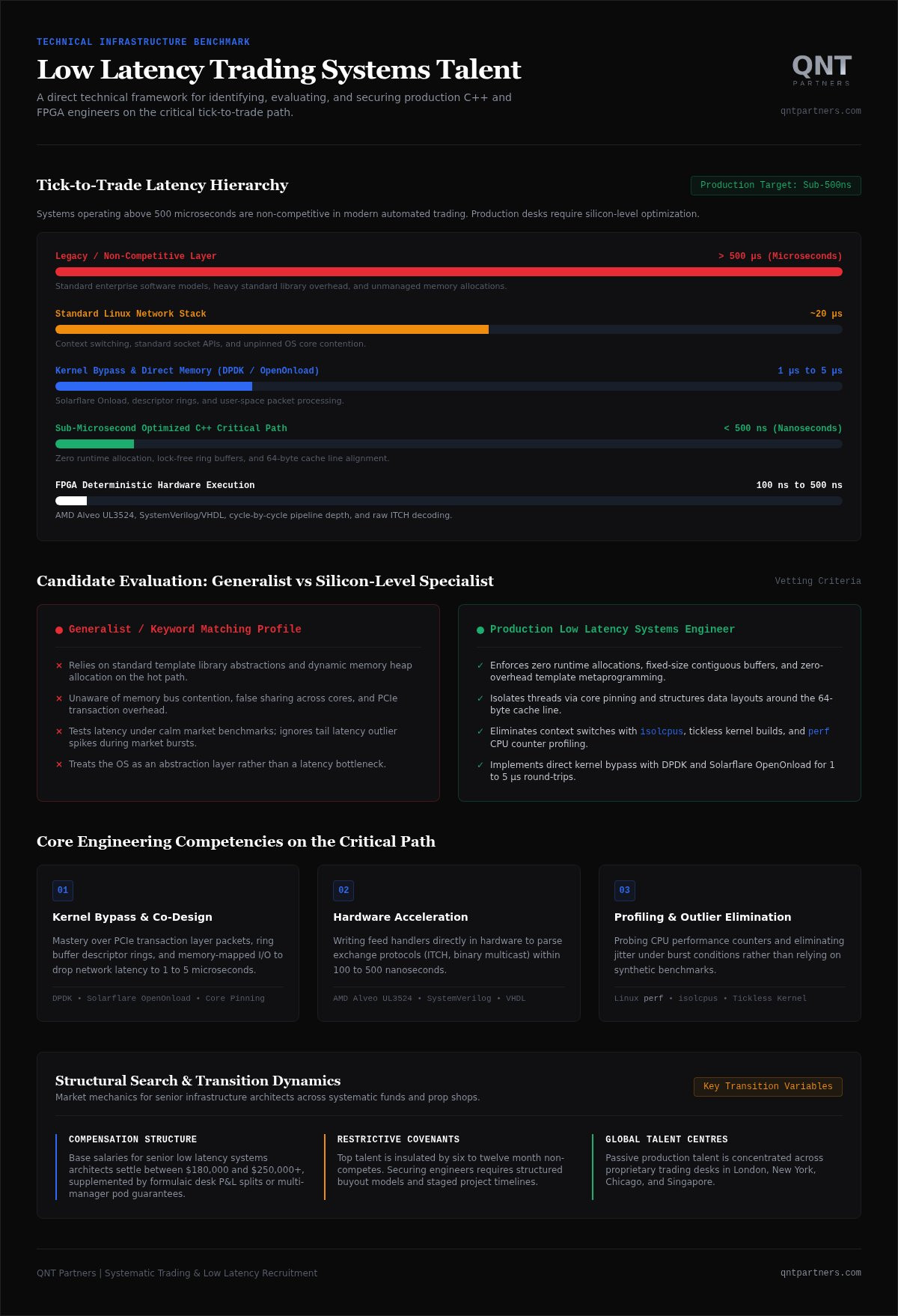
Most low latency trading systems recruitment efforts fail because desks filter for software generalists when they actually need microarchitecture specialists. If your pipeline relies on keyword matching, you end up reviewing candidates who write high-level enterprise C++ but cannot reason about memory bus contention or mechanical sympathy. That disconnect is fatal in high-frequency trading (HFT), where systems exceeding 500 microseconds are non-competitive, and top-tier FPGA platforms process orders in 100 to 500 nanoseconds.
When an engineer deploys code that triggers unexpected cache misses, queue position disappears. So does your P&L. The financial consequence of a poor infrastructure hire is immediate adverse selection on exchange gateways.
Why Traditional Tech Headhunters Miss the Mark
Generalist agencies search for labels like modern C++ or distributed systems. They cannot evaluate whether a developer knows how to avoid false sharing across CPU cores or how to write lock-free ring buffers. Desks then face stacks of CVs from big tech developers who rely on heavy standard library abstractions. The candidate looks exceptional on paper. Put them in front of a Solarflare NIC with direct kernel bypass requirements, and the interview loop falls apart.
The Reality of Candidate Scarcity in Systems Engineering
True sub-microsecond infrastructure engineers do not post on public job boards. They are embedded inside proprietary trading groups or systematic hedge funds, insulated by twelve-month non-compete agreements and deferred compensation. Reaching them requires technical fluency; senior engineers simply delete outreach from recruiters who cannot discuss branch prediction or Linux kernel internals.
At QNT Partners, we focus on identifying passive production engineers across London, New York, Chicago, and Singapore who understand these trade-offs intimately. Desks looking to bypass candidate noise and secure verified systems talent can review our approach to technology and engineering recruitment.
Evaluating Technical Capabilities in Production Systems Candidates
Evaluating candidates for the core tick-to-trade path requires looking past academic algorithms. In low latency trading systems recruitment, the central question is whether an engineer designs for the underlying silicon. Anyone can write clean C++20 code with concept constraints, but production trading demands zero runtime allocations on the critical path, fixed-size contiguous memory blocks, and zero-overhead template metaprogramming.
Hardware-Software Co-Design and Kernel Bypass
Top developers treat the operating system as an obstacle. I look for engineers who bypass the Linux network stack entirely, bringing network latency down from 20 microseconds to the 1 to 5 microsecond band using DPDK or Solarflare OpenOnload. They must understand ring buffer descriptor rings, PCIe transaction layer packets, and memory-mapped I/O. If they cannot isolate threads via core pinning or explain how to prevent false sharing on a 64-byte cache line, their systems will suffer jitter under load.
FPGA Acceleration and High-Frequency Market Data
Modern tick-to-trade pipelines increasingly run on hardware. Top-tier desks lean on cards like the AMD Alveo UL3524, targeting deterministic latencies of 100 to 500 nanoseconds. Candidates working in this layer should possess verifiable experience writing SystemVerilog or VHDL for feed handlers directly decoding exchange protocols like ITCH or binary multicast. They must be comfortable calculating pipeline depth cycle by cycle rather than thinking in clock ticks.
Systems Level Debugging and Profiling Capabilities
Benchmarking under calm market conditions tells you very little. A production systems engineer must capture and analyse tail latency outliers when message bursts hit the NIC. That means probing CPU performance counters, profiling with perf, and eliminating context switches using isolcpus and tickless kernel configurations.
Engineers with this level of systems mastery are exceptionally difficult to unseat, often bound by the widespread use of noncompete agreements that protect proprietary infrastructure. If you want an objective technical audit of how your pipeline benchmarks against other systematic teams, speak with our team at QNT Partners.
Prop Shop vs Multi-Manager Pod: Structuring Competitive Offers
Low latency trading systems recruitment runs into a wall when desks misjudge how talent values different risk profiles. Base salaries for senior low-latency systems architects generally settle between $180,000 and $250,000, reaching total compensation packages of $350,000 to $500,000 at leading shops. How you structure the variable component dictates whether an offer gets signed or ignored.
The split comes down to two opposing compensation philosophies: direct desk economics versus enterprise multi-manager guarantees.
Proprietary Trading House Compensation Mechanics
Prop desks win engineers by providing direct visibility into profitability. Bonuses are not pulled from a nebulous corporate pool; they tie directly to desk P&L or formulaic payouts. For high-volume market making and statistical arbitrage desks, performance bonuses frequently run between 150% and 400% of base salary for top performers.
Mid-tier prop operations and boutique spinouts often supplement this with equity participation or phantom units that mirror equity growth. An engineer accepting slightly lower liquidity today gains direct ownership of the platform's infrastructure value tomorrow.
Multi-Manager Platform Pod Structures
Multi-manager hedge fund platforms take a different path. Pods routinely offer higher guaranteed cash bases and first-year compensation floors to de-risk candidate transitions. A senior developer leaving an established bonus cycle often requires a guaranteed buyout simply to justify resigning.
The vulnerability in pod structures lies in platform drawdown limits. If a portfolio manager breaches a 5% stop-out threshold, the pod shuts down. The infrastructure engineer, regardless of system performance, finds themselves back on the street. Desks recruiting against multi-manager platforms can exploit this insecurity by highlighting platform stability, shared infrastructure investment, and lower turnover.
When we run technical searches across Chicago, New York, and London, we find that the best offer structures align with the candidate's personal risk appetite. High-conviction systems developers who trust their tick-to-trade optimisations will always favour formulaic desk payouts over capped corporate bonuses. Tailoring that package before the final interview loop is critical to securing your hire.
Managing Non-Competes, Garden Leave, and Cross-Desk Transitions
Hiring elite infrastructure talent always collides with restrictive covenants. In low latency trading systems recruitment, assuming an engineer will arrive in two to four weeks guarantees operational failure. Six to twelve month non-competes remain standard across systematic funds, often accompanied by strict garden leave provisions designed to let code familiarity degrade before a candidate touches a competing book.
If you fail to plan for these forced hiatuses, your target hires end up accepting defensive counter-offers from their current employers simply to avoid prolonged inactivity.
Structuring Buyouts and Bridge Compensation
Unseating an engineer requires buying out unvested compensation and bridging their time away from production code. When a systems architect walks away from deferred equity or an unpaid annual bonus, the incoming firm must replace that capital on a dollar-for-dollar basis. We frequently structure this through staggered sign-on bonuses paid across the first 12 to 18 months of employment.
Keeping a developer engaged throughout twelve months of bench time demands deliberate effort. While they cannot write production systems code for your active trading books, you can sponsor research into open hardware specifications or allow them to work on isolated simulation frameworks that sit outside their covenant restrictions.
Mitigating Legal Risks and Protecting Proprietary Work
Clean transitions protect both the candidate and the hiring desk. Systematic operations cannot risk copyright infringement or trade secret disputes originating from an engineer's previous firm. Retaining outside employment counsel to review restrictive covenants prior to formal offer delivery is non-negotiable.
Desks avoid litigation by implementing practical safeguards:
- Strict clean-room protocols barring any use of legacy codebases or personal notes.
- Explicit asset-class carving, placing the hire on equities execution if their covenant covers fixed income.
- Geographic partitioning, relocating engineering duties away from restricted jurisdictions during the non-compete window.
Firms that standardise these transition terms move through recruitment rounds months faster than desks improvising at the finish line. For targeted talent strategy advisory on managing complex transitions, speak with our team about executing clean engineering placements.
Executing High-Impact Infrastructure Searches with QNT Partners
Most heads of trading tell me that reviewing fifty CVs from a contingent agency feels like doing unpaid technical screening for people who don't understand the job. Executing low latency trading systems recruitment at an institutional level requires active operator discernment, not automated keyword scrapers.
When you need an engineer to rebuild an ultra-low latency gateway, candidate volume is a liability. Precision is the only metric that matters.
Discreet Talent Mapping and Market Intelligence
We map engineering benches across London, New York, Chicago, and Singapore without alerting the broader market. When a boutique Chicago prop shop restructures its futures group, or a Sydney systematic fund spins out a new execution team, we know which developers built the core order routing architecture.
Passive systems architects do not respond to generic headhunter messages. They pick up the phone for peers who understand hardware performance counters, thread pinning, and Linux kernel bypass. Because QNT Partners is run by former quantitative industry operators, we speak candidate language from the first exchange. That direct technical credibility secures access to talent that never appears on open markets.
Engaging Dedicated Search for Critical Systems Roles
A retained infrastructure mandate replaces speculative resumes with calibrated technical screening. We evaluate candidates on hardware-software co-design, cache-aware data layouts, and memory topologies before they ever reach your calendar.
This process delivers distinct advantages to trading leadership:
- Elimination of candidate noise, sending your desk only two or three thoroughly vetted engineers.
- Protection of internal engineering hours, keeping your senior developers focused on active production pipelines.
- Structured market intelligence regarding competitor compensation tiers and restrictive covenant durations.
In low latency trading systems recruitment, precision beats volume every time. If your firm is expanding execution capacity or standing up a new automated trading group, start a discussion via QNT Partners Contact to define your mandate.
Executing Your Next Production Build-Out
Building a deterministic trading stack leaves no margin for recruiter guesswork. Securing engineers who can strip execution latency down to the nanosecond level requires evaluating hardware-software co-design from the first screen, structuring offers that resolve the pod versus prop shop dilemma, and staging clean buyouts for restrictive covenants.
QNT Partners operates as a boutique search team composed of former quantitative industry operators. Backed by a demonstrated placement history in sub-microsecond C++ and FPGA engineering, we maintain global candidate access across London, New York, Chicago, and Singapore. We don't flood your calendar with candidate noise; we introduce the specific engineers capable of defending your queue position.
This disciplined focus turns low latency trading systems recruitment into an enduring competitive edge for your firm. When you are ready to expand your core infrastructure group, discuss your engineering hiring mandate with QNT Partners to build an execution path that outpaces the street.
Frequently Asked Questions
What programming languages dominate low latency trading systems recruitment?
Modern C++ standards like C++20 and C++23 remain the core requirement for building execution gateways and deterministic order routing systems. In low latency trading systems recruitment, we also see growing demand for Rust in telemetry and tooling, alongside SystemVerilog and VHDL for FPGA pipelines. Python handles off-path research, but production execution paths require compile-time abstractions and zero-overhead memory controls that only C++ and hardware description languages deliver.
How long does a typical low latency systems search take to complete?
Sourcing and signing a senior engineer usually requires six to ten weeks of active search. The real timeline challenge lies in the notice and garden leave period. Because top infrastructure developers face six to twelve month restrictive covenants, desks must forecast hiring needs well in advance. We advise teams to map passive talent benches continuously rather than waiting for an unexpected resignation.
Why do hedge funds enforce six to twelve month non-compete agreements?
Execution alpha decays rapidly. A firm enforces restrictive covenants to ensure proprietary network topologies, bespoke exchange feed parsers, and custom FPGA logic lose their competitive advantage before an engineer joins a competitor. Paid garden leave operates as an insurance policy against alpha decay, preventing your specific execution methods from walking straight onto a rival desk across the street.
What is the difference between an application developer and a systems engineer in HFT?
Application developers focus on trading signals, compliance logic, and order routing flows. Systems engineers build the underlying hardware and network transport fabric. They configure core isolation, eliminate operating system context switches, tune Solarflare network interfaces, and design memory structures that prevent cache evictions. One writes the trading rules; the other ensures the packet reaches the exchange matching engine without jitter.
How do proprietary trading firms assess hardware-software co-design skills?
Production desks bypass generic algorithmic tests in favour of architecture reviews and systems debugging. Interviewers evaluate how a candidate structures data across 64-byte cache lines, handles memory fences in lock-free queues, and interacts with PCIe buses. Practical assessments often involve profiling real-world code using perf or diagnosing microsecond tail latency spikes in tick-to-trade benchmarks under simulated exchange load.
Can engineers transition from big tech into low latency trading desks?
Yes, but almost exclusively from specialised niches like Linux kernel development, browser engine optimization, or hypervisor engineering. Developers whose experience centres on enterprise web services, distributed databases, or cloud infrastructure struggle in low-latency environments. Desks require candidates who understand raw memory layout and hardware mechanics intimately, traits rarely developed in environments insulated by garbage collection and virtualised instances.
What role do FPGAs play in modern electronic trading infrastructure?
FPGAs provide deterministic sub-microsecond processing where operating system software cannot compete. In tick-to-trade paths, accelerator cards parse market data packets, filter relevant order book updates, and trigger outbound orders directly at the network interface layer in 100 to 500 nanoseconds. They handle the ultra-fast tip of the spear, while C++ software handles broader portfolio risk and multi-venue routing.