Institutional Investment Talent Advisory: What Specialist Support Should Deliver

A quant hire can fit the brief and still be wrong for the investment team. That is why institutional investment talent advisory should start with the strategy and operating model, not a list of titles to fill.
Hiring problems often start when the mandate does not reflect how the team actually works. A researcher joining a pod shop may need to operate within a different risk and P&L structure from someone joining a prop shop. A low-latency engineer building exchange connectivity has different requirements from a generalist developer. Internal networks can miss those distinctions, and a poor hire can disrupt research or delay a planned build-out.
A specialist adviser should contribute more than candidate introductions. The value is in translating the investment strategy into a clear role, reaching relevant people discreetly, and assessing whether their experience fits the team’s technical and commercial context. This guide explains how to define that mandate, decide when external advice is warranted, and assess whether a potential partner understands the work, not just the market.
Key Takeaways
- Use institutional investment talent advisory when a hiring decision needs to account for the investment strategy and the team the firm is building.
- Assess an adviser on sector fluency, mandate definition, access to relevant candidates, and discretion, not introductions alone.
- Define the investment objective and capability gap before settling on role titles, then separate essential technical requirements from preferences.
- Match responsibilities to the firm’s structure. A PM or researcher role can mean different things in a pod shop, prop shop, or multi-manager platform.
- Consider specialist support when the search involves quantitative trading, research, trading technology, or AI and ML expertise.
What Institutional Investment Talent Advisory Should Cover
A role brief can overlook the team-design question behind a hiring need. The title may say “quant researcher”, while the real issue is whether the team lacks signal research, production implementation, or a clear division of responsibility between the two. Effective institutional investment talent advisory starts by examining that context.
Talent advisory connects decisions about people with an investment strategy and the organisation required to execute it. It helps define the capability a team needs before deciding whether to hire, reshape responsibilities, or commission a search. An institutional investor can describe a wide range of organisations, but the talent requirements of a systematic trading group depend on its specific mandate and operating model.
How advisory differs from executive search
Search is a hiring process: agree on the role, identify candidates, and support selection. Advisory is broader. It helps clarify what the role should be, where it fits in the team, and which capabilities are genuinely essential. Not every vacancy needs that work. If the requirement is already clear, a focused search may be enough.
The two can come together when a strategic review identifies a specific gap. For example, a team reviewing its research-to-production workflow might conclude that it needs a researcher with stronger implementation experience. Advisory defines the requirement; a search mandate can then target it. Manager search or capital raising via SMAs are distinct mandates, not other names for talent advisory.
Where institutional investment teams need specialist context
For quant research, the brief should reflect whether the hire will develop signals, test them, or take models into production. In systematic trading, responsibility for research, execution, and risk can vary by team. Those distinctions affect which experience matters, even when two firms use the same job title.
Low-latency engineering needs the same precision. A role focused on exchange connectivity or tick-to-trade performance differs from one centred on broader platform engineering. The brief should describe the actual technical environment and the engineer’s responsibilities, rather than rely on a generic “C++” requirement.
That is the specialist context advisory should provide: a clearer link between the investment work, the team’s structure, and the skills required. Without it, a search can deliver candidates who match the title but not the job the firm needs done.
How Talent Advice Connects Strategy to Quant Team Design
A team should be designed around the work its strategy requires, not around fashionable job titles. For institutional investment talent advisory, the practical question is what capability must exist inside the team for the investment model to operate as intended.
Translate the investment model into role requirements
Start with the strategy’s research and execution demands. If the immediate gap is generating and validating signals, the mandate may call for research depth. If the challenge is turning research into live trading, the brief needs to specify who owns implementation and how the researcher works with traders and engineers. A PM’s remit can also vary. In one structure, the PM owns a discrete book and its risk; elsewhere, portfolio decisions sit within a broader team.
Structure changes the hiring question. In a pod shop, a researcher or trader may operate within a defined pod and its P&L framework. At a prop shop, the role may sit closer to a shared trading platform or broader desk. These differences matter when they change ownership, decision rights, or required skills. The label alone tells you little.
Technology requirements need the same discipline. Co-location and exchange connectivity belong in a brief when the role directly touches latency-sensitive execution or market access. They should not be shorthand for “HFT” if the firm has not confirmed that they are part of the job. First establish what the engineer will own, then describe the actual environment instead of assuming a particular stack or trading model.
Recognise when a build-out needs advice first
Unclear ownership between research, trading, and engineering is a useful warning sign. If a new desk or spinout cannot say who takes a signal from research through testing and into production, adding another hire may simply shift the ambiguity. Clarify the operating model first, then define the roles it needs.
This is where organisational design and talent planning meet. A broader view of quantitative trading firm design can help frame the team question, while a separate review of quantitative finance talent and technology strategy can show how capability needs change as a build-out develops. The CFA Institute’s due diligence process focuses on manager selection, a distinct exercise, but it reinforces the value of testing whether an investment approach and the resources behind it are aligned.
Once the work, ownership, and technical context are clear, the hiring mandate can be precise without narrowing the pool through unnecessary requirements. That gives the search a better chance of finding someone who can contribute to the actual build, not just match the title.
How to Assess an Institutional Investment Talent Adviser
A credible adviser should make the hiring decision clearer before claiming to make it easier. In institutional investment talent advisory, sector fluency matters, alongside mandate definition, relevant candidate access, and discretion. Test each against the work you need done.
An internal team or trusted network may already be enough. If they can define the role precisely, reach suitable people, and assess the evidence, an external mandate may add little. Specialist support is more useful when a search crosses technical disciplines, the team is being built from scratch, or confidentiality limits who can be approached directly.
| Provider | Typical contribution | What to test |
|---|---|---|
| Generalist recruiter | Runs a hiring process against an agreed brief | Can they distinguish the relevant investment and technical skills? |
| Specialist search partner | Finds and assesses candidates in a defined market | Can they explain how the search maps to your team structure? |
| Strategic talent adviser | Helps define capability needs before or alongside a search | Can they connect the talent plan to the investment objective? |
Questions that reveal relevant operating experience
Ask for examples of comparable role types or team challenges, described without identifying clients or candidates. A useful discussion should reveal whether the adviser understands the differences between research ownership, trading decisions, and infrastructure delivery. Ask how they assess fit: what evidence comes from a candidate’s track record, what is explored in discussion, and what remains uncertain. Interviews can probe judgement and experience, but they cannot prove future performance.
Pay attention to how uncertainty is handled. A good adviser separates verified experience from inference and flags where your team needs to make the technical assessment itself. Confident claims without a clear account of the evidence are a warning sign.
Discretion, access, and fit
Before sharing details of a build-out or succession plan, agree what can be disclosed, to whom, and at what stage. Ask whether the proposed engagement covers role definition, search execution, or both. These are different scopes, even when one partner can support each.
For a discreet check on sector focus, review the firm’s stated client focus and specialisms. The right adviser should be able to explain their relevance without disclosing confidential relationships. If they cannot show how they will protect sensitive information and assess the specific mandate, keep the work in-house.
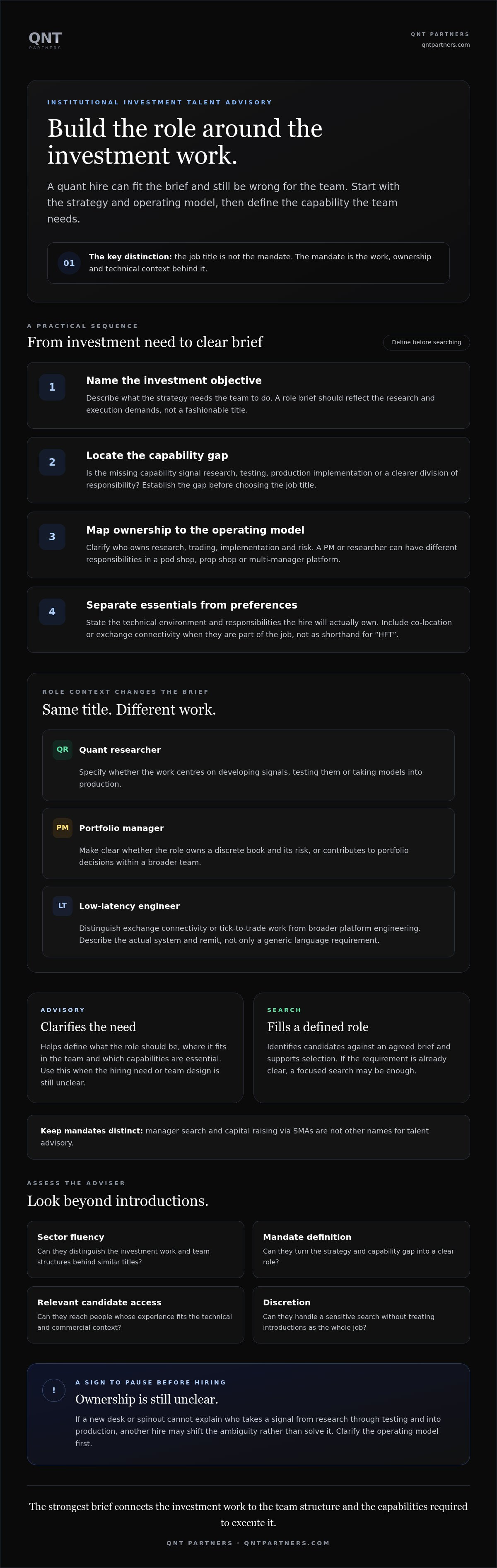
How to Define a Talent Advisory Mandate Before a Search
A search brief is useful only if it describes the capability the investment plan needs. Define the mandate in sequence: state the investment objective, identify the capability gap, define the role or roles, then agree what the advisory engagement covers.
- State the objective: describe the strategy or build-out the team needs to support.
- Identify the gap: specify the work that is not being covered effectively today.
- Define the role: set out outputs, decision rights, and the team interfaces involved.
- Agree the scope: establish whether the adviser is shaping the talent plan, running a search, or doing both.
Set the brief around evidence, not labels
Titles rarely tell candidates enough. Describe what the person will deliver and which decisions they will own. For a researcher, that might mean developing signals or taking models into production. For an engineer, specify the systems they will work on and the relevant constraints. Include FPGA experience as an essential criterion only if the role genuinely requires it.
Separate requirements into two groups: must-haves supported by the work, and preferences that can be tested during assessment. Requiring a particular language, platform, or prior firm experience without a clear reason can exclude people who could do the job. Record what evidence would satisfy each essential criterion so interviewers assess candidates consistently.
Agree boundaries and decision points
Compensation and incentives belong in the mandate because they affect the candidate proposition. Clarify how the firm approaches base pay, bonus, P&L splits, or an equity partnership where relevant, without treating any structure as universal. For candidates subject to garden leave or non-competes, note the issue early and seek advice specific to the applicable jurisdiction. Do not treat a recruiter’s general view as a legal conclusion.
Set out who owns technical assessment, who makes the final decision, and how sensitive information about a desk build-out or succession will be handled. Agree review points too. If market feedback shows that an essential requirement is too restrictive, revisit the evidence behind it before changing the brief.
A clear institutional investment talent advisory mandate gives everyone a shared reference point: the investment objective, the capability sought, the evidence required, and the boundaries of the work. If you are defining that scope for a quant or trading-technology team, discuss a talent strategy advisory mandate with QNT Partners.
When QNT Partners Fits an Institutional Investment Talent Brief
Specialist support is most useful when a hiring brief depends on understanding how a quant team operates. If the challenge involves quantitative research, systematic trading, or trading technology, the adviser should connect the role to the team’s actual investment and technical context.
Where QNT Partners’ specialist remit is relevant
QNT Partners is a boutique recruitment and advisory firm focused on quantitative trading, research, and technology, including AI and ML specialist search. Founded by former industry operators, the firm serves HFT firms and hedge funds. Its services include talent strategy advisory alongside recruitment. This remit can fit a firm that needs help defining a specialist talent requirement, as well as one whose requirement is ready for search.
QNT Partners does not provide direct capital investment. Capital raising via SMAs and talent advice are separate services with different objectives and scopes. A firm looking for capital rather than talent support should assess the relevant mandate on that basis. You can read more about QNT Partners’ background before deciding whether its focus matches your brief.
A practical next step for a prospective client
Before an initial discussion, prepare the investment objective, a clear outline of the current team structure, and the hiring question you need answered. The role does not need to be fully defined yet. Be ready to explain where ownership sits today and what capability the team needs to add or strengthen.
Use the conversation to establish whether the requirement calls for talent strategy advice, a search, or both. The brief can be discussed discreetly, without assuming that an external mandate is the right answer. If specialist input appears useful, contact QNT Partners to discuss your talent brief.
Make the Next Hiring Decision Deliberate
A useful talent mandate starts with the investment objective, then defines the capability gap and the work a hire will own. That sequence helps distinguish an essential technical requirement from a preference that could needlessly narrow the field.
Institutional investment talent advisory adds value when it clarifies team requirements or reaches specialist candidates your internal network may not. It is not required for every vacancy. The right scope might be advice, search, or both, depending on how clearly the role is defined and what your team can cover itself.
QNT Partners is a boutique firm founded by former industry operators, with a specialist focus across quantitative trading, research, and technology. If you are weighing support for a team build-out or a specific talent brief, bring the investment objective and hiring question to an initial discussion. Discuss your talent brief with QNT Partners.
A clear brief gives you a better basis for deciding what to do next, whether that means refining the role internally or engaging specialist support.
Frequently Asked Questions
What does institutional investment talent advisory include?
Institutional investment talent advisory connects hiring and team decisions to an investment strategy and the organisation needed to support it. It can help clarify capability gaps, role responsibilities, and whether a firm needs strategic advice, a search, or both. For a quant team, that may mean distinguishing a research requirement from a trading or engineering need before issuing a brief. It does not mean every vacancy requires a separate advisory mandate.
How is talent advisory different from executive search?
Executive search is a process for identifying and assessing candidates for a defined role. Talent advisory works further upstream, helping a firm decide what capability it needs and how a role should fit into the team. The two can be combined if that work identifies a specific hire. If the requirement is already clear and the internal team can assess it, a search alone may be the right scope.
When should an investment firm use a specialist talent adviser?
Consider specialist advice when a role depends on knowledge of quantitative trading, research, or trading technology that may be missing from a general hiring network. It can also help during a new desk build-out or spinout, especially if responsibilities between research, trading, and engineering are unclear. If your team has a well-defined brief and can reach suitable candidates itself, external advice may add little.
Can a talent adviser help design a quantitative trading team?
A talent adviser can help translate a team’s objectives into capability requirements and role boundaries. For example, they can help clarify whether a brief calls for signal research, execution expertise, or engineering support for an identified technical environment. That input can inform team design, but it should not substitute for the firm’s decisions about its investment model, technology architecture, or risk ownership. Those decisions remain with the people accountable for them.
How should an institutional investor assess a talent advisory firm?
Test whether the firm understands your strategy’s talent implications, can help define the mandate, and has relevant access to candidates. Ask for examples of similar role types or team challenges without requesting confidential client details. Check how it handles sensitive information and distinguishes verified candidate evidence from judgement. A credible adviser should be clear about what interviews can establish and where your team must make its own technical assessment.
What information should a firm prepare before an advisory discussion?
Bring a concise account of the investment objective, the current team structure, and the hiring or capability question you need to resolve. Identify which responsibilities are covered today and where the gap sits. Note essential technical requirements separately from preferences, then decide whether you are seeking talent strategy advice, search execution, or both. The role can still be under discussion; clarity about the problem is more useful than a polished title.
Does QNT Partners provide investment capital or only talent advisory?
QNT Partners does not provide direct capital investment, and talent advisory is not its only service. The firm’s work includes quant trading and research recruitment, technology and engineering recruitment, AI and ML specialist search, manager search and SMA sourcing, and capital raising via SMAs. These are distinct services with different purposes. If you are looking for investment capital itself, QNT Partners is not a direct source of that capital.