HFT Software Engineer Headhunters: The 2026 Guide to Elite Search

A resume that excels at a FAANG firm is often the exact profile that will fail a low-latency technical screening within minutes. You've likely experienced the mounting frustration of long time-to-fill cycles for critical C++ roles while the competition captures alpha through superior execution speed. It's a reality that generalist tech recruitment can't keep pace with a global high-frequency trading market projected to reach $27.49 billion by 2035. You know that finding a developer isn't the challenge; the difficulty lies in identifying an engineer who understands how hardware constraints directly influence trading P&L.
This guide provides a strategic framework for identifying and partnering with specialist hft software engineer headhunters who operate with the precision of an industry insider. We'll show you how to move beyond surface-level sourcing to access passive candidates within stealth firms and align your technical hires with specific alpha generation goals. By the end of this analysis, you'll have the intelligence needed to reduce your interview-to-hire ratio and bridge the market gaps that currently hinder your talent strategy. We'll examine the shift toward outcome-aware engineering and the tactical advantages of a research-driven search process.
Key Takeaways
- Understand why traditional "Big Tech" credentials often fail to satisfy the rigorous low-latency constraints inherent to high-frequency trading environments.
- Identify the critical technical shifts for 2026, specifically the rising demand for engineers who can bridge the gap between FPGA hardware and C++ software.
- Evaluate hft software engineer headhunters using a framework that prioritizes deep industry networks and peer-to-peer technical vetting over simple database volume.
- Refine your execution strategy by calibrating interview loops for cultural resilience and aligning compensation packages with current market trends in formulaic upside.
- Discover how an operator-led search methodology provides access to passive talent in stealth firms while supporting long-term alpha generation goals.
The Market Definition: Why Generalist Tech Search Fails in HFT
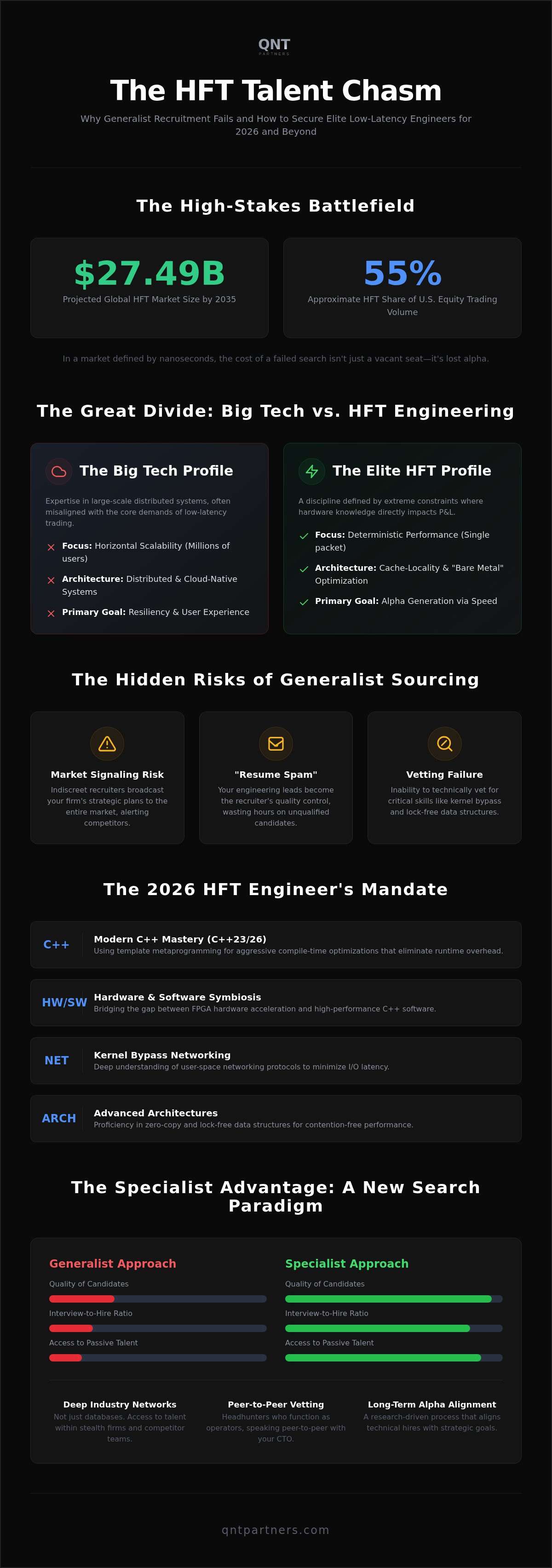
High-frequency trading is not merely a subset of backend engineering; it is a discipline defined by extreme constraints. In a market where High-frequency trading accounts for approximately 55% of the total trading volume in the U.S. equity market, the technical requirements are absolute. Generalist recruiters often treat these roles as standard C++ positions with elevated compensation. This fundamental misunderstanding leads to expensive failures. A failed search doesn't just result in a vacant seat. It leads to lost alpha, eroded team morale, and missed execution windows that competitors will quickly exploit.
By 2026, the complexity of the HFT tech stack has moved beyond simple execution. It now requires a search partner who understands the P&L impact of a single millisecond. Hiring the wrong lead engineer can delay a firm's transition to new hardware-accelerated strategies by months, a timeline that is unacceptable in a sector where the global market size is projected to reach $27.49 billion by 2035.
The Divergence of Big Tech and HFT Engineering
The "Big Tech" fallacy remains a primary cause of interview loop failures. A Senior Software Engineer from a major cloud provider is typically an expert in horizontal scalability and distributed systems. While impressive, these skills are secondary to the cache-locality mastery and deterministic performance required in HFT. In the trading world, we don't care how many millions of users you can support; we care how long it takes for a single packet to travel from the NIC to the CPU. Outcome-Aware Engineering is the alignment of code efficiency with proprietary trading outcomes. Identifying talent with this mindset requires an evaluator who can distinguish between general coding proficiency and the ability to optimize for the metal.
The Hidden Risks of Generalist Recruitment
Engaging non-specialist hft software engineer headhunters introduces significant market signaling risks. Indiscreet recruiters often broadcast your firm's expansion plans to the entire street, inadvertently alerting competitors to your strategic shifts. This lack of professional gravity is a hallmark of high-volume agencies that prioritize database volume over network depth. The resulting "Resume Spam" forces your internal engineering leads to act as the recruiter's quality control, wasting hours on candidates who lack the fundamental skills for the role.
Generalists rarely possess the technical depth to vet for critical HFT competencies such as:
- Kernel bypass and user-space networking protocols.
- Zero-copy architectures and lock-free data structures.
- The nuances of C++23 and its impact on latency profiles.
When hft software engineer headhunters can't speak peer-to-peer with your CTO, they become a bottleneck. Elite firms require a partner who functions as an operator, ensuring every candidate presented is technically viable and understands the high-stakes nature of the industry.
The 2026 HFT Tech Stack: What Your Headhunter Must Understand
The technological landscape of high-frequency trading in 2026 is no longer a simple race to the bottom of the latency curve. It has evolved into a multi-layered optimization problem where software, hardware, and artificial intelligence converge. For hft software engineer headhunters, staying relevant requires a deep understanding of how these components interact to produce alpha. A recruiter who cannot distinguish between a standard systems developer and an architect capable of building HFT infrastructure will inevitably fail to secure the talent necessary for modern market making.
Low-Latency C++ and the 2026 Standards
Mastery of C++23 and the emerging C++26 standards is now the baseline for elite engineering roles. We're looking for individuals who utilize template metaprogramming not just for abstraction, but for aggressive compile-time optimizations that eliminate runtime overhead. Proficiency in lock-free programming and memory-mapped I/O remains critical, yet the focus has shifted toward deterministic performance in increasingly complex environments. Vetting for these skills requires more than a keyword search; it demands a partner who understands how specific language features impact cache-line contention and instruction pipelining. If you're struggling to find this level of technical depth, it may be time to consult with an operator-led search firm that speaks the same language as your engineering leads.
Infrastructure as Alpha: FPGA and Network Engineering
The distinction between software and hardware has blurred. In 2026, the demand for FPGA and C++ hybrid profiles has reached a peak as firms seek to move more of their execution logic onto silicon. RTL design is no longer a niche hardware requirement but a core component of the trading loop. Simultaneously, network engineering has moved toward 800G standards and the implementation of Precision Time Protocol (PTP) to ensure nanosecond-level synchronization across global data centers like Equinix NY4 and LD4.
AI and machine learning research requirements are also reshaping infrastructure needs. Modern stacks must now support massive data throughput to feed AI-driven algorithms while maintaining the ultra-low latency required for execution. This shift requires engineers who specialize in high-performance computing (HPC) environments and can manage the complexities of microwave and laser-link connectivity. Specialized hft software engineer headhunters must be able to identify talent that can navigate this convergence, ensuring that your infrastructure remains a source of competitive advantage rather than a bottleneck.
Evaluating HFT Software Engineer Headhunters: A Comparison Framework
A recruiter's value isn't found in their ability to search public databases; it's found in their ability to bypass them. In the specialized world of low-latency engineering, the most desirable candidates are rarely active on job boards. They operate within a closed ecosystem of "stealth" firms and elite trading houses. Evaluating hft software engineer headhunters requires a shift from measuring database volume to assessing network depth and technical authority. If a headhunter cannot speak peer-to-peer with your CTO about the nuances of memory-mapped I/O or kernel bypass, they cannot effectively vet the talent you require.
The Three Tiers of Recruitment Firms
The recruitment landscape in 2026 is divided into three distinct categories, each offering a different level of signal-to-noise ratio. Understanding where a partner sits on this spectrum is vital for protecting your firm's market reputation.
- Tier 1: Boutique Operators. These firms offer deep specialization and high discretion. They are often led by former industry operators who understand the P&L impact of technical hires. They prioritize quality over quantity, maintaining high success rates through precise candidate calibration.
- Tier 2: Specialized Agencies. These firms provide broad coverage of the financial technology sector. While they have better reach than generalists, their technical depth can be variable. They are useful for mid-level roles but may struggle with elite, high-stakes infrastructure searches.
- Tier 3: Generalist Tech Firms. Characterized by high volume and low signal, these firms are the primary source of the "Resume Spam" problem. They lack the context to distinguish a standard C++ developer from a low-latency systems architect, often leading to high interview-to-hire ratios.
Key Metrics for Headhunter Performance
To move beyond subjective claims of "quality," firms should hold their hft software engineer headhunters accountable to specific performance metrics. The ultimate measure of candidate calibration is the Interview-to-Offer ratio. A Tier 1 partner should consistently deliver a ratio of 3:1 or better, ensuring your engineering leads aren't wasting time on sub-par screenings. Additionally, track the 24-month retention rate; in high-pressure environments, a placement's longevity is a direct reflection of the headhunter's ability to assess cultural resilience.
Finally, demand real-time market intelligence. A sophisticated search partner provides more than just resumes; they offer benchmarking on current compensation trends, the evolving landscape of non-compete structures, and the movement of talent between international markets. This data-driven approach ensures your firm remains competitive without overpaying. The true "Operator" advantage lies in this marriage of technical mastery and strategic market insight.
Execution Strategy: Calibrating the Search for 2026
Execution requires more than just sourcing; it requires a process that mirrors the speed of the markets. Elite hft software engineer headhunters recognize that a bloated interview loop is the fastest way to lose top-tier talent. In 2026, the competition for low-latency expertise is so fierce that your internal process must be as optimized as your trading code. A disjointed or slow-moving search process doesn't just lose you a candidate; it signals a lack of technical urgency that can damage your firm's reputation among the small circle of high-performing engineers.
The Technical Assessment Framework
Standard algorithmic tests often fail to identify the systems-level thinking required for HFT. Replace generic LeetCode problems with assessments that focus on hardware-software convergence and memory management under pressure. Pair programming sessions should simulate real-world problem-solving, such as debugging a race condition in a lock-free queue or optimizing a critical path for a specific NIC architecture. You should test for failure-mode intuition rather than just syntax. This approach ensures you're hiring engineers who can anticipate system bottlenecks before they impact the P&L, rather than those who simply have a theoretical grasp of the language.
Compensation calibration in 2026 demands a nuanced understanding of base, bonus, and formulaic upside. While base salaries for HFT engineers often fall between $120,000 and $173,000, the total package is frequently driven by direct alignment with trading performance. Geography also plays a role as talent pools shift toward emerging tech centers and specialized hubs beyond traditional financial capitals. Managing the offer stage requires a partner who can navigate these variables with discretion, ensuring that expectations are aligned long before the formal contract is drafted.
Negotiating Non-Competes and Buyouts
The most significant barrier to hiring passive talent is the prevalence of 12-24 month non-compete clauses. Navigating these requires a sophisticated strategy for deferred compensation buyouts and "garden leave" management. Experienced hft software engineer headhunters act as essential mediators during these negotiations, ensuring that both the firm's interests and the candidate's transition are handled with professional gravity. Closing an elite hire often depends on the headhunter's ability to structure a buyout that neutralizes the financial risk of a move while maintaining the candidate's momentum. This mediation is particularly critical when dealing with candidates from stealth firms where the legal stakes are high and the talent is fiercely protected.
To refine your firm's approach to these complex negotiations and secure the industry's most elusive talent, consider a talent strategy advisory that understands the intricacies of the 2026 HFT market.
The QNT Advantage: Beyond Traditional Executive Search
Standard recruitment models often fail when applied to the high-stakes world of low-latency infrastructure. At QNT Partners, we operate as strategic advisors rather than mere service providers. Our foundation as former industry operators allows us to approach the role of hft software engineer headhunters through the lens of execution and risk management. We don't just evaluate a candidate's mastery of C++; we assess their ability to contribute to the firm's alpha generation goals from day one. This peer-to-peer relationship ensures that we identify talent that possesses both technical mastery and a deep understanding of trading P&L.
Integrated Talent and Capital Advisory
Our unique position in the market stems from the synergy between our talent strategy and capital advisory services. We understand that a fund's success is directly dependent on the caliber of its engineering team. Our expertise in SMA sourcing informs our view of the talent market, allowing us to identify emerging trends in systematic trading before they become mainstream. We specialize in sourcing entire teams for systematic mandates, providing strategic consulting on organizational structures that foster high performance. This integrated approach ensures that your technical hires are perfectly aligned with your broader capital raising and trading objectives.
Global connectivity is central to our methodology. We maintain deep roots in international markets, providing access to elite engineering talent across the US, Europe, and Asian markets. This reach is essential for firms navigating the regulatory shifts of 2026, such as the implementation of AIFMD II in Europe. Our ability to move talent across borders with professional gravity makes us a trusted partner for global expansion. We don't just find candidates; we manage the movement of elite talent in a way that respects the reader's time and the firm's strategic goals.
Our Commitment to Discretion
In an industry where intellectual property is the primary asset, discretion is non-negotiable. Our search processes are designed to protect your firm's market positioning and proprietary strategies. We avoid the broad-market broadcast methods typical of high-volume firms, opting instead for a research-driven, quality-over-quantity approach. This quiet power allows us to build long-term partnerships with the world's most sophisticated trading desks. We act as a discerning filter, ensuring that only the most technically competent and culturally resilient candidates enter your interview loop.
Discover how QNT Partners secures elite HFT engineering talent.
Securing Technical Advantage in an Evolving Market
Success in 2026 depends on moving beyond database-driven recruitment toward a research-led, operator-centric model. You've seen how the convergence of FPGA acceleration and low-latency software standards has redefined the elite engineering profile. Engaging with specialized hft software engineer headhunters who possess deep technical immersion ensures your firm doesn't just fill seats, but acquires the architectural expertise necessary for sustained alpha. The right talent strategy transforms infrastructure from a cost center into a primary source of competitive advantage.
QNT Partners provides a discreet, global reach across all major trading hubs, specializing in the intersection of HFT, AI, and machine learning within finance. As an operator-led firm, we understand the high-stakes nature of your search and the precision required for success. We invite you to Partner with QNT Partners for Elite HFT Infrastructure Search and secure the engineers who will define your next decade of execution. Your technical evolution deserves a partner that speaks the same language as your highest-performing desks. We're ready to help you navigate this hyper-competitive landscape with the authority your firm demands.
Frequently Asked Questions
What is the average time-to-fill for a Senior Low-Latency C++ Engineer in 2026?
The average time-to-fill for senior low-latency roles typically ranges between three and six months. This duration reflects the scarcity of elite talent and the complexity of navigating 12-24 month non-compete clauses. Finding hft software engineer headhunters who maintain active relationships with passive candidates can compress this timeline. However, most firms prioritize precision over speed to avoid the significant P&L impact of an unqualified hire.
How do HFT headhunters vet for technical competence without a formal coding test?
Specialist recruiters conduct peer-to-peer technical interviews that focus on systems-level thinking and hardware awareness. They probe for experience in kernel bypass, lock-free data structures, and cache-locality mastery. By discussing specific failure modes in proprietary trading environments, an operator-led headhunter can verify a candidate's depth. This research-driven approach ensures that only engineers with genuine "outcome-aware" intuition reach your firm's final interview loop.
Why are HFT firms increasingly hiring from the semiconductor industry?
The demand for FPGA and C++ hybrid profiles has driven firms to source talent directly from semiconductor giants. Engineers from these environments understand silicon-level constraints and instruction pipelining better than traditional backend developers. As trading logic moves closer to the hardware, the ability to optimize for custom NICs and memory controllers becomes a primary source of alpha. This convergence makes semiconductor expertise a critical asset for modern infrastructure teams.
What are the current trends in HFT compensation for software engineers?
Current trends show a shift toward formulaic upside and aggressive buyouts of deferred compensation. While base salaries for senior engineers in the United States often fall between $120,000 and $173,000, total compensation is heavily weighted toward performance-linked bonuses. Firms are also increasingly offering structured sign-on packages to neutralize the financial impact of long garden leave periods. This ensures that elite talent remains financially whole during the transition between firms.
How do specialist headhunters handle candidates with long non-compete clauses?
Headhunters act as essential mediators to navigate the legal and financial complexities of 12-24 month non-competes. They facilitate the structuring of buyout packages that cover lost bonuses and deferred equity. By maintaining high levels of professional discretion, they protect the candidate's market position while ensuring the hiring firm can secure the talent. This mediation is vital for maintaining momentum during the long waiting periods typical of the industry.
What is the difference between a contingency recruiter and a retained search firm in HFT?
Contingency recruiters operate on a success-only basis, which often leads to high-volume resume spam and lower candidate calibration. Retained search firms, such as QNT Partners, work as strategic advisors on a dedicated basis. They provide deep market intelligence, research-driven sourcing, and thorough technical vetting. For elite infrastructure roles, the retained model offers the discretion and network depth required to access candidates in stealth firms who aren't on public databases.
Can a headhunter help in sourcing an entire systematic trading team?
Yes, specialized firms provide talent strategy advisory to facilitate systematic team builds from the ground up. This involves identifying a lead portfolio manager and simultaneously sourcing the necessary quant researchers and low-latency engineers. This integrated approach ensures that the entire unit is technically aligned and ready to execute on specific mandates. It requires a partner who understands both the human capital requirements and the underlying trading strategies.
How has AI/ML changed the requirements for HFT software engineering roles?
AI and machine learning have introduced a need for engineers who can bridge the gap between high-throughput data processing and ultra-low latency execution. Modern roles require proficiency in optimizing the data pipelines that feed AI-driven algorithms without introducing jitter. Engineers must now understand deep learning frameworks while maintaining mastery of deterministic C++ performance. This hybrid requirement has significantly narrowed the pool of viable candidates, making specialized hft software engineer headhunters even more critical.