FPGA Engineer Hiring Guide for Trading Firms

FPGA engineer recruitment for trading firms should start with the trading system’s needs, not a generic list of HDL keywords. The same FPGA title can describe very different responsibilities.
Hiring teams need to distinguish design work from integration and production ownership. The right scope depends on the system bottleneck, team interfaces and what the engineer will own.
This guide explains how to define the mandate and assess candidates against its actual demands. A precise brief helps avoid hiring for experience that won’t address the work your system needs done.
Key Takeaways
- Start the role brief with the system bottleneck, such as tick-to-trade latency or exchange connectivity, then define what the engineer will own.
- Set FPGA requirements around your architecture and deployment model. Treat HDL experience as a starting point, not proof of sound design judgement.
- Use consistent interview prompts tied to the work, so you can compare how candidates reason about design decisions and production responsibility.
- In FPGA engineer recruitment for trading firms, account for firm structure, location and build-out stage before approaching candidates.
- Give a specialist search partner a clear brief on system needs, candidate evidence and team context, while keeping technical assessment with your engineering team.
FPGA engineer recruitment for trading firms: define the brief
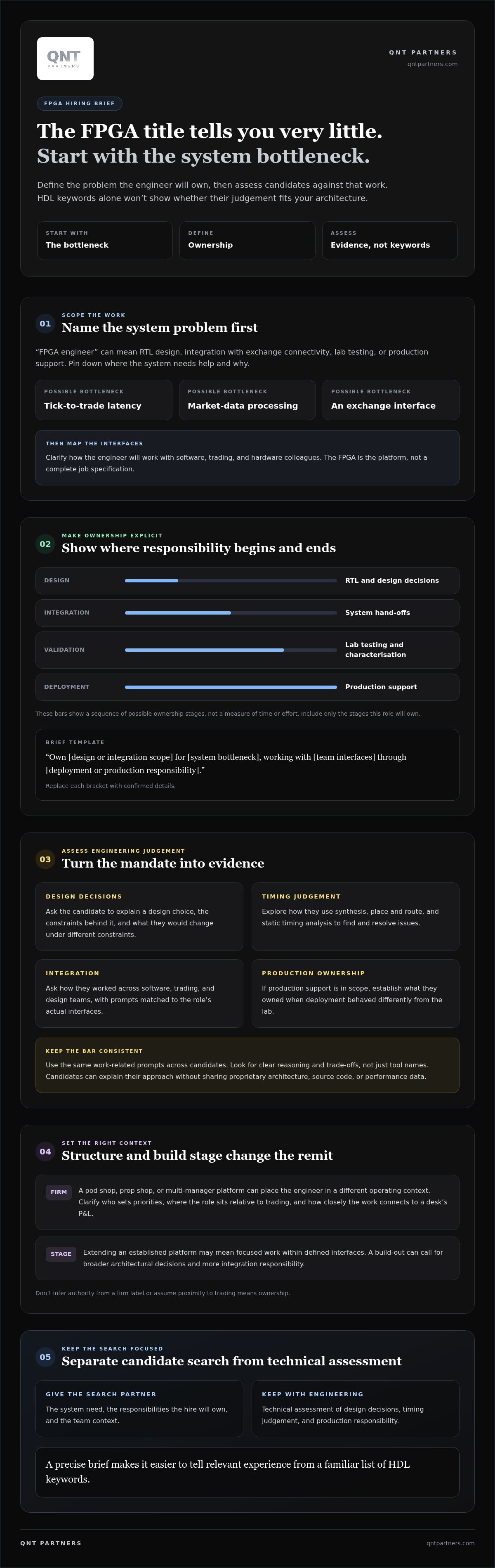
Before sourcing candidates, write down the system problem, the responsibilities the hire will own and the evidence your team will use to assess fit. For example: “Own RTL design for [system bottleneck], work with [team interfaces], and take the design through [integration, validation or production support].” Replace each bracket with confirmed details. This gives recruiters and interviewers a consistent definition of the role.
FPGA Engineer Recruitment Starts With the Trading System
The same FPGA title can describe very different jobs. At one firm, the engineer owns RTL for a latency-sensitive part of the trading path. At another, the work centres on integrating a design with exchange connectivity, running lab tests or supporting the system in production. Start with the system problem, not the title.
Scope the role around the bottleneck
Identify where FPGA work is needed and why. Is the priority tick-to-trade latency, market-data processing or a particular exchange interface? Then map the hand-offs. The engineer may work closely with software engineers on host-side interfaces, traders on operational requirements or hardware colleagues on board-level constraints. The Field-programmable gate array (FPGA) is the platform, not a complete job specification.
Be explicit about ownership. Will the hire make design decisions and take RTL through timing closure, or implement an architecture set by someone else? Will they own lab validation and deployment, or hand the design to a separate integration team? Define production support too: investigating live issues is different from focusing on planned design work.
Role remit: “The FPGA engineer will own [design or integration scope] for [system bottleneck], working with [team interfaces] through [deployment or production responsibility].”
Distinguish firm structures and build stages
A pod shop, prop shop and multi-manager platform can place the role in different operating contexts, but the labels don’t tell you how much authority the engineer will have. Clarify who sets priorities, where the engineer sits relative to trading and how closely the work connects to a desk’s P&L. Don’t assume that proximity means ownership or that a central team has less influence.
Ask whether the hire will extend an established platform or help build a new one. An existing system may call for focused work within defined interfaces; a build-out can require broader architectural decisions and more integration responsibility. These distinctions shape which experience is relevant and how you should approach candidates. For wider team context, see our HFT infrastructure recruitment insights.
Define the FPGA Skills the Trading Role Actually Requires
Once the mandate is clear, turn it into evidence you can assess. A list of Verilog, VHDL or SystemVerilog skills won’t show whether someone can make sound design trade-offs within your architecture. Ask how the candidate has applied those skills to a comparable system problem.
Assess design and timing judgement
Ask the candidate to describe a design decision, the constraints behind it and what they would change under different constraints. Explore how they use synthesis, place and route, and static timing analysis to find and resolve issues. Look for a clear account of trade-offs and how design choices affect the system, not just a list of tool names.
Keep the discussion focused on principles and outcomes. Candidates should be able to explain their reasoning without disclosing proprietary architecture, source code or performance data. The University of Waterloo’s hardware accelerated equity trading system project offers context for how FPGA work can address limitations in conventional computing architecture.
Test integration and production ownership
Probe how the candidate worked across software, trading and design teams. If the role includes lab work, ask how they approached debugging and characterisation. If production support is part of the remit, establish what they owned when a design behaved differently in deployment than it did in the lab.
For this vacancy, end-to-end ownership means taking [defined design scope] from implementation through integration, lab validation and production support, with named interfaces to software and trading. Remove stages the role doesn’t own, and include co-location or exchange connectivity only when they are actual responsibilities.
A concise skills matrix keeps the search focused:
- Essential: HDL and design experience relevant to the architecture; sound reasoning about timing constraints; and ownership of the stages the engineer will actually deliver.
- Trainable context: Firm-specific trading workflows, internal interfaces or deployment practices, provided the candidate has the underlying engineering judgement.
- Role-dependent: Exchange connectivity, co-location and production support, included only where they form part of the remit.
Use the matrix to distinguish a genuine gap from knowledge that can be acquired in the team. If a candidate’s strength is RTL design but the vacancy needs production ownership, make that distinction explicit before interview rather than treating adjacent experience as equivalent.
Evaluate FPGA Candidates With Evidence, Not Keyword Matching
A CV can list Verilog, timing closure and exchange connectivity without showing how well someone makes engineering decisions. Assess candidates in a consistent sequence: map their experience to the role, test their judgement against a relevant design problem, then discuss how they work with the team. This makes comparisons fairer than treating familiar tools or a well-known former employer as proof of fit.
Build a role-specific interview sequence
Start with the candidate’s account of a system they know: what constraint mattered, which trade-offs shaped the design and how they judged the result. Then use a design discussion drawn from the vacancy. If the role concerns market-data handling, explore design choices relevant to that path. Avoid unrelated puzzles that reward interview practice more than job-relevant thinking.
Before interviews begin, agree who will assess technical depth and who will assess collaboration. Keep prompts consistent across candidates, while allowing follow-ups that test their reasoning. The FPGA trading engine architecture paper provides technical context for design considerations that can inform a role-specific discussion, but the interview should centre on your system’s needs.
Useful prompts include:
- Which design constraint drove a significant decision, and what alternatives did you consider?
- How did you investigate a timing or implementation issue, and what evidence informed your next step?
- Where did integration with software or another engineering team change the design or its delivery?
- If production support is in scope, how did you diagnose an issue while separating design behaviour from surrounding system behaviour?
Look for clear reasoning, an honest account of trade-offs and an ability to explain technical consequences to colleagues outside the immediate FPGA team. This is not a sales-style communication test. It shows whether the person can make decisions clear to the people who depend on the design.
Protect confidentiality while testing experience
Set boundaries before asking about prior work. Invite generalised examples and make clear that source code, restricted architecture details, trading logic and confidential performance data aren’t required. Candidates should be able to explain the type of problem, their contribution and their reasoning without exposing a former employer’s information.
Use the same evaluation criteria for each interview: relevance to the vacancy, depth of engineering judgement, and evidence of the collaboration or production ownership the role requires. Keep those findings separate from employer prestige and compensation expectations. That discipline helps distinguish demonstrated capability from recognisable names on a CV.
Account for Firm Structure, Mobility, and Search Constraints
Firm type helps frame the search, but it doesn’t define the job. A pod shop may place an FPGA engineer near a particular team’s requirements, while a prop shop may have the role within a broader platform build. At a multi-manager, the engineer could support shared infrastructure or work closer to a specific investment team. These are possibilities, not templates. Confirm the reporting line, decision rights and interfaces before using firm structure to screen candidates.
Location matters for more than the office address. Establish where the engineering team sits, how it works with trading and software, and whether the build is extending a live platform or starting from a less mature base. If co-location or exchange connectivity is part of the role, say so clearly. A brief that leaves these details vague risks approaching people for a mandate they wouldn’t recognise once they meet the team.
Match candidate motivation to the mandate
Describe the project plainly: what the engineer will own, which decisions sit with them and who they’ll work with day to day. Some candidates favour platform-level design; others want direct collaboration with traders or responsibility for production behaviour. Clarify which of these the role offers rather than suggesting it may include all of them.
Be equally precise about commercial and organisational terms. Don’t imply P&L access, equity participation or autonomy unless those are confirmed for this specific position. The quant trading recruitment guide can provide wider context for hiring across trading teams.
Handle transitions with discretion
Ask candidates directly about timing and any garden leave or non-compete restrictions that may affect a move. Terms vary by individual, so don’t assume a standard duration or predict an outcome. Keep the discussion factual and avoid asking for confidential documents or details about a current employer’s systems. Where a candidate needs advice on contractual obligations, they should seek appropriate professional guidance.
Confidentiality applies to the search as well. Agree what can be shared, and when, before disclosing client or candidate identities. Candidates who want to understand how representation works can read QNT Partners’ candidate representation information.
These constraints affect who can move, when they can move and whether the opportunity fits their priorities. Confirming them early keeps the search focused on candidates who can realistically engage with the role and its build stage.
Run a Focused FPGA Search With QNT Partners
A focused search starts with a brief the hiring team can stand behind. Define the system need, such as a particular latency bottleneck or exchange interface, then specify what the engineer must own and what evidence will show they can do it. Add the team context, location requirements and any timing or confidentiality constraints. Without those details, candidate conversations can drift towards generic FPGA experience rather than the work this role requires.
QNT Partners is a specialist recruitment firm focused on quantitative trading, research and technology. We support targeted search and candidate engagement. Your engineering team remains responsible for technical assessment. For broader context on adjacent infrastructure roles, see our HFT infrastructure recruitment overview.
What to prepare before a search discussion
Bring a concise description of the system problem and the role’s ownership boundaries. Be ready to explain whether the position supports an established platform or a new build, where the engineer will work, and which people will take part in interviews. Separate confirmed details from points that still need internal agreement, especially around production responsibility and interfaces with trading or software teams.
That distinction matters. Candidates should hear what the role actually offers, not a best-case version still awaiting approval. Clear facts also help us represent the mandate accurately and focus the search on relevant experience.
Agree the search brief and next action
Before candidate outreach, agree how we’ll describe the role, what information can be shared at each stage, and how you’ll assess evidence against the brief. Set a practical feedback process so the team can respond consistently as candidates progress. We can shape the search around your requirements, while your engineers remain responsible for evaluating technical depth.
QNT Partners works with high-frequency trading firms and hedge funds, with technology searches that include engineers for low-latency trading systems and financial platforms. The QNT Partners contact page provides a way to discuss a defined FPGA mandate. A clear system need, ownership scope and set of hiring constraints gives us a sound basis to begin candidate conversations.
Set the Search Up for the System You’re Building
A strong FPGA hire is defined by the work the trading system needs, not by a list of HDL keywords. Start with the bottleneck and make ownership clear, from design decisions through the integration or production responsibilities the role actually carries. Then assess candidates against consistent evidence of engineering judgement, rather than relying on employer names or broad claims of experience.
Firm structure, build stage, location and individual mobility constraints also shape who is a realistic fit. Being precise about these factors helps keep the brief credible and candidate conversations discreet. That’s the basis of an effective search.
QNT Partners specialises in quantitative trading, research and technology recruitment. We’re a boutique firm founded by former industry operators, and we approach technology searches in the context of the system and team that need the hire. We support targeted search and candidate engagement; your engineers remain responsible for technical evaluation.
If you have a defined FPGA mandate, discuss your FPGA hiring brief with QNT Partners. A clear brief gives your team a practical starting point for a focused search.
Frequently Asked Questions
What does an FPGA engineer do at a trading firm?
An FPGA engineer at a trading firm implements or supports hardware-accelerated components of its trading system. Depending on the mandate, that can include RTL design for a defined system bottleneck, integration with software and exchange connectivity, or lab validation and production support. The job brief should specify which stages the engineer owns and how the work connects to trading. A title alone won’t show whether the role is design-led or operational.
Which FPGA skills should a trading firm look for?
Prioritise skills that match the firm’s architecture and the work the hire will own. Relevant evidence may include HDL design, reasoning about timing constraints and experience with the implementation flow used by the team. If the role involves system integration, assess experience working across hardware and software interfaces. Include co-location or exchange connectivity only when they are part of the actual remit, not as generic keywords on the specification.
How should trading firms assess FPGA engineer candidates?
Use a consistent interview sequence tied to the vacancy. Ask candidates to explain a relevant design decision, the constraints involved and how they approached implementation or debugging. Then discuss a system problem similar to the role, rather than using an unrelated puzzle. Assess technical depth separately from collaboration. Candidates should be able to describe their contribution and reasoning without disclosing source code, restricted architecture or confidential trading details.
Is trading experience essential for an FPGA engineer?
No. Trading experience can help a candidate understand the environment, but it isn’t a substitute for relevant engineering ability or a universal requirement. Skills such as deterministic RTL design, timing analysis and low-latency networking can transfer from other technical fields. Focus on whether the candidate can apply their experience to the firm’s system constraints and work effectively with its trading and engineering teams. Trading context can be learned where the role and team support it.
How do FPGA roles differ between prop shops and multi-manager firms?
The firm label alone doesn’t determine the role. A prop shop may hire into a new platform build or an established infrastructure team; a multi-manager firm may have shared technology or a role closer to a particular team. Scope, decision authority and proximity to trading vary by organisation. Confirm the reporting line, system stage, interfaces and production responsibilities directly, rather than assuming every firm of a given type works the same way.
Can a specialist recruiter assess FPGA engineering ability?
A specialist recruiter can clarify the mandate, identify relevant experience and support targeted candidate engagement, but shouldn’t replace the firm’s technical assessment. QNT Partners specialises in quantitative trading, research and technology recruitment. We can help align a search with the system need and team context; your engineers should assess design judgement, implementation depth and production capability through role-specific interviews.