Executive Search for Systematic Funds: Start With the Mandate

The title on the brief can be right while the mandate is wrong. Executive search for systematic funds should start with the investment model, not a generic “Head of Quant” profile. A PM in a pod shop may own a book within tight platform limits, while a partner at a prop shop may have broader control over research, execution and capital allocation.
Senior candidates can look similar on paper and operate very differently. The useful distinction is what they have owned, how their decisions connect to P&L, and where risk authority sits. Get that wrong and even a polished shortlist can miss the role.
I start by turning the fund’s strategy and operating model into a precise leadership mandate, then assess candidates against the work they will actually own. That means defining decision rights before mapping the market, and planning discreet outreach from the beginning. At QNT Partners, we bring an operator’s perspective to specialist searches across quantitative trading, research and technology.
Key Takeaways
- Define the mandate through the strategy, responsibilities, decision rights and outcomes the hire will own, not the role title alone.
- Match the fund’s structure, whether pod shop, prop shop or multi-manager, to the experience that will transfer to the role.
- In executive search for systematic funds, assess demonstrated ownership and mandate fit, not keywords in a biography.
- Build confidentiality into market mapping and outreach, and treat garden leave or non-competes as individual transition considerations.
- Use a focused sequence: define the mandate, calibrate the profile, map relevant talent, approach candidates discreetly and assess fit.
Define the Systematic Fund Executive Mandate Before the Search
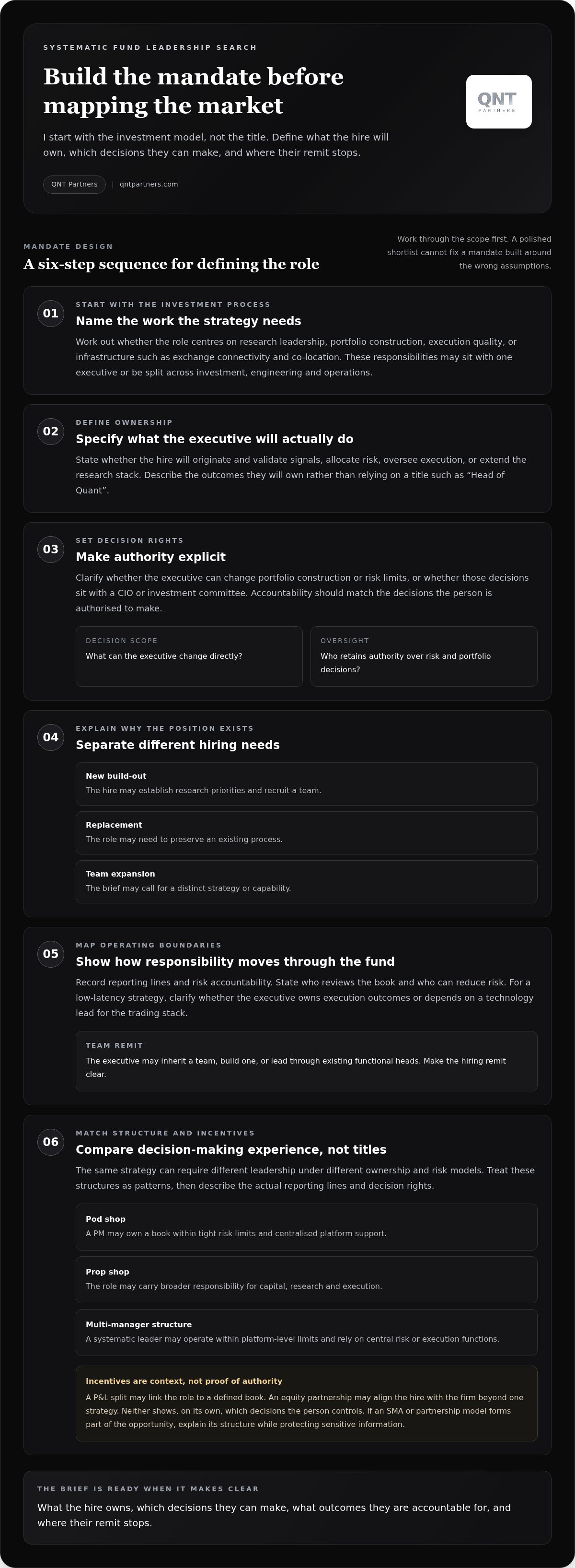
Role titles alone don’t define an effective systematic-fund search. A “Head of Quant” might own a portfolio, lead research without trading authority, or build the research and execution platform that supports other PMs. In executive search for systematic funds, define the mandate by the strategy, responsibilities, decision rights and outcomes the hire will own.
Start with the investment process. A systematic strategy may depend on research leadership, portfolio construction, execution quality or infrastructure such as exchange connectivity and co-location. Those responsibilities might sit with one executive or be divided across investment, engineering and operations leaders. Systematic Trading offers useful background on the approach, but the mandate needs to describe how that approach works inside your fund.
Translate strategy into role scope
Write down what the strategy requires from the hire. Will they originate and validate signals, allocate risk, oversee execution, or extend the research stack? Then specify which decisions sit with the executive. Can they change portfolio construction or risk limits, or do those decisions remain with a CIO or investment committee?
Be clear about why the position exists. A new build-out may call for someone to establish research priorities and recruit a team. A replacement may need to preserve an existing process, while a team expansion could require a leader who adds a distinct strategy or capability. Those are different searches, even when the title is identical.
Set the executive’s operating boundaries
Map reporting lines and risk accountability before approaching candidates. State who reviews the book, who can reduce risk, and how the executive works with researchers, traders and engineers. For a low-latency strategy, clarify whether the role owns execution outcomes or depends on a separate technology lead responsible for the trading stack.
Define the hiring remit as well. The executive may inherit a team, build one, or lead through existing functional heads. Don’t assume a title carries the same authority across funds. A credible mandate tells candidates what they can decide, what they will be accountable for, and where their remit stops.
Match the Search to the Fund’s Structure and Strategy
The same investment strategy can call for different leaders under different ownership and risk models. A candidate who has run a book inside a pod shop may understand tight risk limits and centralised platform support. That experience doesn’t automatically translate to a prop shop, where the role may carry broader responsibility for capital, research and execution. Executive search for systematic funds should match the candidate’s actual decision-making experience to the fund’s operating model.
Titles are weak evidence on their own. A PM might own a strategy and its P&L, contribute research within another PM’s process, or focus on execution without owning investment decisions. Make those distinctions explicit in the mandate, including whether the hire is expected to originate strategy, improve an existing process, or lead its implementation.
Identify the decision-making model
Map where portfolio construction, research priorities and risk decisions sit. In a multi-manager structure, a systematic leader may work within platform-level limits and rely on central risk or execution functions. At a prop shop, the role could span more of the investment lifecycle. These are patterns, not rules. Describe the actual reporting lines and decision rights without exposing sensitive strategy details.
Clarify how the executive will work with traders, researchers and engineers. A leader accountable for portfolio outcomes needs a different track record from someone whose remit centres on research quality or exchange connectivity.
Account for incentives and partnership structures
Incentives affect what a senior candidate is being asked to own. A P&L split may connect the role to the performance of a defined book, while an equity partnership can align the hire with the firm beyond a single strategy. Neither structure proves the person has the authority to make the decisions in the mandate. Explain how the arrangement works alongside risk limits, capital allocation and the executive’s expected contribution.
Keep compensation discussions confidential and tied to the specific mandate. Generic market ranges can imply equivalence between a pod allocation, a prop arrangement and partnership economics when the structures are different. If an SMA or partnership model forms part of the opportunity, explain the structure clearly while protecting sensitive information. See our guide to SMA and partnership structures for related considerations.
Evaluate Executive Search Against the Mandate, Not the Shortlist
A long shortlist can look productive while telling you little about search quality. The test is whether the search identifies people whose decisions and track records match the mandate, not whether their biographies contain the right titles or terms.
General finance recruitment may recognise seniority and broad investment experience, but a systematic-fund mandate needs finer distinctions. A specialist search should understand how research, portfolio construction and execution fit together, and reach candidates with experience in relevant operating models. In executive search for systematic funds, mandate fluency matters before outreach begins. Without it, adjacent experience can be mistaken for direct ownership.
Test investment and technical understanding
Candidate discussions should establish what the person actually owned. Did they set research direction, allocate risk or make portfolio decisions, or did they contribute models within another leader’s framework? Ask for specific examples of how their remit connected to investment outcomes. Technical vocabulary alone is not evidence of investment authority.
For a low-latency mandate, probe the relevant layer. Experience with co-location, exchange connectivity or FPGA-based systems may matter if the executive must lead those functions. But a candidate who has managed tick-to-trade performance is not automatically suited to own a systematic portfolio. Separate engineering depth from responsibility for strategy and risk.
Compare search process and candidate evidence
Before outreach, calibrate the brief with the people who understand the role’s investment and operating constraints. Resolve which experience is essential, which is adjacent and what would rule a candidate out. This gives the search a clear basis for discreet, consistent conversations with prospective executives.
For each person presented, expect concise evidence against the mandate: the scope they held, the decisions they made and the outcomes they were accountable for. A biography that matches keywords is not enough. Neither is a large slate. A focused shortlist with clear evidence is more useful than a broad set of plausible names.
Discretion is part of search quality, not a final-stage courtesy. Keep the fund and candidates anonymised in early discussions, and share identifying details only when appropriate. We focus on quantitative trading, research and technology, assessing fit against the work itself while protecting the confidentiality of the process.
Handle Discretion, Incentives, and Transition Risks Carefully
A senior search can expose sensitive information before a candidate is even identified. Agree what can be shared at each stage. Treat confidentiality as a practical requirement for both the fund and the executive, not a line in the process document.
Keep outreach precise and discreet
Start with an anonymised description of the fund, strategy and remit. Share enough for a candidate to judge relevance, but hold back identifying details until there’s a clear reason to disclose them and the parties are comfortable proceeding. Avoid details about capital, performance or internal structure that could point directly to the firm.
Set expectations for how candidate interest will be recorded and communicated. A current employer shouldn’t learn about an exploratory conversation through loose outreach, and a fund shouldn’t receive identifying candidate details beyond what’s needed to assess fit. Keep timing and interest confidential throughout.
Plan for a credible transition
Raise transition constraints early. Garden leave, notice arrangements and non-competes vary by contract and situation, so don’t assume a standard timeline or treat any restriction as universal. Establish a candidate’s likely availability while treating legal obligations as a separate matter for the relevant parties to assess.
Separate commercial expectations from those obligations. A candidate may be interested in the mandate but unable to move on the fund’s preferred timetable. That affects planning, not necessarily suitability. Discuss timing directly before the process reaches offer stage, and avoid promising a start date until the candidate’s circumstances are understood.
Discuss incentives when they form part of the role. If a P&L split or equity partnership is relevant, explain how it connects to the executive’s remit and the fund’s structure. Don’t use a generic compensation benchmark to imply that different arrangements are equivalent. Keep the discussion specific and confidential.
At QNT Partners, we conduct specialist searches for quantitative trading, research and technology roles. For a discreet discussion about a systematic-fund mandate, discuss a confidential search.
Run a Systematic-Fund Executive Search With QNT Partners
A focused search follows the mandate, not a standard template. At QNT Partners, we work with hedge funds and high-frequency trading firms on specialist searches across quantitative trading, research and technology. Our operator background informs how we assess a candidate’s experience, but the fund’s requirements determine the profile.
Start with a focused mandate discussion
We begin by defining the strategy, the fund’s structure and the responsibilities the executive will own. We clarify reporting lines and decision rights, then agree what evidence would demonstrate fit. A role accountable for portfolio decisions needs different evidence from one centred on research leadership or engineering capability.
Keep the discussion specific. A strong mandate makes it easier to distinguish essential experience from adjacent skills before outreach starts.
Move from calibration to confidential outreach
From there, we calibrate the candidate profile against the mandate, map relevant talent and conduct discreet outreach. Candidate assessment focuses on ownership: the decisions a person made, the remit they held and how their experience relates to the fund’s operating model. We then present a focused shortlist with clear reasons for fit, rather than relying on title or biography keywords.
The sequence is straightforward:
- Define the strategy, role scope and decision rights.
- Calibrate the profile against the fund’s requirements.
- Map relevant talent across quantitative investment and technology roles.
- Approach candidates discreetly and assess their actual ownership.
- Present evidence of fit against the mandate.
That is the practical discipline behind executive search for systematic funds. We’re a boutique firm founded by former industry operators, focused on specialist mandates rather than general finance recruitment. Each search is shaped around the fund’s structure and the executive’s intended contribution. The priority is a credible process and relevant candidate evidence.
If you’re defining a senior hire or planning a confidential search, I invite you to discuss the mandate with us directly.
Put the Mandate to Work
A strong search starts with a precise account of what the executive will own. Define the strategy and decision rights first, then match the profile to the fund’s operating model rather than relying on title similarity. Assess evidence of genuine investment or technical ownership, and keep outreach and transition discussions discreet.
That discipline is central to executive search for systematic funds. It helps separate a PM who has owned a book from a researcher who has contributed to one, or an engineering leader from an executive accountable for investment outcomes. The distinction makes the shortlist more relevant and gives candidates a clearer picture of the role.
QNT Partners is a boutique firm founded by former industry operators, with specialist recruitment across quantitative trading, research and technology. We ground search discussions in the work the hire will actually do, and assess candidates against the mandate.
If you’re defining a senior mandate or preparing a confidential search, discuss a systematic-fund executive search with us. A clear brief is a practical starting point for finding the right leadership fit.
Frequently Asked Questions
What does an executive search for a systematic fund involve?
An executive search for a systematic fund defines the role around the investment strategy and operating model, then identifies and assesses candidates against that mandate. The process clarifies what the hire will own, which decisions sit elsewhere, and how success will be assessed. Depending on the role, it may include market mapping, confidential candidate outreach and structured discussions about investment, research or technical responsibilities.
How is executive search different from general finance recruitment?
Executive search for systematic funds requires a clear grasp of how quantitative research, portfolio decisions and execution fit together. General finance recruitment may focus on seniority and broad experience, while a specialist search distinguishes someone who owns a strategy from someone who contributes research or builds trading infrastructure. That distinction matters when assessing a candidate’s authority, risk accountability and fit with the fund’s structure.
Which roles can an executive search firm recruit for systematic funds?
A specialist firm may recruit senior quantitative researchers, systematic traders, portfolio managers and leaders across technology and engineering. The relevant profile depends on the mandate: a fund may need an investment leader to own a book, a research head to guide model development, or an engineering executive responsible for low-latency infrastructure. QNT Partners focuses on quantitative trading, research and technology, alongside manager search and SMA sourcing.
How should a systematic fund assess executive candidates?
Assess candidates against decisions they have actually owned, not title or biography keywords. Establish whether they set research direction, made portfolio decisions, managed risk or led execution and infrastructure. For a technical remit, probe relevant experience such as exchange connectivity or FPGA systems. Technical fluency alone does not demonstrate investment leadership, so connect each candidate’s evidence to the responsibilities and outcomes defined in the mandate.
How can a fund keep an executive search confidential?
Agree what can be shared at each stage, starting with an anonymised description of the fund, strategy and role. Disclose identifying details only when appropriate, and restrict candidate interest and transition timing to those involved in the process. Confidentiality also depends on precise outreach: share enough for a candidate to judge relevance without exposing sensitive information about the fund or their current employer.
When should a systematic fund use a specialist search firm?
Use a specialist firm when the role depends on experience that’s difficult to assess through titles alone, or when discreet access to a focused candidate market matters. This can be especially relevant for senior hires spanning investment, quantitative research or trading technology. QNT Partners is a boutique firm founded by former industry operators, with specialist recruitment across these areas, making its sector focus relevant to mandate-led searches.