Equity Quant Research Talent Search: Hiring for Research Judgement

A strong CV can still point to the wrong researcher. An Equity quant research talent search should start with the decisions the person will own, not a broad title or a recognisable firm name. “Equity quant researcher” can describe very different work, from cross-sectional signal research to portfolio construction or research embedded with a trading team.
Credentials and prior employers matter, but they don’t show whether someone has worked with the data, investment horizon or research process your desk uses. A better test is how they form a hypothesis, check it against evidence and decide whether a result merits further work, without disclosing proprietary material.
I’ll set out how to define the mandate, assess candidates consistently and reach relevant people discreetly across the global quant market. At QNT Partners, we specialise in quantitative research and trading recruitment, grounding the search in the work the hire needs to do. That distinction can determine whether a candidate contributes to your research process or simply matches the job title.
Key Takeaways
- Define the role by the research decisions and responsibilities the hire will own, rather than relying on a broad job title.
- Assess how candidates move from a research question to evidence and a decision, without asking them to disclose proprietary work.
- Compare candidates’ research remit, data context, collaboration and implementation exposure instead of treating firm names as proxies for fit.
- Run an Equity quant research talent search by calibrating the brief, mapping relevant talent and keeping outreach discreet and consistent.
- A specialist search grounded in quantitative research and trading can connect the mandate with relevant talent across the global market.
Define the Equity Quant Research Mandate Before Opening the Search
The same title can describe materially different work. One equity quant researcher might develop cross-sectional signals; another might own portfolio construction research or support a systematic team working to a different investment horizon. Start an Equity quant research talent search with the desk’s decisions, not a list of credentials or familiar employer names.
An equity quant research mandate defines the investment decisions a researcher is expected to inform, the evidence they must produce and where responsibility passes to portfolio management, trading or engineering. A researcher may partner closely with a PM without owning portfolio risk, or work alongside traders without responsibility for execution algorithms. Set those boundaries before screening begins.
Translate the desk’s needs into a research remit
Describe the investment process at the level needed to identify relevant experience. Does the research rank stocks, estimate risk, test portfolio construction choices or examine how signals behave across market conditions? Explain how findings enter portfolio decisions, including whether the researcher recommends changes or provides analysis for a PM to assess.
Set out the conditions behind the research. Specify the data types, modelling work and how results are reviewed or implemented. A role built around noisy alternative data and feature validation calls for different evidence from one focused on financial statement data and factor design. Clarify the collaboration boundary too: who owns production code, and who maintains the research pipeline?
Identify why the seat exists. A new build-out may need someone to establish research standards across an emerging team. A replacement may call for continuity in a defined remit, while an expansion may add capacity or a missing specialism. These are different mandates, even when the external title is identical.
Write a brief that protects sensitive strategy detail
A search brief should explain the research problem without revealing proprietary signals, live positions or specific portfolio exposures. Use an anonymised description, such as “a systematic equity team at a multi-manager platform”, and describe the mandate through its inputs, workflow and decision scope. Candidates need enough detail to judge relevance, not enough to reconstruct the strategy.
For example, state that the researcher will test whether candidate signals add information to an existing equity process without naming the signals or disclosing current holdings. Keep the same level of detail across initial conversations so candidates can be compared fairly. The wider field of quantitative finance spans research and implementation, so make clear which part this desk is hiring for.
For broader hiring context, the quant trading recruitment guide discusses how specialist search relates to the wider trading organisation. For this seat, state the research decisions, the evidence expected and the hand-offs to adjacent teams. That gives candidates a precise account of the work without exposing the strategy.
Assess Equity Quant Researchers by Their Research Process
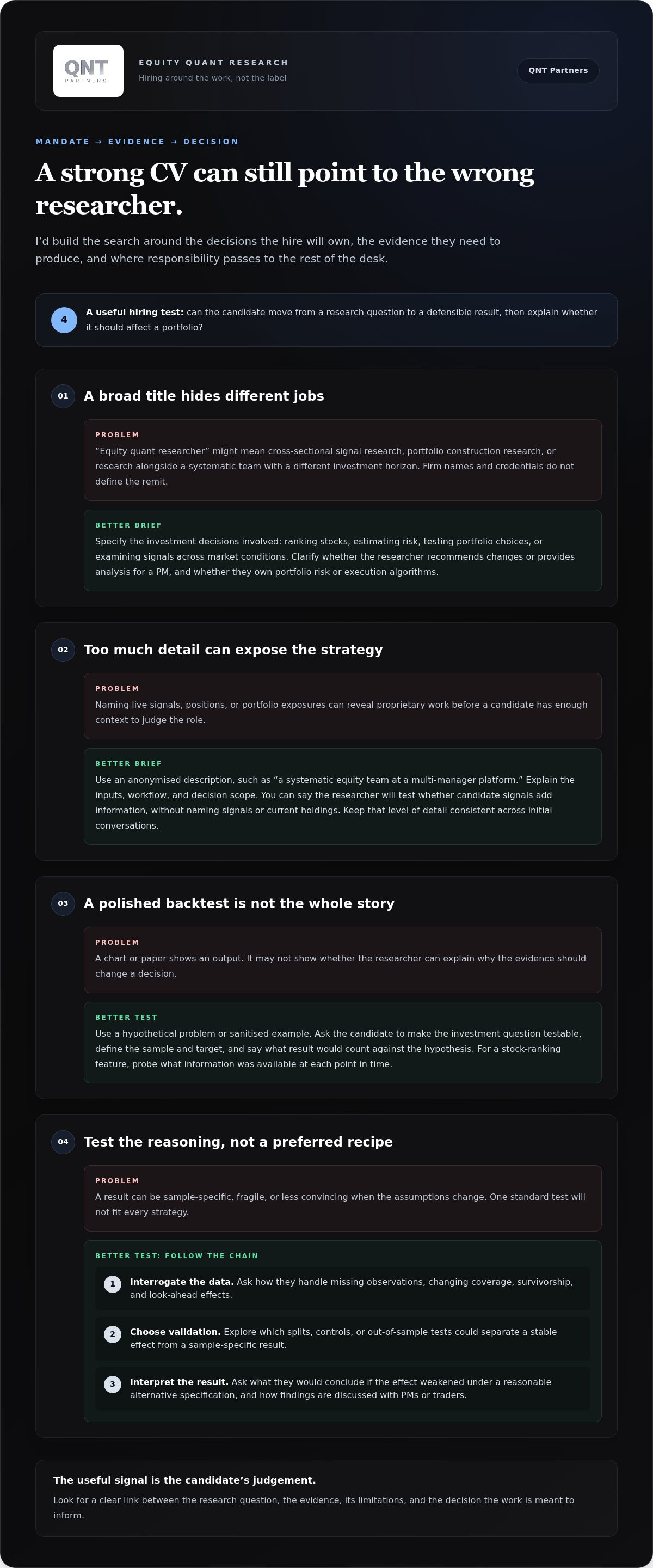
A polished backtest is easy to present. The choices behind it are harder to assess. I’d focus the interview on how a researcher moves from an investment question to a defensible result, then decides whether it should affect a portfolio. In an Equity quant research talent search, this gives the desk a consistent basis for comparing candidates whose past work may look very different.
Research output shows what a candidate produced; research judgement shows whether they can explain why the evidence should change a decision.
Test how candidates frame and validate a hypothesis
Use a hypothetical problem or sanitised example, not a request to reproduce confidential work. Ask the candidate to make the investment question testable, then explain how they would define the sample, target and comparison. For instance, a proposed stock-ranking feature needs a clear account of what information was available at each point in time and what result would count against the hypothesis.
Follow the reasoning in order:
- Frame the question. What decision might the research inform, and what observable outcome would provide evidence?
- Interrogate the data. How would they handle missing observations, changing coverage or possible survivorship and look-ahead effects?
- Choose validation. Which splits, controls or out-of-sample tests would help separate a stable effect from a sample-specific result?
- Interpret the result. What would they conclude if the effect weakened under a reasonable alternative specification?
The aim isn’t to prescribe one test for every strategy. It’s to see whether the candidate can explain why a method fits the question, identify where the evidence is fragile and revise a view when results conflict. The overview of quantitative techniques in equity research provides context for the methods involved; an interview should probe how the candidate applies them.
Understand the path from research to portfolio use
Research rarely ends at a chart or paper. Ask how the candidate has presented findings to PMs, traders or other researchers, and what changed after scrutiny. A strong answer separates statistical evidence from the judgement needed to decide whether a signal belongs in a portfolio, merits more testing or should be rejected.
Include implementation in the discussion without assuming the researcher owns production systems. Depending on the desk, the practical constraint may be turnover, capacity, costs, data availability or a hand-off to engineering. Ask how the candidate would communicate that constraint and what further evidence they’d want before recommending deployment. This tests decision relevance without turning the interview into a coding test for a role that doesn’t require production ownership.
Keep the assessment anchored to the role’s actual interfaces. If the researcher works directly with a PM, assess how clearly they frame trade-offs. If research passes through a separate implementation team, assess whether their findings and assumptions can be handed over cleanly. That distinction makes the assessment fairer and keeps confidential strategy details out of candidate discussions.
Compare Candidate Profiles Against the Desk, Not Firm Labels
A familiar employer type is a clue, not a fit test. A researcher from a pod shop may have worked close to a PM and portfolio constraints, while someone from a prop shop may bring a different research cadence or ownership model. Neither background guarantees the right experience for your desk. In an Equity quant research talent search, compare what candidates actually researched and how their work connected to investment decisions.
Use the same dimensions for each profile, then record the evidence behind your view. This keeps evaluation tied to the mandate rather than drifting into a prestige hierarchy.
| Dimension | Evidence to examine | Fit question |
|---|---|---|
| Research remit | Questions tackled, contribution to the work, and ownership from hypothesis through recommendation | Does that experience map to the decisions this seat will inform? |
| Data context | Data types, coverage, history and known limitations in the candidate’s prior work | Are the data conditions meaningfully comparable to this desk’s inputs? |
| Collaboration | How research interacted with PMs, traders or other researchers | Does the candidate understand the hand-offs in this team’s process? |
| Implementation exposure | Whether the candidate built, specified or supported deployment, and where responsibility sat | Does this match the role’s expected involvement after research? |
Distinguish research specialisms without overgeneralising
Compare the questions candidates have worked on, not just the labels attached to their strategies. Equity experience can mean cross-sectional ranking, risk modelling, portfolio construction or work on a narrower universe. Those skills may transfer, but the transfer needs evidence. Ask what the candidate personally contributed, what others owned and which parts of the work they can explain in detail.
Be explicit about the balance the role requires. A specialist seat may call for depth in a particular research problem; a build-out may need someone who can move across adjacent questions. Don’t reward breadth by default or mistake a narrow remit for shallow work. Score candidates against the stated requirement, noting where experience is adjacent rather than directly comparable.
Calibrate for the team’s operating model
The same research profile can land differently in a pod shop, a prop shop or a team operating through an SMA. Map where research meets portfolio construction and trading decisions, then assess whether the candidate has worked effectively at that interface. A team refining an established process may value a different contribution from one building its research function.
Keep the framework open enough to recognise relevant experience from less familiar firms, but specific enough to guide the interview. Write down the evidence that would support a strong fit before reviewing CVs. Compare each person against those criteria, not against the last impressive profile the team met.
Run a Discreet Search Without Losing Technical Precision
Confidentiality works only if the search stays specific. A vague brief may protect strategy details, but it also makes it harder to identify researchers whose experience matches the desk. In an Equity quant research talent search, keep the mandate precise internally, then control how much detail is shared at each stage of outreach.
Calibrate the search before approaching candidates
Before mapping the market, align the hiring team on what the role must deliver and what can remain flexible. Separate essential evidence, such as experience with the relevant research problem, from preferences that shouldn’t screen out adjacent but credible backgrounds. Agree who owns each interview stage and what evidence each interviewer is expected to assess.
Then build a search sequence that preserves discretion and consistency:
- Calibrate the brief. Confirm the research remit, reporting relationships and boundaries with trading, portfolio management and engineering.
- Map relevant talent. Search by research contribution and operating context, not only by job title or employer category. Include adjacent experience where the underlying work may transfer.
- Approach discreetly. Start with an anonymised description of the desk and a clear account of the role. Share more about the firm and mandate only when appropriate.
- Assess against agreed criteria. Use the same core dimensions across candidates and record evidence, open questions and areas of fit.
Candidate communications need to be accurate at every stage. Describe the remit as it stands, including whether the role is a new build-out, replacement or team expansion, and explain the interview process without implying a decision or outcome is certain. If the scope changes, update candidates directly rather than letting an earlier description shape their expectations.
Keep candidate assessment consistent
Consistency doesn’t mean asking every person identical technical questions. Keep the core criteria fixed while allowing follow-ups to reflect a candidate’s actual work. Record what they did, the decisions they influenced and the context around their contribution. Separate evidence from inference, especially when a candidate’s prior team used a different structure or terminology.
Handle garden leave and non-compete topics as individual circumstances. Don’t assume a candidate can move on a particular date, or that terms from one employer or jurisdiction apply to another. Keep the conversation factual, avoid offering legal conclusions and account for relevant constraints when discussing a potential process.
Team structure also shapes the search and assessment criteria. The broader quant finance talent architecture discussion is useful context for how research roles relate to a firm’s technology and operating model. For a defined equity research mandate, we focus the search on relevant responsibilities and assess candidates against the agreed remit.
How QNT Partners Approaches Equity Quant Research Talent Search
A search is only as focused as the mandate behind it. QNT Partners specialises in quantitative research and trading recruitment, and we start by understanding what the equity researcher needs to contribute to the desk. We ground the brief in the research remit and team context, rather than treating a familiar title as a complete specification.
QNT Partners was founded by former industry operators. That background informs how we discuss research roles with hiring teams and candidates: we pay attention to where the work sits, which decisions it supports and how it connects to adjacent functions. A role in a pod shop, for example, may have different interfaces from one in a smaller systematic team. The relevant distinction is the actual responsibility, not the label alone.
Bring specialist context to a defined mandate
For an Equity quant research talent search, we work from the hiring team’s specific remit. We clarify the questions the researcher will address, the evidence that matters and the expected collaboration with portfolio management, trading or engineering. We use that definition to guide a focused search and keep candidate discussions aligned with the role.
That clarity supports discretion. Early conversations can describe the firm and strategy in anonymised terms while remaining precise about the work. Candidates need to understand the research challenge, seniority and team interface well enough to assess their interest. They don’t need proprietary signal logic, current positions or other sensitive strategy detail for a useful first discussion.
It also helps the hiring team distinguish essential experience from useful adjacent experience. If the role requires depth in a particular research problem, the search can prioritise evidence of that work. If the team is building or broadening its process, the brief can include relevant experience from different firm structures. We keep those distinctions explicit rather than using employer names as shortcuts for capability.
Start with the search problem
The first useful conversation is about the seat itself: what the researcher will own, how the team makes decisions and what prompted the hire. From there, we define the mandate, align the search and assess candidates against consistent criteria. We conduct specialist searches for quantitative research and trading roles with global coverage, keeping the process tied to the specific brief.
If you’re hiring for an equity research seat, discuss the role, team context and decision point with QNT Partners. We’ll start by defining what the hire needs to contribute.
Set the Search in Motion
The search shouldn’t end with a ranked shortlist. Before making an offer, agree how the successful researcher’s first work will be scoped and who will review it. That gives the hire a clear path from joining the desk to producing research the team can evaluate.
An Equity quant research talent search can also expose assumptions the team hasn’t resolved, such as where research ownership ends or how a new idea moves into portfolio review. Treat those as operating decisions, not interview footnotes. Settling them early gives the new researcher a more useful starting point.
Once the role is filled, keep the original mandate visible through the first research cycle. The team can then judge progress against the decisions the hire was brought in to inform and adjust responsibilities based on the work itself.
Frequently Asked Questions
What does an equity quant researcher do?
An equity quant researcher studies systematic patterns in stocks and turns findings into inputs for investment decisions. Depending on the mandate, that could mean estimating expected returns, modelling risk or examining how portfolio exposures behave. The role may involve research code and analysis, but it doesn’t automatically include PM responsibilities or ownership of production trading systems. Those boundaries depend on how the desk divides accountability.
How do you assess an equity quant researcher in an interview?
Give the candidate a short, synthetic research problem and ask them to explain their approach at the level expected in the role. Have a research peer probe methodological depth, then ask the relevant investment decision-maker to assess whether the candidate can connect the work to portfolio use. Keep those perspectives distinct in the debrief. A clear division helps prevent communication style or technical fluency from masking gaps in role fit.
Should an equity quant researcher have a PhD?
No. A PhD can be useful when the role depends on advanced statistical or machine-learning research, but it isn’t a universal requirement for equity quant work. Applied experience may be more relevant for a seat focused on production research or portfolio analytics. Judge the candidate’s depth against the problems they’ll own, and look at how they’ve applied their methods, not simply whether they hold an academic credential.
How is equity quant research different from quant trading?
Equity quant research is generally accountable for investigating investment hypotheses and producing evidence that can inform a strategy. Quant trading is more directly concerned with turning a strategy into orders and managing execution, including practical factors such as market impact and order handling. Some desks combine these responsibilities, while others separate them. The useful distinction is where accountability sits when a research result meets live trading constraints.
How can a firm protect confidential strategy information during a search?
Set a clear boundary around what candidates may discuss. Don’t request former employers’ source code, notebooks, live positions or non-public performance data. Invite candidates to describe their methods at a general level or use work they can appropriately share. This avoids making access to confidential material part of the assessment and lets the hiring team focus on the candidate’s individual contribution.
When should a firm use a specialist equity quant research recruiter?
A specialist recruiter can help when the role combines responsibilities that market titles describe inconsistently, or when relevant candidates may sit outside the firm types the hiring team usually targets. That perspective can sharpen the role definition and widen the range of backgrounds considered without lowering the technical bar. It’s particularly useful when the team needs to distinguish genuine research experience from adjacent quant or trading work. For a focused search, speak with QNT Partners about the remit, team structure and research decisions the hire will own.