Emerging Manager Search: A Guide for Institutions

A compelling presentation can make a strategy look attractive before you know whether it belongs in the portfolio. Emerging manager search for institutional investors needs to separate the investment case from the manager’s ability to operate within the mandate. A short or uneven track record makes that distinction harder, not less important.
It’s reasonable to look beyond established firms for specialist capability. But a persuasive pitch, a strong prior role or an attractive early record doesn’t settle the question of fit. I’d define the mandate first, then assess how the strategy, team and operating setup meet its requirements.
This guide sets out a disciplined way to do that. It covers how to frame the mandate before reviewing candidates, assess evidence when the track record is limited, and distinguish investment fit from operational readiness. It also explains when specialist search support can help, including manager search and SMA sourcing for institutional mandates. The aim is a defensible shortlist, or a clear decision to pass.
Key Takeaways
- Emerging manager search for institutional investors starts with a defined mandate, so candidate assessment reflects portfolio needs rather than presentation quality.
- Assess investment evidence separately from operating readiness, then test the strategy’s logic and portfolio construction against the mandate.
- Compare SMA and pooled structures by mandate control, reporting requirements and operational responsibilities, rather than assuming one format is always preferable.
- Use clear decision gates to move from sourcing to assessment, then reach a reasoned shortlist or pass decision.
- QNT Partners provides manager search and SMA sourcing for institutional clients, with specialist coverage across quantitative trading and research.
Why emerging manager search requires a mandate-first approach
A polished deck can explain a strategy without showing that it belongs in your portfolio. A manager may have compelling research and a credible record, yet still sit outside the mandate’s risk budget, liquidity needs or intended portfolio role. Start with fit, not presentation quality.
Emerging manager search for institutional investors is a structured effort to identify and assess managers against an institution’s defined investment requirements. It tests two separate questions: does the strategy suit the allocation, and can the organisation implement it consistently? Strength in one area doesn’t compensate for a material gap in the other. This is a decision guide, not an argument that every emerging manager belongs in an institutional portfolio.
Define the mandate before reviewing managers
Write down the allocation objective and the role the strategy is expected to play. Is it meant to diversify existing systematic exposure, add a distinct source of return, or provide access to a market or trading horizon the current portfolio doesn’t cover? The answer shapes which managers are relevant.
Then set the boundaries. For a quantitative trading mandate, these might include eligible instruments, holding-period expectations, liquidity constraints and acceptable exposure to execution or market-structure effects. Separate requirements that determine eligibility from preferences you can weigh later, such as a particular research background. If the mandate is vague, a broad search will produce a broad, hard-to-compare set of candidates.
What makes an emerging manager relevant to an institution?
“Emerging” describes a manager’s stage or institutional history, not the quality of its investment process. Definitions vary, so I wouldn’t use a universal AUM or tenure threshold as a proxy for merit. The institutional investor category itself covers organisations with different objectives and constraints. Let the mandate, not the label, determine the screen.
A focused strategy can warrant examination when its return drivers, capacity assumptions and portfolio role are clear. For example, a team spinning out of a larger platform may bring experience in a specific market. Its prior results alone won’t show how the strategy performs with a different capital base or operating setup. Establish what is portable, what has changed and where the evidence remains limited.
Give operating readiness its own assessment. A sound investment thesis doesn’t establish that a team can support the required reporting, risk oversight or operational controls. Equally, institutional-grade infrastructure doesn’t prove that the strategy fits. Keep these judgements distinct so a weakness in one area isn’t obscured by a strength in the other.
The practical test is whether the mandate gives the investment team a consistent basis for comparing candidates, recording trade-offs and reaching a shortlist or pass decision. Without that reference point, the most persuasive manager can end up setting the criteria after the search has already begun.
Assess emerging managers across investment evidence and operating readiness
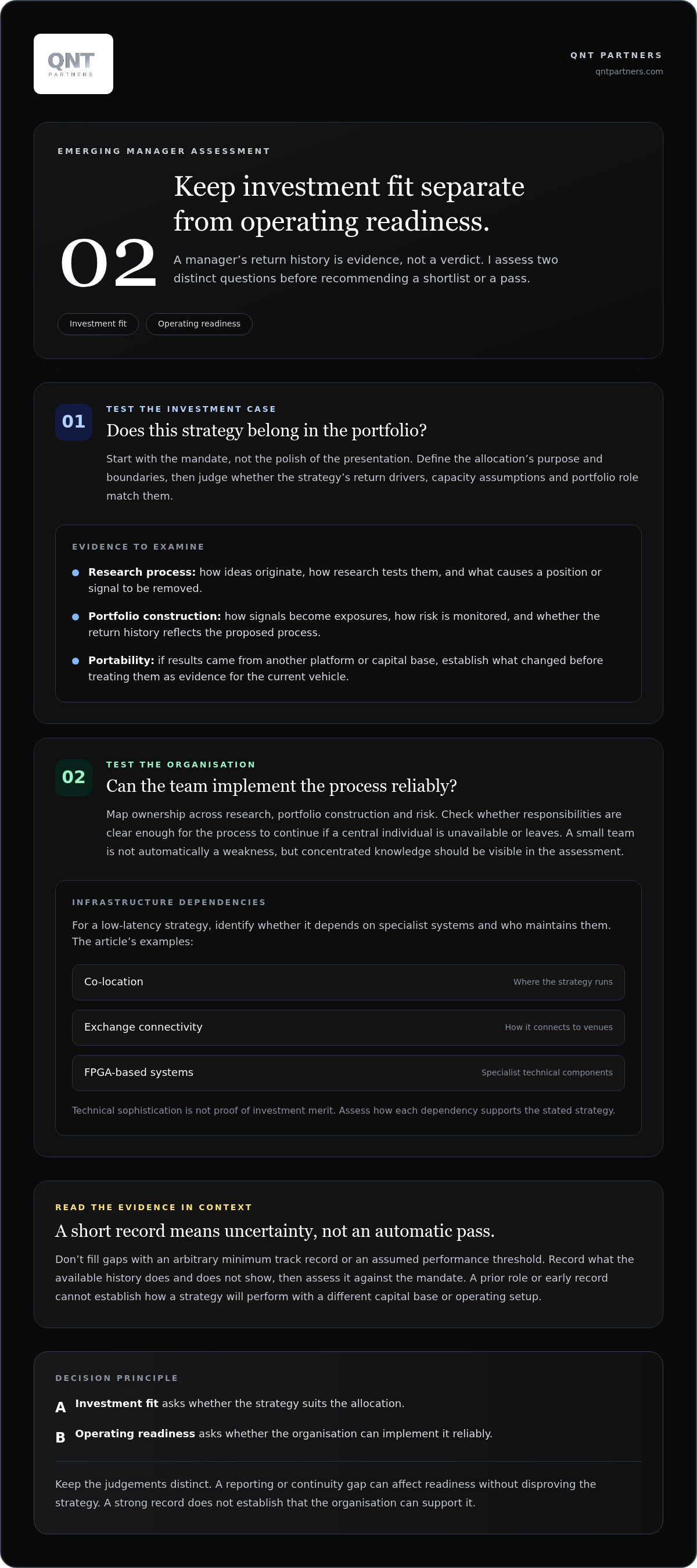
A manager’s return history is evidence, not a verdict. I’d assess what produced it, how closely the conditions match the proposed mandate, and whether the team can run the process with institutional capital. These are separate lines of inquiry. Investment fit asks whether the strategy belongs in the portfolio; operational readiness asks whether the organisation can implement it reliably.
In an emerging manager search for institutional investors, a short record may leave genuine uncertainty. Don’t fill that gap with an arbitrary minimum track record or an assumed performance threshold. Record what the history does and doesn’t show, then judge the available evidence against the mandate.
Interrogate the investment case
Ask the manager to explain how ideas originate, how research tests them and what causes a position or signal to be removed. The account should connect the research process to actual portfolio decisions, rather than relying on a persuasive description of the strategy.
Assess whether the evidence supports the mandate’s return and risk objectives. Look at how portfolio construction translates signals into exposures, how risk is monitored, and whether the return history reflects the proposed process. If results come from a prior platform or a different capital base, establish what changed before treating them as evidence for the current vehicle.
Test whether the organisation can support the strategy
Map decision ownership across research, portfolio construction and risk. The key question is whether responsibilities are clear enough for the investment process to continue when a central individual is unavailable or leaves. A small team isn’t automatically a weakness, but concentrated knowledge should be visible in the assessment.
Consider dependencies on specialist infrastructure. A low-latency strategy, for example, may rely on co-location, exchange connectivity or FPGA-based systems. Establish who maintains those components and how they support the stated strategy, without treating technical sophistication as proof of investment merit.
Keep operational findings separate from performance conclusions. A gap in reporting or unclear continuity planning may affect readiness, but doesn’t by itself disprove the strategy. Conversely, a strong backtest or live record doesn’t establish that the organisation can support the investment process at the scale and structure proposed.
For each candidate, document the evidence, its limits and the questions that remain open. That record helps the investment team distinguish a genuine mandate fit from a promising but incomplete case, and makes the eventual shortlist or pass decision easier to defend.
Compare emerging-manager mandates, including SMA and pooled structures
Structure affects how an allocation is controlled and administered, but it doesn’t establish whether the manager’s strategy fits. An SMA and a pooled vehicle can each suit an institutional mandate. The decision turns on the allocator’s requirements and the manager’s setup, not on a default preference for one format.
In an emerging manager search for institutional investors, compare the structures against the same mandate. Consider how much account-level direction is needed, what reporting the investment team requires, and which operational responsibilities sit with the allocator or manager. The details depend on the arrangement, so don’t assume a structure carries particular terms by itself.
When an SMA structure may fit the mandate
A separately managed account, or SMA, is an account managed separately for an investor. It may suit an allocator that needs to tailor the mandate or maintain account-level oversight. That can matter when portfolio constraints require specific exposure parameters or when the institution needs reporting aligned with its monitoring process.
Those features still need to be weighed against the manager’s ability to operate the account and the responsibilities assigned to each party. Account governance, reporting arrangements and other terms are set by agreement. An SMA shouldn’t be treated as inherently more transparent or easier to administer without considering the actual setup. QNT’s discussion of SMA and SVA partnerships examines how structural choices shape the relationship between allocator and manager.
When a pooled structure may better suit the allocation
A pooled vehicle brings investor capital together within a shared structure. It may suit an allocator whose portfolio and operating requirements align with the vehicle’s design, rather than requiring account-specific control. Assess whether the vehicle’s mandate, reporting and administration work for the institution, and whether the manager can support them.
Don’t infer liquidity, fees, access or reporting terms from the word “pooled”. Those depend on the specific vehicle and its governing arrangements. Compare the institution’s requirements with the manager’s proposal, and identify any mismatch before making the structure part of the investment case.
The practical comparison isn’t “SMA versus fund” in the abstract. It’s whether the chosen structure supports the allocator’s oversight and portfolio requirements while remaining workable for the manager’s investment process. For a systematic strategy, understand how account-level constraints interact with execution and portfolio construction. A structure that restricts those mechanics may change how the strategy is implemented, so assess the implications directly with the manager.
Document the structural trade-offs alongside the investment assessment. That stops a preference for control, reporting or administrative simplicity from being mistaken for evidence that the strategy itself is suitable.
Run an emerging manager search with clear decision gates
A search loses discipline when candidates are added faster than the team can explain why they belong. Set decision gates before outreach, then use them to keep the work focused from mandate through final decision. The process needn’t be elaborate, but each stage should have a clear purpose and a recorded outcome.
For an emerging manager search for institutional investors, I’d organise the work into four stages:
- Define the mandate. Specify the portfolio role, strategy boundaries and essential requirements before building a candidate universe.
- Source relevant managers. Identify teams whose strategy and setup warrant assessment against those requirements.
- Assess fit. Examine investment evidence, alignment with the mandate and operating readiness as distinct questions.
- Decide. Progress candidates that warrant further diligence, or record why the search should pass.
Build a focused search universe
Let the mandate determine which strategies and manager characteristics matter. If the allocation calls for a particular market, trading horizon or research capability, use those criteria to guide sourcing rather than compiling names simply because they are available. A smaller, relevant universe gives the investment team more room to assess each case properly.
Handle manager interest and search discussions discreetly. Unnecessary circulation of names or preliminary views can create noise for both the allocator and potential candidates. Keep access to search information appropriate to the people involved, and distinguish exploratory conversations from a formal decision to progress.
Make the shortlist decision defensible
Apply consistent criteria while allowing for differences in how strategies generate returns. A systematic market-making manager and a slower-frequency research-led team shouldn’t be judged on identical implementation details. They should still be assessed against the same mandate requirements, with any strategy-specific interpretation made explicit.
Keep three types of finding separate in the decision record: evidence that supports fit, established weaknesses, and unresolved questions. An incomplete data history isn’t automatically a weakness, but it may leave a question unanswered. Recording that distinction helps the team decide whether more work could resolve the uncertainty or whether the gap is material to the mandate.
A clear pass is a valid outcome. If the strategy falls outside the allocation’s boundaries, or the operating setup can’t support the required approach, documenting that conclusion prevents the search from drifting towards a candidate simply because time has been invested. A defensible process explains why a manager advanced, why another didn’t, and what evidence would change the decision.
QNT Partners provides manager search and SMA sourcing for institutions, with specialist coverage across quantitative trading and research. For a focused discussion, discuss an institutional manager search with our team.
How QNT Partners supports institutional emerging-manager search
Specialist input is most useful when it helps an allocator describe what it needs in terms the manager market can answer. Strategy labels can conceal differences in decision-making, implementation and team responsibilities. A focused discussion brings those distinctions back to the mandate, rather than treating every manager with a similar label as interchangeable.
Where specialist search adds value
For an allocator, the challenge is often translating a portfolio requirement into a clear profile of the manager and strategy being sought. We work with institutional clients on manager search and SMA sourcing, helping define which characteristics are central to the brief and which are preferences to weigh during assessment. The aim is a relevant search universe, not a longer list of names.
Market-specific context can also help frame questions about a manager’s background and proposed setup. A team’s prior experience, for example, may relate to a different operating environment from the one it is proposing now. That distinction is useful to surface, but it doesn’t replace the allocator’s own assessment or imply a particular investment outcome.
Start with the mandate and the decision
A practical first conversation starts with the allocation objective, the portfolio role and the constraints shaping the decision. It can also cover whether the institution is considering an SMA or another structure, and what information the investment team needs to make its assessment. Clear requirements make for a more focused search discussion.
That keeps the conversation tied to a live institutional need rather than a general overview. If the mandate is still taking shape, identifying the open points can help the team decide what needs to be settled before a search begins.
For a focused discussion about your requirements, speak with QNT Partners about an institutional mandate. A clear allocation objective gives the conversation a practical starting point.
Turn the mandate into your next decision
Capture the mandate in a brief your investment team can use beyond this search. Record the portfolio role, non-negotiable constraints and the evidence that would change your view. That gives colleagues a shared reference point if priorities shift before a decision is reached.
For an Emerging manager search for institutional investors, keep the rationale behind key trade-offs alongside the decision. Your team can then revisit its assumptions later without relying on memory, while retaining room to adjust the brief as the institution’s needs evolve.
If you’re ready to put a live requirement into motion, bring your mandate to QNT Partners. Start with the allocation objective and the constraints shaping your decision.
Frequently Asked Questions
Is there a universal definition of an emerging investment manager?
No. Allocators may use different criteria to describe an emerging manager, reflecting their programme design and investment scope. One institution may focus on a manager’s operating history, while another may consider the firm’s fundraising stage or prior institutional experience. Define the criteria that matter for your allocation and apply them consistently. That keeps classification separate from any judgement about investment quality.
How should institutional investors assess a manager with a short track record?
Assess the quality and context of the available evidence, then be explicit about what remains uncertain. A live record from a related strategy may offer useful information, but it may not represent the proposed portfolio or current team. Consider how the data was produced, which market conditions it covers and whether the process has changed. A short history limits what can be inferred, but doesn’t by itself settle the investment case.
Can an institutional investor allocate to an emerging manager through an SMA?
Yes, an institution can consider an SMA if the structure fits its mandate and the manager can support the agreed arrangement. Before progressing, clarify account-specific requirements, reporting expectations and each party’s operational responsibilities. The SMA label alone doesn’t determine the degree of customisation or oversight available. Those details depend on the terms agreed between allocator and manager, as well as the strategy’s implementation needs.
What happens if a manager’s strategy changes during an institutional search?
Pause the assessment and establish what has changed before treating earlier conclusions as current. A shift in instruments, holding period or decision-making team could alter how the strategy fits the allocation. Record the change, identify which evidence still applies and reassess against the mandate’s original requirements. If the mandate itself needs revision, document that separately. The search should progress only when the updated case is clear to the investment team.
Is an emerging manager suitable for every institutional portfolio?
No. Suitability depends on the portfolio’s objectives, constraints and capacity to assess the manager’s particular risks. A strategy may be interesting in isolation yet add little if it duplicates existing exposures or conflicts with liquidity needs. The relevant question is whether the manager can serve a defined role within that institution’s portfolio. A well-supported decision to pass is appropriate when the fit isn’t there.
When should an allocator use specialist manager-search support?
Specialist support can be useful when the mandate involves strategies or markets that require focused knowledge to identify relevant managers. For example, an allocator assessing quantitative trading may need to distinguish research approaches and trading models that broad labels obscure. In an Emerging manager search for institutional investors, support is most relevant when it helps define the search universe against the mandate, rather than simply expanding the list of names.