Derivatives Quant Talent Acquisition: Hiring for Trading, Research and Technology

A derivatives quant job title tells you very little about what the hire must own. Derivatives quant talent acquisition goes off track when pricing, signal research and trading are bundled into one broad “quant” brief.
A researcher developing volatility signals has a different remit from a quant building pricing models or a trader managing live risk. I’ve seen searches stall when those jobs are treated as interchangeable and assessed against the same generic specification.
Start with the strategy and desk structure, then define the derivatives knowledge and implementation experience the role demands. Be specific about the instruments, model ownership, production code and trading decisions involved. A title and a list of familiar tools won’t tell candidates or interviewers what success in the role looks like.
This article sets out how to define the role and assess candidates against its actual requirements. It also covers how to run a discreet search when candidate relationships, garden leave or non-competes affect the process. At QNT Partners, we work across quantitative trading, research and technology recruitment. A clear brief helps us distinguish relevant expertise from a polished but poorly matched profile, and shows candidates what they will own on day one.
Key Takeaways
- Start with the desk’s strategy and the work the hire will own, then shape the role around its instruments, data and implementation needs.
- Use Derivatives quant talent acquisition to test for relevant expertise, not just familiar titles or credentials.
- Ask candidates to explain model assumptions, failure modes and the trade-offs involved in putting research into production.
- Calibrate the mandate before mapping talent, then adapt outreach to the required discretion and whether the team is a build-out or spinout.
- Match candidate profiles to the desk’s actual requirements, using specialist search grounded in quant trading, research and technology experience.
Derivatives quant hiring starts with the desk’s actual problem
Two people with the title “derivatives quant” can have very different day-to-day responsibilities. One might maintain a valuation capability; another might help a desk find where its strategy is underperforming. The title doesn’t tell you what gap the hire should fill or what they’ll be accountable for after joining.
Derivatives quant talent acquisition should start with that gap. Before drafting a specification, identify what has prompted the hire: a new strategy, a research bottleneck, a change in desk coverage or reliance on another team. The answer helps separate a genuine capability requirement from a familiar title copied from an old organisation chart.
The scope of quantitative analysis in finance includes areas such as derivative pricing and risk. That breadth shouldn’t turn the job description into a catch-all. State what the role must own, where it contributes to the desk’s decisions and what remains with colleagues. Then assess candidates against the mandate, not every skill associated with quantitative finance.
Hire for the strategy the person will own, not the title the organisation has assigned. The strategy context matters. A derivatives role may centre on a particular instrument set, a research problem or a trading mandate, and each calls for different experience. Give candidates enough context to understand the work without disclosing sensitive strategy details in early conversations.
Start with the mandate, not the title
Set out what the hire must establish, improve or take responsibility for. Clarify whether the position is part of a new build-out, a replacement or an expansion of an existing team. A build-out may need someone who can define how their work fits with the desk. A replacement may need to maintain a specific capability. An expansion may add capacity without changing existing ownership.
Those distinctions shape the candidate profile. If the hire will help establish a new function, experience in a closely related environment may matter more than an exact match with an internal title. If the team needs continuity in an established remit, direct experience with the work may carry more weight. Make that priority explicit before screening begins.
Separate adjacent derivatives quant profiles
Pricing and modelling, signal research and trading decisions may sit close together in an organisation, but they call for different evidence of ownership. A quantitative developer may support research or execution without owning the strategy itself. Don’t treat experience in one area as proof of competence in another. Define the hand-offs, then make the title reflect the scope rather than stand in for it.
Map derivatives expertise to the work the hire will own
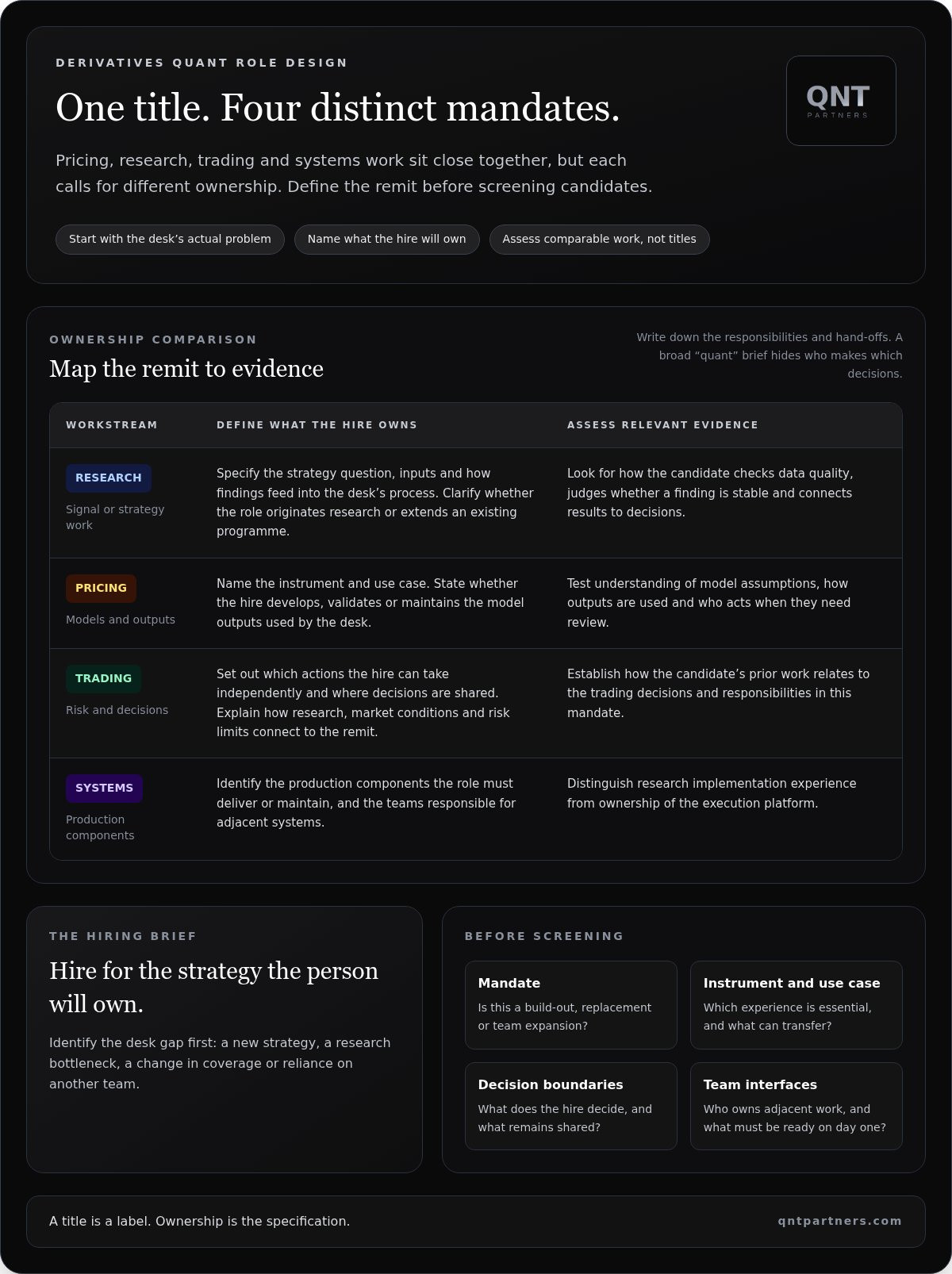
A useful role map connects each responsibility to a decision, an input and an output. If the desk needs research to inform a trading decision, specify who interprets the result and how it reaches the person taking risk. If the role maintains a pricing capability, clarify who uses its outputs and what the hire is expected to change or support.
These boundaries depend on the desk structure and mandate. A researcher may work closely with a trader in a small team. A larger operation may separate research, risk-taking and platform ownership. Write down the interfaces as well as the tasks. Otherwise, a specification may ask a candidate to “own” work whose key decisions sit elsewhere.
Match each responsibility to evidence that shows the candidate has handled comparable work. A clear role map gives interviewers a practical basis for assessment. It also separates capabilities needed on day one from those that rely on collaboration with existing colleagues.
- Research: Specify the strategy question, the data or market inputs involved and how findings feed into the desk’s process. Say whether the hire will originate research or extend an existing programme.
- Pricing: Define the model outputs the desk uses and whether the role owns their development, validation or maintenance. Name the relevant instrument and use case rather than assuming all derivatives pricing work is interchangeable.
- Trading: Set out which actions the hire can take independently and where decisions are shared. Clarify how research findings, market conditions and risk limits connect to the trading remit.
- Systems: Identify the production components the role must deliver or maintain, along with the teams responsible for adjacent systems. This distinguishes a research implementation need from ownership of the execution platform.
Research and pricing responsibilities
For research, map the path from a question to a result the desk can use. Ask what inputs the hire will work with, how they should check data quality and how they’ll decide whether a finding is stable enough to inform further work. For pricing, identify how the model is used, which assumptions its outputs depend on and who acts when those outputs need review.
Tie instrument requirements to the mandate. A role may require experience with a particular derivatives class, or it may prioritise transferable modelling and research practice. State which applies so candidates can show relevant depth without guessing what matters to the team.
Trading and engineering responsibilities
For a quant trader, clarify whether the remit includes proposing positions, adjusting them or evaluating execution. Those are distinct responsibilities, even when they sit within one role. Apply the same discipline to engineering: include exchange connectivity, FPGA work or tick-to-trade latency only when the system requirements make them part of the job.
Define the hand-offs, too. Researchers need to communicate assumptions and changes. Traders need outputs they can interpret in context. Engineers need requirements they can implement. A clear map shows where collaboration is expected and where the hire is accountable, giving interviewers a concrete basis for assessing the remit.
Assess candidates against strategy fit, not credentials alone
A CV shows where someone has worked, but rarely how they made a difficult technical decision. Use a structured assessment to compare candidates against the mandate, while leaving room to explore how they think when an answer isn’t obvious. Degrees, employers and model names can provide context, but they don’t show who owned the work.
A compact scorecard keeps interviewers focused on the same requirements:
Role requirement: Research ownership. Evidence to probe: How the candidate framed a hypothesis and chose a way to test it. Possible mismatch: They describe team results but can’t separate their own contribution.
Role requirement: Pricing or modelling judgement. Evidence to probe: Which assumptions they challenged and how they interpreted model outputs. Possible mismatch: They explain the mathematics but not its practical use or limitations.
Role requirement: Implementation. Evidence to probe: How they translated a method into a workflow others could use. Possible mismatch: They discuss research results without showing how their work reached users.
Test technical depth through concrete work
Ask the candidate to walk through a project from the point where a decision had to be made. Which alternatives did they consider? Which assumption was most sensitive, and what would have changed their conclusion? Focus on the reasoning, not on reproducing a polished presentation.
Probe how they responded when results weakened or market conditions changed. A strong account distinguishes signal from noise, explains what they could infer from the available evidence and identifies what remained uncertain. For implementation work, ask how they balanced maintainability, runtime constraints and the needs of downstream users. Keep examples sanitised. An interview should test judgement without inviting disclosure of a former employer’s confidential strategy, data or code.
Use consistent criteria, but don’t force identical questions onto candidates with different experience. A follow-up might test whether a researcher understands how traders use a result, or whether a developer can explain the operational assumptions behind an implementation. Record the evidence behind each assessment, rather than relying on a general impression such as “strong technically.”
Evaluate desk and incentive alignment
Candidate fit also depends on the operating model. In a pod shop, prop shop or multi-manager environment, the boundaries around research, risk and decision-making can differ. Describe the actual remit, then ask candidates which parts they want to own. A mismatch may emerge if someone expects direct risk authority but the role is mainly research support.
Discuss P&L attribution, P&L splits or equity partnerships when they’re relevant to the mandate and the candidate’s expectations. These arrangements vary by firm and role, so they aren’t generic screening benchmarks. Nor do they establish that a person will stay. In Derivatives quant talent acquisition, the useful test is whether the candidate understands the decisions, accountability and incentives attached to this position.
Structure the search around access, discretion and constraints
A discreet search needs a stable brief. Run it in stages, with a clear decision at each point before moving to the next. That keeps outreach specific and limits unnecessary exposure of a confidential build-out or replacement.
- Calibrate the mandate. Agree the role’s remit, strategy context and essential technical evidence.
- Map relevant talent. Identify the desks and candidate backgrounds most likely to contain that experience.
- Engage discreetly. Share enough about the opportunity to establish relevance, while controlling what is disclosed and when.
- Refine. Use candidate responses to test the brief, then adjust the target profile or messaging when the evidence warrants it.
Calibrate the brief before outreach
Separate requirements from preferences. If the role needs someone who has owned derivatives research in production, say so. If a programming language or instrument is useful but not essential, don’t make it a hard filter without a clear reason. Over-specified briefs can screen out candidates whose experience transfers directly to the work.
Set the strategy context and decision rights, then agree what evidence will count: ownership of research, model implementation, trading decisions or systems delivery. Keep compensation aligned with the actual role and its structure. Figures without verified, role-specific context add noise rather than precision.
Build-outs and spinouts call for different conversations. A new team may need someone comfortable shaping a process and working across functions. A spinout may need someone whose experience fits the strategy and operating model the team is carrying forward. Describe the mandate accurately, without implying a level of autonomy or infrastructure that isn’t there.
Engage a specialist candidate market discreetly
Relevant candidates may not be actively applying. They may be focused on live strategies, committed to a team or unwilling to respond to a generic job description. A useful first approach gives enough context to show why the remit fits their experience, while holding back sensitive firm or strategy details until appropriate.
Confidentiality should shape the whole process, not just the first message. Keep the candidate list controlled, agree what can be shared at each stage and avoid circulating identifying details more widely than the search requires. In Derivatives quant talent acquisition, this protects the hiring firm’s plans and existing candidate relationships.
Garden leave and non-competes are individual constraints, not assumptions to apply uniformly. Record the candidate’s stated circumstances and timing, and treat questions about restrictions as specific to that person. Don’t promise a start date or draw legal conclusions from a general description.
For a broader view of how specialist mandates are framed, explore our quant recruitment insights. A focused brief gives outreach a clearer basis and helps candidates judge whether the work fits.
How QNT Partners approaches derivatives quant talent acquisition
A search is productive when the role is clear enough for the right people to recognise themselves in it. At QNT Partners, we focus on quantitative trading, research and technology roles, shaping the brief around the work rather than a generic quant title.
A specialist search shaped around the mandate
I’m James, co-founder of QNT Partners. The firm was founded by former industry operators, and that background informs how we discuss a derivatives mandate with a hiring team. We clarify whether the need sits in research, pricing, trading or technology, then establish what the hire must own and how the work connects to the desk.
That distinction matters in practice. A request for a derivatives researcher might mean developing a signal, improving a pricing model or taking research into a production workflow. Those are different searches, even if the internal title is the same. We use the mandate to focus the candidate profile and the evidence to explore, rather than treating a familiar title or keyword match as proof of fit.
The same applies to technology roles supporting derivatives strategies. If the position concerns low-latency execution, the brief should say whether the work involves exchange connectivity, FPGA implementation or another part of the production stack. If it doesn’t, those requirements shouldn’t appear simply because they’re common in other quant job descriptions.
Our work covers specialist search and talent strategy advisory across quant trading, research and technology. For Derivatives quant talent acquisition, we ground the search in the desk’s structure and requirements, then refine the profile as we learn more about the relevant candidate market.
Move from role definition to a focused conversation
A useful first discussion starts with the problem the team needs the hire to solve. Is the role part of a new build-out, a spinout or an established desk? Which decisions will sit with the person, and what evidence would show they can handle that work? Those details give us a basis for shaping a focused search and advising on talent strategy.
From there, we can align the role description and candidate discussions with the actual mandate. That helps avoid outreach that overstates autonomy, underspecifies technical work or confuses adjacent profiles. It also gives candidates a more accurate account of the opportunity and what they would be expected to own.
If you’re defining a derivatives quant hire, discuss the mandate with QNT Partners. A precise brief gives the search a clear target and makes each candidate conversation more relevant to the desk’s needs.
Keep the next hire aligned with the strategy
A derivatives hiring plan shouldn’t sit untouched while the strategy changes around it. As research moves towards live deployment or a desk takes on a different mandate, the capability gap can shift. Revisit the brief at those points to keep future hiring tied to the work the team needs done, rather than a role description written for an earlier phase.
That’s the practical value of getting Derivatives quant talent acquisition right: the search starts from the desk’s current priorities and can adapt as the build evolves. I’d rather see a clear mandate that can be refined than a long specification that treats every desirable skill as essential.
QNT Partners specialises in quantitative trading, research and technology recruitment. If you’re shaping a derivatives hire or planning a team build, discuss a derivatives quant search with QNT Partners. Start with the capability gap the desk needs to close, and make that the target for the search.
Frequently Asked Questions
What does a derivatives quant recruiter assess?
A derivatives quant recruiter assesses whether a candidate’s experience matches the role’s actual remit. Useful evidence includes their contribution to a project, the decisions they made and how they worked with adjacent teams. Ask what they handed over to engineering and how they responded to feedback from traders. Keep comparisons consistent across candidates, while using follow-up questions to explore differences in their experience.
How is derivatives quant hiring different from general quant recruitment?
Derivatives quant hiring accounts for the instruments and trading context behind the role. A broad quant job family can obscure whether the desk needs someone focused on model behaviour, strategy research or production systems. Build the assessment around those distinctions. Experience with one derivatives product may be relevant, but it shouldn’t automatically stand in for familiarity with the specific work the team needs covered.
Should a derivatives quant role require prior experience with the exact strategy?
No, not in every search. Exact strategy experience matters most when the role depends on specialised knowledge the team can’t readily provide. For other requirements, transferable experience may be enough if the candidate can explain how they’d apply it to the new mandate. Consider the support available from researchers, traders and engineers, then decide which gaps can be covered internally and which would leave a critical capability missing.
How can a firm assess a derivatives quant candidate’s research experience?
Ask the candidate to describe a research decision they made and what evidence changed their view. Go beyond headline performance: explore how they selected a comparison, interpreted an unexpected result or decided further work wasn’t justified. Keep the discussion focused on their reasoning and contribution, not proprietary details. A consistent interview framework helps distinguish clear research ownership from familiarity with a project conducted mainly by others.
What should a confidential derivatives quant search account for?
A confidential search should define who can receive candidate details and what the candidate may learn at each stage. Agree how to describe the opportunity before outreach, especially if naming the desk could reveal a build-out or strategy. A candidate’s garden leave or non-compete may affect their circumstances, so handle each case individually and avoid assumptions about timing or restrictions based on someone else’s situation.
How does desk structure affect derivatives quant recruitment?
Desk structure affects how a hire works with colleagues and where decisions sit. Clarify who sets research priorities, who manages risk and how the role interacts with execution or portfolio management. Those details help identify candidates suited to the working arrangement, rather than treating a pod shop, prop shop or multi-manager as a proxy for fit. Consider P&L arrangements in the context of the specific mandate.
When should a derivatives team use a specialist search firm?
A specialist search firm can help when the hiring team needs support defining a technical mandate, reaching a discreet candidate market or assessing experience across quant disciplines. Start by identifying what the internal team can assess confidently and where it needs an outside perspective. Derivatives quant talent acquisition works best when the search partner understands the role, its decision rights and the evidence that would make a candidate relevant.