Choosing a Systematic Quant Developer Search Firm

Choosing a Systematic quant developer search firm on language keywords alone is a mistake. A shortlist can be full of C++ and Python experience yet miss the difference between research code and a production system connected to an exchange. The gap is often in what the developer is expected to own, not the syntax they know.
The title can cover roles shaped by very different desk priorities. One team may need someone close to research iteration; another may need a developer responsible for systems traders rely on in production. If the specification blurs those expectations, technically capable candidates can still miss the mandate. The right people may not be actively applying, so a focused and discreet search matters.
I’m James, co-founder of QNT Partners. I believe a useful search starts with the desk’s workflow and the contribution the hire will make. This article sets out how to assess whether a search partner can turn those needs into meaningful evidence of candidate fit. It covers role definition, technical assessment and the decisions that keep a search focused as the brief develops.
Key Takeaways
- Separate research tooling, production systems and strategy-facing development by the work each role owns and the teams it supports.
- Assess a Systematic quant developer search firm on how it translates desk requirements into evidence from candidates’ actual work.
- Score the search partner’s mandate calibration, market reach, technical assessment, discretion and communication before agreeing the search.
- Set the brief in sequence: define the mandate, specify relevant evidence, agree search boundaries, then review the shortlist against those criteria.
- Connect quant and technology recruitment to the workflow, interfaces and contribution the desk needs, rather than relying on a generic job title.
Why systematic quant developer searches miss the mark
The title “quant developer” can describe materially different jobs. One role may centre on tools researchers use to test ideas; another may involve services traders depend on in production. A generic specification compresses those responsibilities into a list of languages and platforms. It can attract capable candidates whose experience does not match the desk’s actual need.
A well-calibrated search starts with the desk’s workflow, ownership boundaries and production responsibilities, not just a preferred technology stack. Define those before reviewing profiles. Otherwise, a shortlist can look relevant on paper while representing several different interpretations of the role.
Separate the role label from the operating model
Reporting lines and team structure shape the remit. At a prop shop, a developer might work closely with a trader or research group on a strategy-specific system, while another firm may centralise engineering work. In a pod shop, the role could sit alongside a PM’s strategy or within a wider engineering function. A multi-manager platform might also have shared teams alongside developers embedded with individual groups. These are possible models, not rules for every firm.
The key questions are who sets priorities and what the developer owns. A strategy-facing role may involve implementing research requirements and resolving differences between a model and its production behaviour. A platform-facing role may support shared data services or trading systems used by several desks. The same languages can appear in both jobs, but the expected collaboration and accountability differ.
The broad definition of Algorithmic Trading describes automated trading methods, not how a particular organisation divides research, strategy development and engineering. Make that division explicit in the hiring mandate.
Identify the cost of a vague mandate
Unclear ownership creates shortlist noise. A developer who built research tooling may have had little responsibility for deployment or live operation. Another candidate may have maintained production services but rarely worked directly with researchers or traders. Both profiles can look relevant against a loose title and technology list, yet point to different contributions once interviews begin.
A strong résumé shows prior experience, but it does not establish fit with a specific desk. Probe what the candidate personally owned, which decisions they made and how their work connected to the people using the system. Separate hands-on responsibility from participation in a larger project. That gives interviewers a clearer basis for judging whether the experience transfers.
A Systematic quant developer search firm should establish these distinctions before approaching candidates. At QNT Partners, we bring former industry-operator experience to role calibration; our firm background informs that work. If the brief describes only a title and technology list, sharpen the ownership and deliverables before outreach begins.
Map systematic developer skills to the trading workflow
A candidate’s tools matter less than the work those tools support. Python used to test a feature on historical data tells you something different from C++ used to maintain a live execution path. Ask what the person built, what they owned and how the work reached the desk.
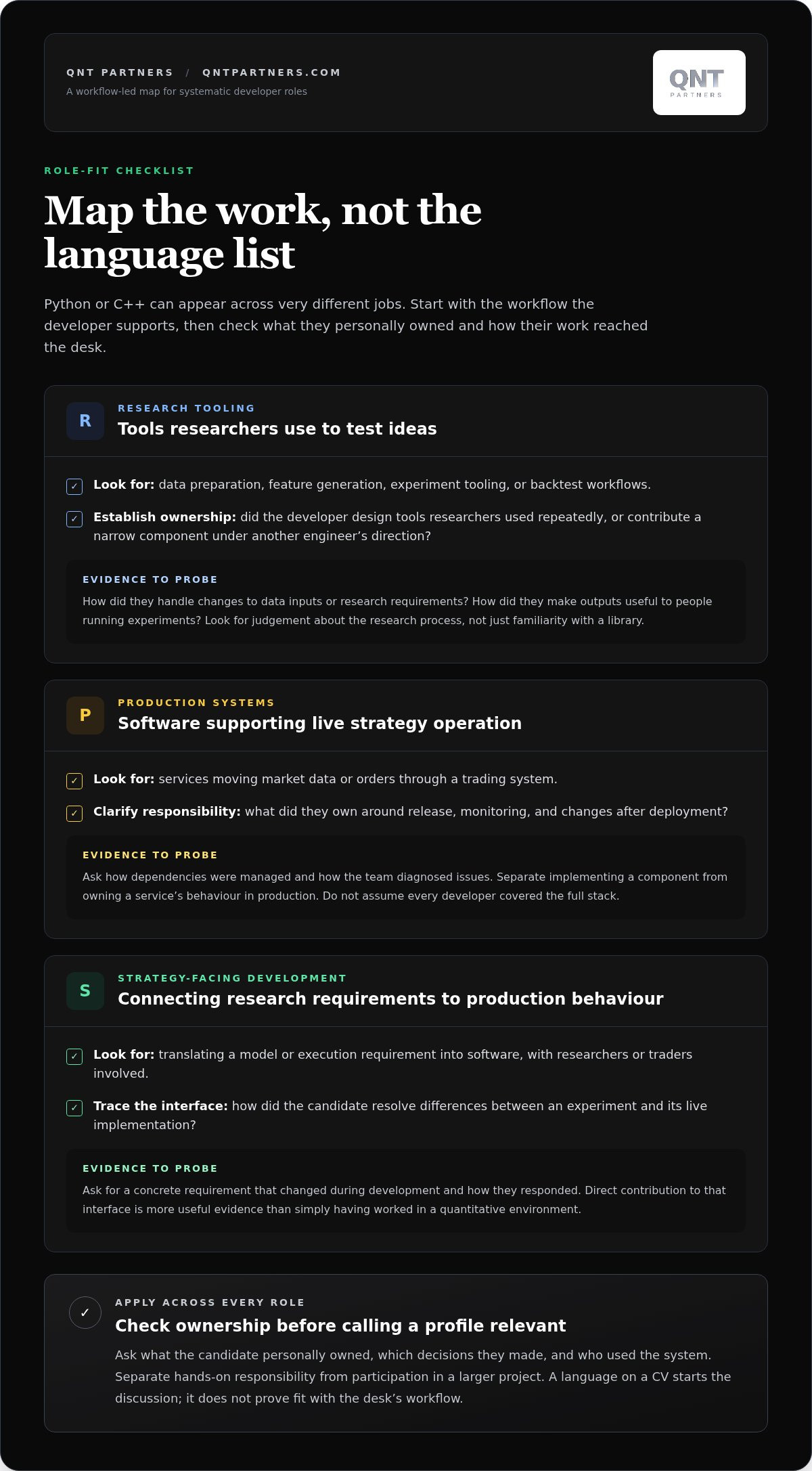
Relevant experience depends on the system and the team’s remit. A language on a CV is a starting point for discussion, not proof that someone can take responsibility for the workflow the hiring team needs covered. Trace the work from its initial requirement through implementation and use.
Research tooling: Look for work on data preparation, feature generation, experiment tooling or backtest workflows. Establish whether the developer designed tools researchers used repeatedly or contributed a narrow component under another engineer’s direction. Ask how they handled changes to data inputs or research requirements, and how they made outputs useful to the people running experiments. The evidence to look for is judgement about the research process, not simply familiarity with a library.
Production systems: Focus on software that supports live strategy operation, such as services moving market data or orders through a trading system. Clarify the candidate’s responsibility for release, monitoring and changes after deployment. Someone who implemented a component may not have owned the service’s behaviour in production. Ask how dependencies were managed and how the team diagnosed issues, without assuming every developer was responsible for the full stack.
Strategy-facing development: Assess work that connects a research requirement to production behaviour. The developer may translate a model or execution requirement into software, then work with researchers or traders to resolve differences between an experiment and its live implementation. Ask for a concrete example of a requirement that changed during development and how the candidate responded. Direct contribution to that interface is more useful evidence than simply having worked in a quantitative environment.
Distinguish strategy-facing and platform-facing work
Research iteration and production deployment impose different constraints. A research tool may need to support changing inputs and analysis, while a production service must meet the desk’s operational requirements and fit its interfaces. A shared trading system can serve several strategies, while a strategy-facing component may be shaped by one team’s process. Neither scope is inherently better. Match the hire to the point where the team needs ownership.
That choice changes how the developer spends time with colleagues. A researcher may need help understanding how data transformations affect an experiment; a platform team may need clear interfaces and predictable service behaviour. Map the hand-offs, including who defines requirements and who accepts the result, before weighing a candidate’s previous job title.
Read technical evidence in context
Ask candidates to trace a piece of work from its initial requirement to its use by the desk. Which parts did they design? What trade-offs did they make? What happened when the requirement changed? These questions reveal the candidate’s scope and decision-making, not just the project’s technology stack.
Then establish how the work interacted with researchers, traders or portfolio managers. C++, Python or another tool can be relevant, but none is a universal threshold. The useful signal is whether the candidate applied the required technology at the right layer and understands the consequences of their implementation for its users.
Evaluate a systematic quant developer search firm
A search partner should explain how the desk’s requirements become evidence in a candidate profile. If the pitch stays at “strong C++” or “systematic experience”, you have not yet seen how they will distinguish relevant ownership from proximity to a project.
I’d use this scorecard before agreeing a search. A Systematic quant developer search firm should be able to speak clearly to each point and show how it affects the shortlist.
- Mandate: Can the partner describe the team structure, reporting line and work the hire will own? Look for a clear distinction between strategy-facing development and shared platform responsibilities.
- Market reach: Can they explain which candidate backgrounds map to this remit, including relevant experience across systematic funds, prop shops or technology teams? Reach matters when it is tied to the role, not presented as a broad contact count.
- Assessment: Do candidate notes separate verified experience from inference? “Owned the production service” is different from “worked in a team that supported it”. The partner should be able to explain the basis for each claim.
- Discretion: Can they describe the opportunity accurately without exposing sensitive details too early? A search can be confidential without being vague about the work, reporting line or candidate expectations.
- Communication: Will updates identify what the market is telling you, including where the brief is narrowing the viable pool? Clear communication helps the hiring team resolve trade-offs before they create shortlist noise.
Test mandate calibration
Before profiles arrive, expect questions about who sets priorities, what the developer will own and how success will be judged. The partner should test the boundary between adjacent mandates rather than assume a title or language requirement settles it. For wider context on specialist hiring in quant, compare the proposed approach with the principles discussed in quant trading recruitment firms.
A useful test is to ask the partner to describe the role in terms of candidate evidence. What would demonstrate direct ownership? Which experience would be relevant but not sufficient? If the answer does not reflect the desk’s workflow, calibration is still in progress.
Assess discretion and candidate communication
Sensitive searches need controlled, accurate descriptions. Candidates should understand the mandate and operating context without receiving details the client intends to keep confidential. Accuracy matters: overselling scope or understating constraints can damage trust before a first interview.
Garden leave and non-competes can affect when a candidate is available and what they are comfortable discussing. Treat those as individual timing and confidentiality considerations, not assumptions about every candidate. A careful search partner records what the candidate has actually said and keeps inference separate.
QNT Partners was founded by former industry operators. That background informs how we discuss technical roles and desk context, as set out in our firm background.
Set the search brief before approaching candidates
A search brief should describe the job the desk needs done, not a generic quant developer profile. Align the internal hiring group before outreach starts; otherwise, each interviewer may assess a different role.
I’d set the brief in four steps:
- Define the mandate. Record the team’s operating model, reporting line and decision-making scope. Establish whether the developer will work alongside a PM or researcher, contribute to a shared platform, or cover both with clear boundaries.
- Specify the evidence. Describe the work that would demonstrate readiness for the role, such as owning a data pipeline, deploying a research component or maintaining a trading service. Separate evidence that is essential at shortlist stage from preferences to explore in interviews.
- Agree boundaries. Set out which systems, teams and decisions fall within the role. Decide what can be shared with candidates about the strategy, technology and reporting structure, and what must remain confidential during early conversations.
- Review against the brief. Compare candidate evidence and hiring-team feedback with the agreed mandate. Change criteria when the role genuinely changes, not simply because an early profile exposes a new technology or adjacent skill.
Define success in the first conversation
Write down the role’s interfaces as well as its deliverables. A developer might receive research requirements from one group, maintain a shared service used by another, and have production decisions reviewed by an engineering lead. Capture who sets priorities and where the hire can make technical decisions. That makes ownership concrete without forcing the position into a standard job specification.
Keep essential requirements distinct from preferences. If direct ownership of production deployment is necessary, state what evidence would demonstrate it. If experience with a particular platform is preferred rather than essential, keep it in that category. Agree what can be disclosed before the first candidate conversation, so confidentiality does not turn the opportunity into an uninformative pitch.
Keep the search aligned as the market responds
Candidate responses can expose a real trade-off. Perhaps the desk needs someone strong in research workflows and production engineering, but the current brief gives equal weight to both. Use those conversations to clarify which responsibility matters most, rather than adding every desirable skill to the specification.
At QNT Partners, we align search activity with the agreed brief, connecting quant and technology recruitment to the mandate the hiring team has set. If the role is infrastructure-heavy, the scope may also need to account for responsibilities such as exchange connectivity or shared trading systems. A focused HFT infrastructure recruitment perspective can help frame that part of the search.
Record any agreed change to ownership, essential evidence or candidate messaging. That gives the hiring team and search partner one brief to work from as new information comes in.
How QNT Partners approaches systematic developer search
A systematic developer search works best when the recruiter understands what the desk needs the hire to own. At QNT Partners, we bring quant and technology recruitment together around the specific mandate, whether the role sits close to research, supports a trading team or contributes to engineering infrastructure.
We’re a boutique recruitment and advisory firm founded by former industry operators. That background matters in the first conversations. A role involving strategy-facing development calls for a different discussion from one centred on shared systems, even when both briefs mention similar languages and tools. I’ve found that clarifying those distinctions early gives the hiring team a firmer basis for assessing candidate evidence.
Bring industry context to the brief
I’m James, co-founder of QNT Partners. My view is that the job title should follow the desk’s operating needs, not substitute for describing them. A useful brief explains where the developer sits, which teams they work with and what decisions they’re expected to make. That context helps distinguish direct experience with a relevant workflow from a résumé that simply includes the right technology.
Our work spans quantitative trading, research and technology recruitment for quantitative trading and HFT organisations. We connect the role’s technical remit to the team that will rely on it. If the developer will work with researchers, the conversation should establish how research requirements reach production. If the role supports a shared engineering function, the brief should explain the services and interfaces within its scope.
That’s also why I favour evidence tied to actual contribution. A candidate may have used a tool without owning the system around it. The hiring team should be able to see what they built, what they maintained and how their work supported the desk’s process.
Start a focused search conversation
For a first discussion, hiring leads can outline the desk’s structure, the role’s ownership boundaries and the decision timeline. It also helps to identify what can be shared with candidates, particularly if the search involves a build-out, a sensitive team change or a discreet replacement. We can then relate the search to the defined mandate rather than circulate a broad profile based on title alone.
A Systematic quant developer search firm should make the connection between the desk’s requirements and candidate evidence clear. That is the standard I’d use to judge a search, and the one we bring to our quant and technology recruitment work.
To discuss a systematic quant developer search with QNT Partners, outline the desk, the role and the timing you’re working to.
Set the mandate in motion
Turn the role’s operating requirements into a brief your hiring team can stand behind. Be clear about the first systems or workflows the new developer will own, where decisions sit and what evidence will matter in interview. That gives candidates a sharper picture of the work and gives the desk a consistent basis for evaluating fit.
A Systematic quant developer search firm should make those links explicit, from the desk’s needs through to the experience presented for review. I’d rather see a focused mandate with clear trade-offs than a long specification assembled from every desirable skill.
At QNT Partners, our work centres on quantitative trading, research and technology. If you’re shaping a search or reviewing a brief that isn’t producing the right conversations, we can discuss the role and its requirements discreetly.
Start a discussion about your developer mandate. A well-defined brief gives the search a clear direction from the first conversation.
Frequently Asked Questions
What does a systematic quant developer do?
A systematic quant developer builds or supports software used to research, implement or operate systematic strategies. The day-to-day remit can include research tooling, data handling, model implementation or production services, depending on the desk. One role might help researchers run and compare experiments, while another translates strategy requirements into code used in live trading. The useful distinction is what the developer owns and who relies on the system.
How is a systematic quant developer different from a low-latency engineer?
A systematic quant developer is often closer to strategy research or its implementation, while a low-latency engineer typically focuses on reducing delay and improving trading-system performance. These are overlapping skill sets, not fixed job categories. A developer may work on an execution path with latency constraints, while an infrastructure engineer may support systematic desks without touching strategy logic. Compare actual responsibilities, such as model integration versus network or exchange connectivity work.
When should a hedge fund use a specialist quant developer search firm?
Use one when the hiring need sits between quantitative research and software engineering, or when a general technical brief is producing candidates with adjacent but mismatched experience. A Systematic quant developer search firm can help distinguish research infrastructure from a developer embedded with a PM, then source against that remit. Specialist support can also suit confidential searches or teams seeking candidates who are not actively applying through public channels.
How does a search firm assess a quant developer's technical fit?
Assessment should establish the candidate’s actual contribution, not infer ownership from a project title. Trace one piece of work from the original requirement to its use: which components did the candidate design, what trade-offs did they make, and who reviewed or depended on the result? Then compare that evidence with the role’s interfaces. Experience supporting a researcher signals something different from maintaining a shared service.
Can a search firm help recruit developers for a new systematic desk?
Yes. A new desk may need several distinct capabilities, and the first hire can shape how research and engineering work together. Begin by identifying the immediate gap, such as research tooling or production ownership, rather than assuming every function belongs in one developer role. Quant recruitment and talent strategy advisory can help a hiring team frame the mandate and consider how the role fits the planned organisation.
How should a firm brief a search for a systematic quant developer?
Give the search partner a working picture of the desk: its strategy workflow, team structure, reporting line and the systems the hire will touch. Specify what the person must have owned before, then separate that evidence from skills the team can assess later. Include the interview decision-makers and any constraints on candidate communication. This lets the partner describe the opportunity accurately without turning the brief into a long catalogue of technologies.
What should a discreet quant developer search process include?
A discreet process should control when sensitive information is shared while still giving candidates enough detail to judge the role. Agree what can be disclosed at each stage, who receives candidate information and how updates will be handled. Record availability and any candidate-raised garden leave or non-compete considerations as individual circumstances, not assumptions. Keep role descriptions accurate, since confidentiality should not obscure the work, reporting relationship or expected contribution.