Challenges in Hiring Quantitative Talent: A Strategic Analysis for 2026

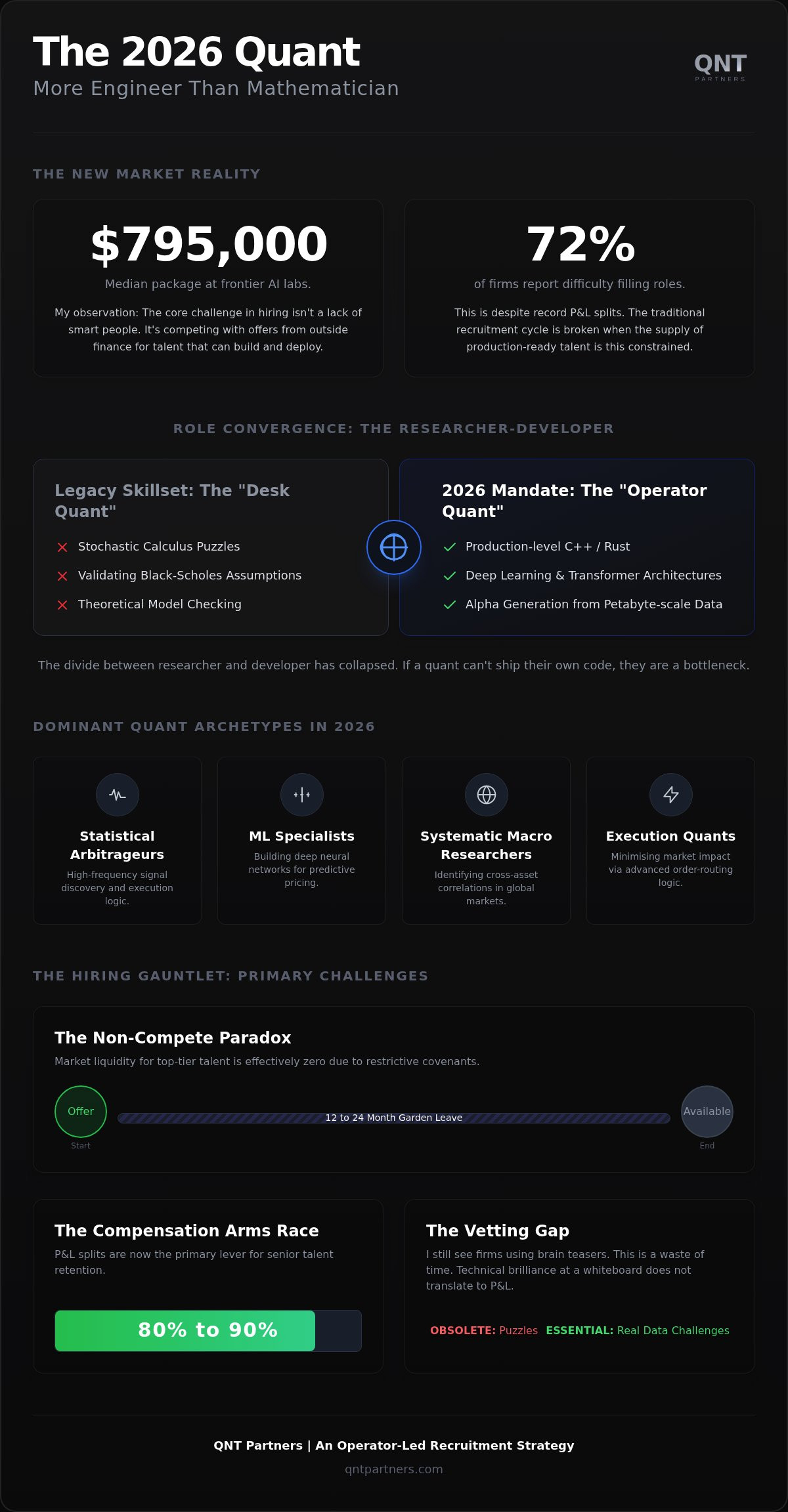
A Distinction in a Cambridge PhD programme has become a baseline rather than a differentiator for a Chicago prop shop. Most heads of trading I speak with are tired of seeing candidates who can solve stochastic calculus puzzles but fail to write production-level C++ that survives a low-latency environment. The core challenges in hiring quantitative talent in 2026 aren't about finding smart people, they're about competing with the $795,000 median packages offered by frontier AI labs like OpenAI.
You likely recognise that the traditional recruitment cycle is broken when 72% of firms report difficulty filling roles despite offering 80% to 90% P&L splits. It's a strategic arms race where the quants meaning in a 2026 context has evolved from pure mathematical modelling to a requirement for deep, hands-on engineering. I'll provide a framework for evaluating talent beyond the usual technical filters and share how we advise firms on retention strategies that actually work in a market where garden leave is often the only thing keeping a team together.
Key Takeaways
- Recognise why the 2026 market demands researchers who function as alpha generators rather than simple model checkers.
- Analyse the structural challenges in hiring quantitative talent, including the impact of deferred bonuses and 24-month garden leave clauses on your time-to-hire.
- Learn how to structure offers that compete with the $800,000 packages found at frontier AI labs while maintaining internal equity.
- Discover why research autonomy and P&L splits in the 80 to 90 percent range are the primary drivers for senior talent retention.
- Use an operator-led recruitment strategy to protect your firm’s reputation during sensitive build-outs or spinouts.
Defining 'Quants Meaning' in the 2026 Systematic Landscape
The era of the "desk quant" who spends their afternoon validating Black-Scholes assumptions is finished. In 2026, if you aren't building the infrastructure to extract alpha from petabytes of alternative data, you're essentially a back-office functionary. One of the primary challenges in hiring quantitative talent is that the job title hasn't kept pace with the technical requirements of a modern pod. I've observed the industry move far beyond the foundational Quantitative analysis (finance) roots where pricing derivatives was the peak of the profession.
Now, a quant researcher is expected to be a full-stack operator. I see several distinct profiles dominating the market:
- Statistical Arbitrageurs: Focused on high-frequency signal discovery and execution logic.
- ML Specialists: Building deep neural networks for predictive pricing.
- Systematic Macro Researchers: Identifying cross-asset correlations in global markets.
- Execution Quants: Minimising market impact through advanced order-routing logic.
Traditional financial engineering degrees are no longer a sufficient signal. The quants meaning has shifted to include low-latency engineering and a mastery of non-stationary datasets.
The Shift from Stochastic Calculus to Deep Learning
Whiteboard sessions involving complex partial differential equations have been replaced by discussions on transformer architectures and reinforcement learning. The required mathematical toolkit has pivoted toward predictive modelling rather than risk-neutral pricing. A 2026 quant is a data scientist with the financial intuition to distinguish between statistical noise and tradable alpha in volatile markets.
Quants vs. Engineers: The Convergence of Roles
The divide between the "researcher" and the "developer" has collapsed in most elite Sydney-based systematic funds. If a researcher cannot write production-level C++ or Rust, they become a bottleneck for the entire pod. This has led to the rise of the Quant Developer as a critical infrastructure pillar. This convergence creates significant challenges in hiring quantitative talent, as the overlap between high-level mathematics and systems programming is minimal. Firms that fail to identify these hybrid specialists will find their research pipelines stalled by engineering bottlenecks that no amount of capital can fix.
Primary Challenges in Hiring Quantitative Talent Today
Finding a researcher with a verified Sharpe ratio above 2.5 who isn't already buried under three years of deferred compensation is the industry's hardest solve. The most significant challenges in hiring quantitative talent today stem from the fact that raw intelligence is now a commodity. I see plenty of candidates with perfect academic records, but very few who can manage the transition from a backtest to a live production environment without their models collapsing under the weight of market impact and slippage.
There is also a growing issue of asymmetric information during the interview process. In specialised niches like high-frequency market making or exotic options, the candidate often understands the nuances of their specific model better than the PM conducting the interview. This makes it incredibly difficult to distinguish between genuine alpha and clever curve-fitting. If you are struggling with these vetting hurdles, it might be time to re-evaluate your search strategy with someone who understands the underlying mechanics of a pod shop structure.
The Non-Compete and Talent Lock-in Paradox
Market liquidity for top-tier talent has effectively dried up due to the prevalence of 12 to 24 month non-competes. Since the Federal Trade Commission withdrew its proposed nationwide ban in September 2025, firms have doubled down on these restrictive covenants to protect their IP. We are seeing more "buy-outs" where a fund will pay out the entirety of a candidate's deferred bonus just to get them through the door, but this creates internal equity issues with existing staff. Managing these legal and financial hurdles requires a level of discretion that most generalist recruiters simply don't possess.
The Vetting Gap: Why Puzzles No Longer Work
I still see firms using brain teasers and probability puzzles to screen senior researchers, which is a waste of everyone's time. Technical brilliance at a whiteboard does not always translate to trading P&L. Modern vetting must focus on real-world data challenges and the candidate's ability to handle the following:
- Ability to handle non-stationary data in volatile regimes.
- Understanding of exchange connectivity and its impact on execution.
- Resilience during drawdowns exceeding two standard deviations.
- Proficiency in production-ready coding to avoid research-to-dev bottlenecks.
Hiring an academic who has spent years refining a backtest to perfection often results in a researcher who is over-fit to historical noise and utterly incapable of adapting to live market regimes. Cultural fit is equally vital; a brilliant researcher who can't operate within a high-pressure pod structure will eventually cause a blow-up, regardless of their individual performance. You cannot afford to ignore the friction that a "lone wolf" researcher creates in a collaborative HFT environment.
The War for AI and ML Specialists in Finance
OpenAI's median compensation package for a software engineer has hit $795,000. This figure represents the new floor for the 1% of talent that systematic funds and frontier AI labs are both chasing. The competition now extends beyond traditional rivals to include the entire Silicon Valley ecosystem, which is one of the most pressing challenges in hiring quantitative talent in 2026.
Hiring for Deep Learning and Neural Network applications in a trading context requires a different filter than general tech recruitment. A researcher who can optimise a recommendation engine for a streaming giant might struggle with the non-stationary nature of financial markets. I've seen brilliant ML specialists fail because they couldn't grasp that in finance, the data doesn't just change, it actively reacts to your presence in the market.
Systematic Trading vs. Big Tech: The Value Proposition
Selling a role at a Sydney-based systematic fund to a pure-play ML researcher requires focusing on the impact-to-reward ratio. In a multi-manager structure, an ML specialist's work directly hits the P&L. This allows for bonus structures tied to performance that can far exceed the capped upside of Big Tech equity. I find that the most effective pitch centres on the sheer complexity of the data, as financial markets represent the ultimate adversarial environment for machine learning.
For an elite researcher, the chance to test their architectures against a live, hostile market is often more compelling than refining an ad-targeting algorithm. We prioritise finding candidates who value this direct feedback loop. This requires a discreet search process that reaches into non-financial sectors like autonomous driving or signal processing to identify individuals with the necessary mathematical maturity.
Hiring for Predictive Modeling and Alpha Decay
Vetting for ML talent in finance requires a deep dive into how a candidate handles alpha decay. Most academic models are over-fit to historical noise. A researcher must demonstrate an ability to build resilient models that remain effective across regime shifts without requiring constant, manual recalibration. They need to understand that a model with a high Sharpe ratio in a backtest is worthless if it cannot survive a two-standard-deviation event in live trading.
This specific technical intersection is why we specialise in Specialised Executive Search for AI & ML in Finance. We look for candidates who possess the financial intuition to distinguish between statistical noise and tradable alpha. Firms that treat AI hiring as a standard technical search will continue to lose the best talent to labs that offer more research autonomy and faster feedback loops.
Human Capital Benchmarking and Retention Strategies
Senior researchers with a decade of experience don't move for a 10% bump in base salary. Base salary is secondary. They move for a 15% to 25% P&L cut and the freedom to trade their own signals without being second-guessed by a central risk desk. Compensation for senior lead roles now routinely exceeds $1.5 million to $5 million. This makes the standard hedge fund bonus model look antiquated to the market’s top performers.
I see a significant volume of talent leakage from multi-manager funds to boutique crypto firms and spinouts. While a median tenure of 1.8 to 3.0 years is expected in the pod shop model, losing your best alpha generators is a strategic failure. One of the primary challenges in hiring quantitative talent in 2026 is that the best individuals now value the ability to own their IP. It's about autonomy.
If your retention strategy relies solely on garden leave and non-competes, you are already behind the curve. We provide the market intelligence necessary to benchmark your team structure against the most aggressive players in the industry.
Strategic Talent Advisory for Quant Funds
Structuring a team to avoid a single point of failure is a delicate balance. If one researcher holds the keys to your entire signal library, they effectively own the firm. We help funds transition toward a structure where collaborative research and siloed alpha generation coexist. This ensures that the departure of one individual doesn't result in a total drawdown. A comprehensive talent strategy advisory is the only way to maintain a competitive edge in a market where your rivals are constantly headhunting your most profitable pods.
Global Salary Benchmarking
The rise of multi-hub teams in Singapore, London, Dubai, and New York has complicated the compensation environment. You cannot simply apply a New York cost-of-living adjustment to a researcher based in Dubai and expect them to stay. It won't work. Transparency laws in 2026 have made it easier for candidates to see what their peers are making. This has forced many firms to standardise their equity partnerships and P&L splits to avoid internal friction. If your benchmarks are based on 2024 data, you are likely underpaying your top researchers by at least 15%.
The QNT Approach: Solving the Quant Recruitment Paradox
Most generalist headhunters couldn't tell the difference between a mid-frequency statistical arbitrageur and a low-latency execution engineer. This technical illiteracy is why so many firms struggle with the persistent challenges in hiring quantitative talent, as they rely on keyword matching rather than understanding the underlying mechanics of a trading desk. At QNT Partners, we operate differently because we've sat in the seats you're trying to fill. We don't just source candidates. We perform peer-level technical vetting that filters out the academic over-fitters from the genuine alpha generators.
Our approach is built on discretion and deep-rooted international relationships across HFT hubs. In a market where a leaked hire can signal your entire research direction to competitors, privacy is a functional requirement. We act as a quiet power, facilitating the movement of elite talent through a global network that generalist firms cannot access. This ecosystem extends beyond simple placement to include talent strategy advisory and capital advisory, ensuring that your team structure is built for long-term P&L growth rather than short-term filling of seats.
Discreet Executive Search for Systematic Trading
Accessing the passive market requires more than a LinkedIn Recruiter license. The researchers you actually want to hire are currently managing significant capital and are protected by 24-month non-compete clauses. We specialise in identifying these individuals long before they hit the open market. By conducting The Architecture of Quant Trading & Research Recruitment, we ensure that every candidate has been vetted by an operator who understands Sharpe ratios and drawdown limits. This peer-to-peer relationship allows us to bypass the usual friction points of the recruitment cycle.
A Partner for the High-Stakes Operator
Hiring is only one half of the equation for a growing fund. We bridge the gap between human capital and financial capital by connecting institutional investors with managers through specialised SMA sourcing. This holistic approach means we can facilitate capital raising alongside talent acquisition, helping spinouts and boutique funds scale with the right infrastructure from day one. If you are planning a build-out or looking to secure your next lead researcher, you should Partner with QNT for your next elite mandate. Failing to align your talent strategy with your capital requirements is a fast way to burn through your runway without ever hitting your performance targets.
Securing Your Edge in the 2026 Talent Market
The window for securing elite alpha generators is narrowing as the 2027 graduate and lateral cycles begin in August 2026. You cannot rely on legacy vetting processes when the market floor is being set by frontier AI labs and boutique spinouts offering aggressive P&L splits. Success requires a shift from viewing recruitment as an administrative function to treating it as a strategic human capital mandate.
We’ve seen that the primary challenges in hiring quantitative talent are structural. They involve navigating 24-month non-competes and the convergence of research and low-latency engineering roles. QNT Partners was founded by former industry operators to solve these specific frictions through deep-rooted international relationships and technical peer-to-peer vetting. We maintain global reach with the boutique discretion required for high-stakes build-outs and sensitive spinouts.
If you need to benchmark your current pod structure or identify the 1% of talent capable of surviving live market regimes, I suggest we talk. You can consult with QNT Partners on your talent strategy to ensure your firm remains competitive in an increasingly adversarial landscape. The right hire is out there, and the right structure will ensure they stay.
Frequently Asked Questions
What is the modern quants meaning in systematic trading?
The definition has shifted from derivative pricing to a requirement for full-stack alpha generation. A 2026 quant is expected to master predictive modelling and low-latency systems rather than just validating stochastic calculus assumptions. It involves extracting signals from non-stationary data and ensuring those signals can survive live execution. The focus is now on the entire pipeline from data ingestion to trade execution.
What are the biggest challenges in hiring quantitative talent in 2026?
Competing with $800,000 packages at frontier AI labs is currently the most significant hurdle. One of the primary challenges in hiring quantitative talent is navigating 24-month non-compete clauses that stifle market liquidity. Firms also face asymmetric information where candidates understand their niche models better than the PM conducting the interview. This makes it difficult to distinguish between genuine alpha and clever curve-fitting.
How much do quantitative researchers earn in HFT firms?
Junior researchers with up to three years of experience earn between $250,000 and $450,000. Mid-level talent (3 to 5 years) typically sees total compensation between $400,000 and $900,000. Senior leads and portfolio managers often exceed $1.5 million to $5 million. These figures are driven by P&L splits that now range between 15% and 25% for high performers in multi-manager structures.
Why do quants leave hedge funds for tech companies?
Senior researchers often leave for the research autonomy and faster feedback loops found at frontier AI labs. While systematic funds offer high P&L splits, the $795,000 median packages at firms like OpenAI provide a compelling alternative for those tired of the pod shop churn. The chance to work on transformer architectures without the immediate pressure of daily P&L is a significant draw for academic-leaning quants.
How do you vet a quantitative researcher for alpha generation?
Move beyond probability puzzles and focus on real-world data challenges that test for over-fitting. Vetting must include a candidate’s ability to handle slippage, market impact, and alpha decay in live regimes. I look for researchers who can explain why their model failed during a specific market event. A researcher who only performs well in a backtest is usually just capturing historical noise.
What is the role of a quant headhunter in a discreet search?
An operator-led headhunter protects your firm’s reputation while accessing the passive market of elite researchers. We use deep-rooted international relationships to identify candidates who are currently protected by garden leave. This peer-level vetting ensures that only individuals with genuine alpha-generating capability reach the final interview stage. It’s about protecting the interests of both the fund and the candidate in a high-stakes environment.
Can machine learning experts from outside finance become successful quants?
Yes, provided they can adapt to the non-stationary nature of financial markets. The main hurdle is teaching them that the data reacts to their presence in the market. Those from autonomous driving or signal processing backgrounds often have the mathematical maturity required for systematic trading. We often target these sectors during a discreet search to find fresh perspectives on predictive modelling.
What is the difference between a quant researcher and a quant developer?
A researcher focuses on signal discovery and predictive modelling using Python or R. A developer builds the low-latency infrastructure, FPGA connectivity, and C++ frameworks required for execution. In elite pods, these roles are increasingly converging into a single hybrid profile. If a researcher cannot write production-level code, they become a bottleneck for the entire trading desk.