Capital Raising for Quant Funds: A Practical Guide for 2026

The wrong capital vehicle can make a credible quant strategy harder to fund than it needs to be. In capital raising for quant funds, fit matters as much as the return stream: an SMA that suits one mandate may constrain another strategy’s implementation, while a commingled fund or equity partnership changes the investor conversation and the operating work involved.
A strong backtest won’t close an allocation on its own. Investors need to understand what produces the P&L, where capacity sits and how live results behave in different conditions. Preparing that case takes time, and fundraising can draw senior people away from research and trading if the process isn’t scoped carefully.
This guide explains how to match a vehicle to the strategy and investor mandate, then make the allocator case beyond headline performance. It compares SMAs with commingled funds and equity partnerships, and covers what to prepare before outreach and when SMA sourcing may be worth exploring. The goal is a focused process that protects investment time and puts the strategy in front of capital that could fit it.
Key Takeaways
- Capital raising for quant funds starts with fit: assess how the strategy’s implementation and constraints match the proposed vehicle and investor mandate.
- Compare commingled funds, SMAs and equity partnerships by control, reporting needs and the operational work each structure requires.
- Make the allocator case specific to the strategy, with clear evidence on capacity, drawdowns, execution dependencies and research governance.
- Sequence investor outreach carefully: confirm mandate fit and review the operating setup before approaching allocators selectively.
- SMA sourcing may be worth discussing when an institutional mandate aligns with the manager’s strategy, but advisory support cannot guarantee capital or an allocation.
Why capital raising for quant funds is a strategy and structure decision
A strong performance record doesn’t, by itself, establish which investors can use a strategy or which vehicle will let it run as intended. Capital raising for quant funds means aligning the investment process with a capital structure and an investor mandate the manager can credibly serve.
Start with the operating model. A strategy dependent on particular exchange connectivity, co-location or tick-to-trade latency may have different capacity and implementation constraints from a slower-turnover systematic macro strategy. Understand those dependencies before discussing capital. A mandate that changes execution or liquidity may change the strategy itself.
This guide focuses on how a manager’s strategy, vehicle and investor expectations interact before outreach begins. It is not general fund-marketing advice: the practical question is whether a proposed structure can accommodate the strategy’s actual requirements.
What managers need to decide before approaching investors
Begin with facts the team can support: how capacity is assessed, how the strategy’s liquidity profile may behave under stress, and which parts of implementation are essential. Separate observed evidence from assumptions. A live record or research result can show how a process has behaved; it does not establish that a particular allocator has appetite for it.
Be precise about drawdowns, execution dependencies and the conditions under which signals may weaken. A performance record can support the discussion, but no record guarantees an allocation. If the operating model is unsettled, investor conversations may pull the PM into negotiating constraints before the strategy’s requirements are clear.
Why the capital vehicle changes the conversation
A commingled fund pools investor capital under a shared vehicle. An SMA, or separately managed account, is an account managed for an individual investor according to an agreed mandate. A strategic partnership may involve a different arrangement between a manager and a capital partner. Terms and rights depend on the specific structure, so don’t assume they are uniform.
These routes can change how much control an investor has over guidelines, transparency and portfolio restrictions, as well as the manager’s reporting and operational workload. The key question is whether those requirements leave the strategy intact. For instance, an investor-specific restriction may be manageable for one model but incompatible with another that depends on broad instrument access or consistent execution.
The Quantitative fund overview provides a useful starting point on the range of vehicles and systematic investment processes associated with quant funds. But “quant” is too broad to guide a raise. Investors need to assess the specific return drivers and implementation needs, then decide whether the proposed structure can accommodate them.
Settle the operating fit before outreach. It gives the manager a clearer basis for selecting investors and helps avoid spending time on mandates that require material changes to the strategy.
How quant fund capital structures shape investor fit
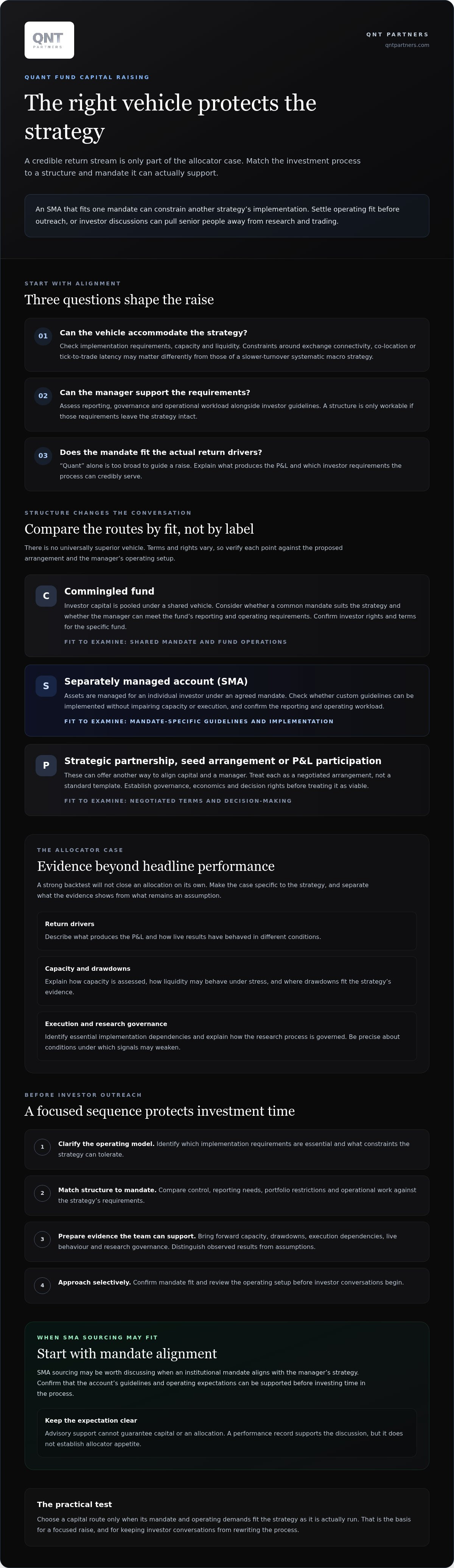
The vehicle affects more than how capital is held. It shapes an investor’s ability to set mandate-specific requirements and the manager’s workload for reporting, governance and implementation. There’s no universally superior route. The choice depends on strategy capacity, how much customisation the model can tolerate and the resources available to support the structure.
Use the comparison below as a starting point, not as a statement of standard terms. Verify each operational and control point against the proposed arrangement and the manager’s own setup.
Commingled fund
Capital is pooled under a shared vehicle. Consider whether a common mandate suits the strategy and whether the manager can support the fund’s reporting and operating requirements. Verify investor rights and terms for the specific fund.
Separately managed account (SMA)
Assets are managed in an account for an investor under a defined mandate. Assess whether custom guidelines can be implemented without impairing capacity or execution, and confirm the reporting and operating workload with the investor.
Strategic partnership, seed arrangement or P&L participation
These may provide another route to align capital and a manager, but the arrangement is negotiated rather than presumed. Confirm governance, economics and decision rights before treating it as a viable structure.
Commingled funds and separately managed accounts
A commingled fund applies a shared structure to pooled capital; an SMA gives an investor a dedicated account managed to its mandate. That distinction matters for a strategy with constrained capacity or material execution dependencies. An investor’s restrictions may be workable for one model and disruptive for another. Check how account-specific guidelines would affect position limits, instruments and implementation. Then assess the additional operational work rather than assuming it will be minor.
For further context on partnership structures, see our article on SMA and SVA partnerships. The relevant details still need to be confirmed for each manager and investor.
Partnerships, seed arrangements and P&L participation
A seed arrangement or P&L participation can be part of a negotiated capital relationship, but neither is a guaranteed route to funding or a standard package. Write down who controls investment decisions, how governance works and how economics are determined. Clarify any conditions that could affect the manager’s independence or the strategy’s operation.
In capital raising for quant funds, investor fit is a practical test: can the manager satisfy the structure’s requirements without compromising the process that generates returns? Before choosing a route, confirm capacity assumptions, customisation needs and who is available to handle account-level operations and reporting. Those checks turn a broad preference for pooled or dedicated capital into a decision grounded in the strategy.
Which capital-raising route fits your quant strategy?
Choose a route based on the strategy’s operating limits, not a preferred fundraising template. Test each prospective mandate against the actual implementation: does it restrict instruments, change position limits or add reporting work the team can support without drawing researchers and traders away from the process?
Investor type matters because governance and diligence processes vary by organisation. Map the mandate’s requirements to the manager’s capacity to answer questions, provide agreed reporting and maintain decision-making discipline. Don’t infer fit from an investor’s label alone. Confirm what that investor needs and whether the team can deliver it.
When an SMA may be worth exploring
An SMA is worth exploring when a defined investor mandate appears compatible with the strategy as it is actually traded. Test custom constraints against research and execution before treating the account as viable. For a low-latency strategy, for example, consider whether account-level guidelines could affect order handling, exchange connectivity or deployment across venues. Establish who will own the additional reporting and operational work as well.
This is a diligence question, not a promise of capital. A mandate that requires material changes to signal use or implementation may be a poor fit, even if the investor is interested. Understand those trade-offs before discussing a potential allocation.
When a pooled vehicle or partnership may fit better
A manager seeking a repeatable vehicle for multiple investors may prefer to assess a pooled structure. A partnership could also be considered where a capital partner and manager can agree on governance, decision rights and economics. These are negotiated matters, not standard features to assume in advance.
Consider two hypothetical teams. A Chicago prop-shop spinout with a strategy built around specific co-location and execution requirements would need to test investor constraints against that setup. A Sydney-based systematic team might first establish whether its strategy can be delivered consistently under one investor’s mandate or whether it is designed for a shared vehicle. These examples illustrate different questions, not known outcomes or recommendations.
For capital raising for quant funds, the useful decision is the one grounded in the manager’s strategy, operating resources and the investor’s confirmed requirements. Before choosing a route, write down which constraints are acceptable, which would change the process and who would handle added governance or reporting. That gives the first investor discussion a clear boundary: what the team can accommodate without weakening implementation.
What to prepare before quant-fund investor outreach
Investor outreach is more useful once the manager can explain what the strategy needs to operate and what evidence supports its claims. For capital raising for quant funds, preparation should be a short sequence, not a large presentation assembled before the vehicle and mandate are clear.
- Clarify mandate fit. Record which investor requirements the strategy can accommodate and which could alter its signals, instruments or execution.
- Evidence the process. Explain the return drivers and distinguish observed results from hypotheses about how the strategy may perform in future conditions.
- Review operations. Check capacity assumptions, research ownership, reporting responsibilities and dependencies on people or infrastructure.
- Approach selectively. Prioritise investors whose stated mandate appears compatible, then verify requirements directly rather than assuming every allocator follows the same process.
Make the strategy legible without overstating it
An allocator needs a clear account of how the strategy seeks to generate returns, what conditions can affect it and where capacity may become constrained. Describe drawdowns in context, including the period and market conditions, and explain whether any material change in the process affected the record. Don’t present a research hypothesis as a live result.
Include technical detail when it changes the investment or operating discussion. If co-location, exchange connectivity, tick-to-trade latency or FPGA use is material to capacity or execution, explain the dependency and what happens if it changes. Verify track-record and operational claims with the manager before sharing them.
Check operational and people dependencies
Identify who owns research, who can maintain production systems and where the strategy depends on a particular PM, researcher or engineer. A strategy may look repeatable in aggregate while relying on one person’s undocumented knowledge or a fragile deployment path. State those dependencies plainly and explain how the team manages them.
Garden leave or non-compete restrictions may matter if a key hire or spinout is part of the operating plan. Their effect depends on the specific facts and applicable terms, so verify them with appropriate legal advice before making claims about availability or timing. Don’t assume every investor will ask the same questions.
Before sending materials, check that the mandate, performance narrative and operating description tell the same story. A mismatch, such as capacity claims that ignore execution constraints, is easier to correct before an allocator relies on it.
When specialist SMA sourcing can support a quant fund raise
An SMA route is worth exploring when an institutional investor’s mandate appears compatible with how the strategy trades. The hard part is establishing that fit before outreach, not simply finding a potential allocator. In capital raising for quant funds, a specialist conversation can help test the match between manager, mandate and operating structure.
At QNT Partners, our relevant work includes manager search, SMA sourcing and capital-raising advisory for institutional clients. We connect investors with investment managers and support the process of assessing whether a strategy may fit a mandate. That support can help with alignment and introductions. It cannot guarantee capital or an allocation.
What a specialist sourcing conversation should establish
Start with the manager’s strategy and preferred operating structure. Be clear about capacity, liquidity and the mandate constraints the process can accommodate without changing implementation. Then establish what investor fit means for this manager: which requirements are essential, where there may be flexibility and what would rule out a match.
Keep the discussion appropriately discreet. Use anonymised examples when discussing the market, and share confidential strategy or investor information only with suitable care. Our article on SMA and SVA partnerships offers further context on how those arrangements can be structured. Specific terms still need to be assessed for each situation.
How to assess whether advisory is appropriate
Before agreeing a process, clarify its scope, how potential mandates would be screened against the strategy and what remains the manager’s responsibility. The manager still needs to substantiate performance and operational claims, decide which constraints are acceptable, and assess any proposed terms with the appropriate advisers. Specialist support should make the matching process more focused, not replace the manager’s judgement.
A useful first step is to write a short mandate-fit brief: summarise the strategy, capacity assumptions, preferred vehicle and non-negotiable implementation requirements. That gives a sourcing discussion a concrete basis and helps identify misalignment early. Managers assessing institutional SMA sourcing can review QNT Partners’ institutional client focus and consider whether a structured discussion about mandate fit is appropriate.
Put the right capital structure to work
Capital raising for quant funds works best when the vehicle fits the strategy’s real operating limits and the investor’s mandate. Decide what the model can accommodate before outreach, then make the allocator case with evidence on capacity, drawdowns and execution dependencies. A strong record helps, but it doesn’t guarantee an allocation.
An SMA may suit a strategy and investor whose requirements align. If they don’t, a pooled vehicle or negotiated partnership may be more appropriate. The choice should follow the manager’s facts, not a fundraising template.
At QNT Partners, we specialise in quantitative trading, research and technology. We provide SMA sourcing and capital-raising advisory for institutional clients, supporting manager and mandate alignment without promising capital or allocations.
If you’re assessing investor fit or considering an SMA route, discuss your quant fund’s capital-raising requirements. A clear mandate-fit conversation is a practical next step, keeping the focus on a structure the strategy can operate within.
Frequently Asked Questions
How do quant funds raise capital?
Quant funds raise capital by presenting a defined strategy to investors through a suitable structure, such as a commingled fund, an SMA or a negotiated partnership. Capital raising for quant funds starts with establishing which investor mandates the strategy can serve without changing its implementation. Managers then prepare evidence on return drivers, capacity, drawdowns and operations, and approach relevant investors. A performance record supports the case, but doesn’t guarantee an allocation.
Is an SMA a good fit for a quantitative fund?
An SMA can fit a quantitative fund when an investor’s mandate aligns with the strategy’s implementation and the manager can support account-specific requirements. Assess whether guidelines, reporting or portfolio constraints could affect signals, instrument access, execution or capacity. Also establish who will handle the additional operational work. An SMA isn’t automatically preferable to a pooled vehicle, and the proposed mandate should be assessed on its own terms.
What do investors look for when allocating to quant funds?
Investors assess the specific strategy, not simply the “quant” label. They may examine how the process generates returns, how it has behaved through drawdowns and where capacity or execution could constrain it. They’ll also need a clear account of research governance and operational dependencies. Investor requirements differ, so managers should verify each mandate rather than assume that one diligence process or set of expectations applies across allocators.
Can a new quant fund raise capital without a long track record?
A new quant fund may be considered without a long fund-level record, but there’s no assured route to capital. The manager needs to distinguish any verifiable prior results from research evidence and explain what each does, and doesn’t, demonstrate. Investors may assess the team, process and operational readiness alongside performance history. Whether that evidence suits a particular mandate depends on the investor, the strategy and the proposed structure.
How is raising capital through an SMA different from a pooled fund?
A pooled fund combines investor capital under a shared vehicle, while an SMA is an account managed for an investor under a defined mandate. That account-level arrangement can bring specific guidelines and reporting requirements, which the manager should check against the strategy’s implementation and operating capacity. Terms vary by arrangement. Neither structure is universally better: the choice depends on investor requirements and what the manager can support.
When should a quant manager use a capital-raising adviser?
Consider specialist advice when the manager needs help assessing investor fit or exploring SMA sourcing for an institutional mandate. Before engaging, agree the scope, process and how potential mandates will be screened against the strategy. An adviser may support alignment and introductions, but can’t promise capital or an allocation. The manager remains responsible for substantiating claims, assessing proposed terms and deciding whether an investor’s requirements are workable.
What information should a quant fund prepare before investor outreach?
Prepare a concise description of the strategy’s return drivers, capacity assumptions and drawdown context, with observed performance clearly separated from expectations. Document material execution dependencies, such as co-location or exchange connectivity when they affect implementation, and explain who owns research and operations. Confirm that each claim is accurate with the manager. Then clarify which investor requirements the strategy can accommodate before approaching allocators selectively.