Capital raising for emerging quant managers via SMAs: The shift from pods to independence

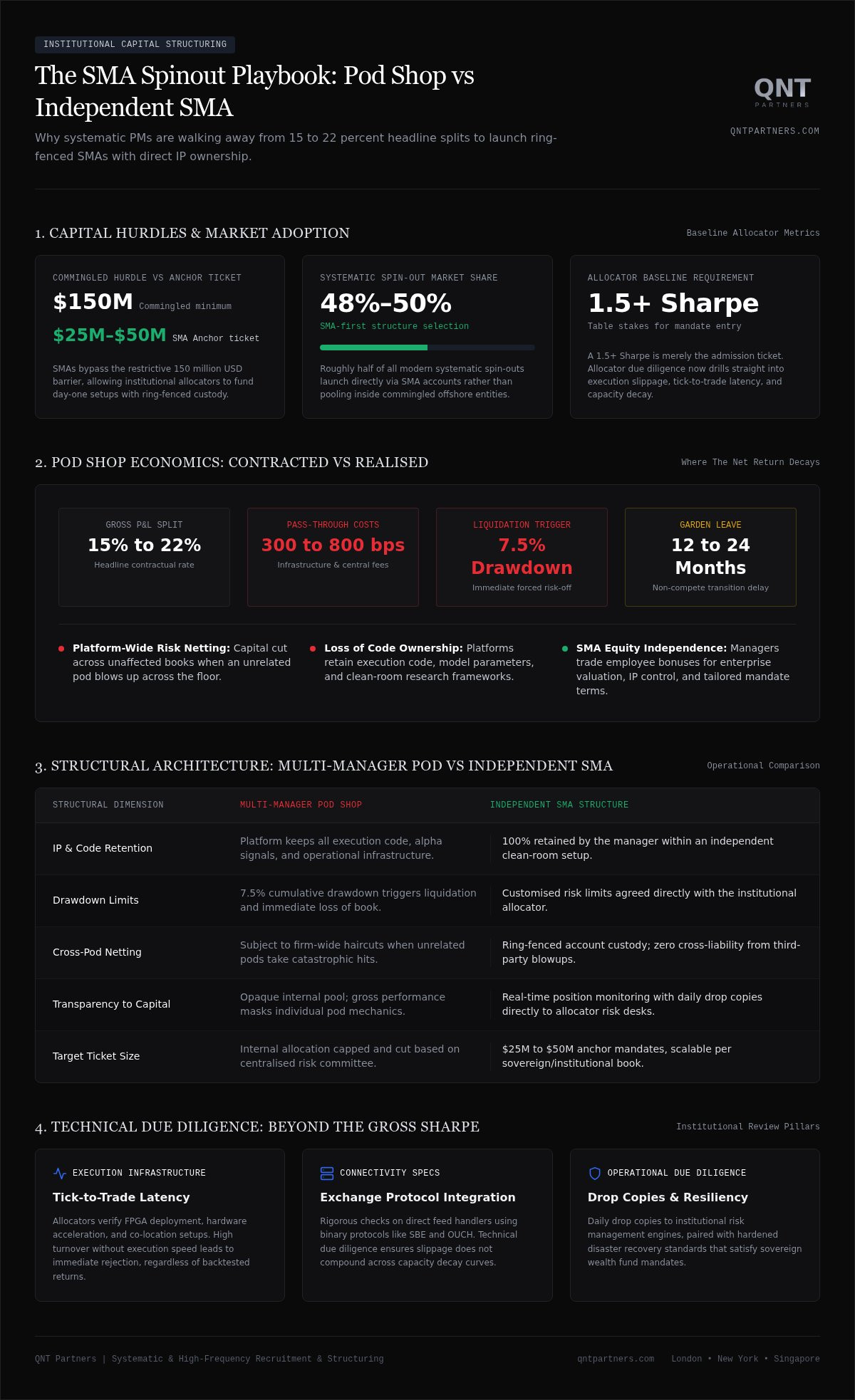
The maths of the multi-manager pod shop no longer adds up for the most elite systematic talent. While a 15 to 22 percent P&L split looks good on a contract, the actual net payout often collapses after accounting for 300 to 800 basis points of pass-through costs and platform-wide risk netting. Capital raising for emerging quant managers via SMAs has moved from a niche alternative to the primary route for those who want to own their IP and their destiny.
You know the frustration of having your book cut because an unrelated pod across the floor blew up, or facing a 7.5 percent cumulative drawdown limit that triggers immediate liquidation. It's a structure that prioritises platform stability over individual alpha.
This guide examines why sovereign wealth funds and institutional allocators are increasingly favouring ring-fenced SMAs over commingled funds or pod structures. I will outline the operational requirements for a 25 million to 50 million USD anchor ticket and how to organise an independent launch that keeps your execution code and research framework under your control. We will look at the shift toward independent capital allocation and the mechanics of proving your alpha to external allocators without the platform's shadow.
Key Takeaways
- Top-tier portfolio managers are trading 15 to 20 percent P&L splits for the autonomy of an independent structure. Moving to an SMA allows you to retain ownership of your IP rather than leaving it behind at a multi-manager platform.
- Modern institutional vetting has evolved far beyond the backtest and gross Sharpe ratio. Technical due diligence now scrutinises your execution stack, exchange connectivity, and capacity decay curves.
- Capital raising for emerging quant managers via SMAs provides a direct path to institutional mandates while bypassing the 150 million USD hurdle of a commingled launch. It is the vehicle of choice for allocators seeking daily position visibility and ring-fenced custody.
- You cannot secure institutional backing without a professional operational setup. Success requires a resilient infrastructure that meets rigorous operational due diligence standards for risk and disaster recovery.
- Successful managers treat capital raising as a technical problem rather than a sales pitch. Your success depends on translating a technical edge into a narrative that institutional allocators can actually fund.
The exodus from multi-manager platforms to independent SMAs
I am seeing a clear trend where top-tier PMs are trading their 15 to 20 percent P&L splits for the autonomy of an SMA. The attraction of the multi-manager platform used to be the turnkey infrastructure. Today, that convenience comes at a price many elite researchers find too high to pay. Platforms provide the connectivity and the capital, but they also take the lion's share of the upside and keep every line of your IP.
Transitioning from a pod to an SMA requires a careful dance around non-competes and garden leave. These periods often stretch from 12 to 24 months for senior PMs at major systematic hubs. I have spoken with researchers who spent two years sitting on the sidelines just to ensure they could launch with a clean-room implementation of their execution stack. It is a long game, but for those with a 1.5+ Sharpe strategy, the math usually works out. You can learn more about these structures in our guide to SMA and SVA partnerships.
Why the pod shop model is fraying for elite talent
Internal netting risk is the primary driver for this migration. Within a multi-strategy fund, your capital allocation is often subject to the performance of unrelated pods. If a volatility pod in London blows up, the firm might cut risk across the entire portfolio (including your mid-frequency statistical arbitrage book in New York). This capital haircut happens regardless of your individual performance.
Many PMs now seek direct equity partnerships rather than being high-paid employees. They want to build a firm with enterprise value, not just a bonus pool. IP ownership disputes remain the biggest point of friction. When a researcher wants to port a strategy to a new environment, the platform will fight to keep the code. Moving to an SMA structure from the start ensures the manager, not the platform, owns the alpha.
The appeal of the SMA for institutional day-one capital
Allocators are now comfortable funding a researcher directly if the technical stack is proven. Capital raising for emerging quant managers via SMAs has increased because institutional investors demand transparency that commingled funds cannot match. They want real-time position monitoring and daily drop copies sent to their own risk systems.
This structure allows for customised risk limits that fit the specific mandate of a sovereign wealth fund or pension scheme. It also lowers the key person risk for the allocator. By having direct control over the assets in a ring-fenced account, the investor is protected from the operational failures or cross-liability issues of a broader fund. Approximately 48 to 50 percent of newly launched systematic spin-outs now favour this SMA-first route.
Institutional capital is bypassing the middleman to find the source of the alpha. Capital raising for emerging quant managers via SMAs is the mechanism making that direct connection possible.
Vetting systematic alpha: Beyond the Sharpe ratio
I find that most allocators used to look at a backtest and a Sharpe ratio, but that is no longer enough. In 2026, the entry fee for an institutional mandate is a 1.5+ Sharpe, but the actual vetting happens in the plumbing. If you are running a high-turnover strategy, your slippage and tick-to-trade latency are more important than your three-year trailing return. Capital raising for emerging quant managers via SMAs now involves a level of technical scrutiny that used to be reserved for internal HFT pod reviews.
We help allocators understand if the alpha is structural or just a temporary market inefficiency. I've seen researchers with a 3.0 Sharpe get rejected because their execution logic was too slow for the alpha they were chasing. If you are preparing for this level of scrutiny, we can help you vet your technical narrative before you meet the first allocator.
Assessing tick-to-trade latency and execution slippage
FPGA and hardware acceleration are now standard parts of the capital raising conversation. Allocators want to know exactly how you handle co-location and exchange-specific protocols like SBE or OUCH. For a high-frequency systematic strategy, execution costs can easily eat 300 to 500 basis points of gross return. If your tick-to-trade latency isn't competitive, your backtest is essentially fiction. We look for managers who have built their own execution algorithms rather than relying on generic prime broker wheels.
- Co-location strategy: Proximity to the matching engine and cross-connect reliability.
- Hardware stack: Use of FPGA for signal generation and risk checks.
- TCA analysis: Demonstrated slippage vs model assumptions across different liquidity regimes.
Identifying strategy capacity and alpha decay
The biggest question for a 25 million to 50 million USD anchor ticket is whether the strategy scales to 250 million USD without the Sharpe collapsing. I look for capacity decay curves. Is the manager just 'buying the factor' or generating true idiosyncratic alpha? Many quants are just running leveraged momentum or carry trades disguised as machine learning. We vet the feature engineering process to ensure the signals are unique.
By 2026, the role of machine learning in maintaining a competitive edge is non-negotiable. However, it's about the quality of the data pipeline and the avoidance of over-fitting rather than just using the latest transformer model. Capital raising for emerging quant managers via SMAs depends on proving that your edge is sustainable as AUM grows and market participants evolve. A strategy that worked in 2024 might be crowded beta by 2026.
SMA structures vs commingled funds for the emerging manager
The choice between a commingled fund and an SMA often comes down to who you want to own the relationship. If you are looking to scale hundreds of small tickets, a commingled structure is the only logical path. However, for a high-calibre spin-out, capital raising for emerging quant managers via SMAs is the superior strategy for securing day-one institutional backing. I advise managers to start with an SMA to build a verifiable track record while keeping operational overheads low during the early stages of independence.
SMAs are the preferred vehicle for 'first-loss' capital providers and large institutional mandates because they ring-fence the investor's capital. Commingled funds lack the prestige and the security that a sovereign wealth fund or a large pension scheme demands. When you launch an SMA, the assets stay in the allocator's chosen prime broker, which removes the fear of the manager 'gating' the fund during a period of market stress.
Transparency and control: What allocators actually demand
Institutional allocators now demand a level of transparency that traditional hedge fund structures cannot provide. This includes the requirement for daily NAV reporting and independent valuation of all positions. By utilising an SMA, the allocator gets daily drop copies and can perform their own risk analysis on the portfolio in real-time. This level of visibility is a hard requirement for many North American and European public pensions that have moved away from opaque pooled vehicles.
Customised reporting is another factor. Many allocators have specific regulatory or ESG requirements that a standard commingled fund cannot accommodate. An SMA allows the manager to tailor the reporting and the risk constraints to the specific needs of a single large ticket, making the proposition much more fundable.
Managing non-competes and IP ownership in a new launch
Navigating a 12-month non-compete is the most difficult part of moving to an independent structure. You must ensure your proprietary code remains your own, which requires a clean-room implementation during your garden leave. I have seen managers use SMA SVA partnerships to bridge the gap during a spin-out, allowing them to establish the necessary infrastructure without violating their prior employment agreements.
Structuring the SMA correctly is vital to protect your IP from the allocator. While the investor wants transparency, they should not have access to the underlying signal generation logic or the raw execution code. Capital raising for emerging quant managers via SMAs requires a balance between providing enough data for risk monitoring and keeping the 'secret sauce' of the alpha research protected. If you don't define these boundaries in the Investment Management Agreement (IMA), you risk losing control of your most valuable asset.
Operational requirements for a successful SMA launch
Institutional allocators will pass on a 2.0 Sharpe ratio if the operational due diligence (ODD) reveals a single point of failure in your execution stack. The era of raising capital from a bedroom is over. Success in capital raising for emerging quant managers via SMAs requires a resilient technical infrastructure that includes a clear disaster recovery plan and a SOC 2 audit path. Operational burn rates for a standalone quant firm typically range from 500,000 to 1.5 million USD annually before portfolio manager compensation, reflecting the high cost of this institutional-grade setup.
We specialise in finding the low-latency engineers who can build this infrastructure from scratch. The team you hire in the first six months defines your credibility with the big shops. If you are mapping out your first three technical hires, get in touch to discuss the current talent market.
Prime brokerage and exchange connectivity for systematic desks
Selecting a prime broker goes beyond financing rates. You need a partner that understands quant-specific needs such as high-volume API access and drop-copy aggregation for real-time risk monitoring. Managing the trade-off between latency and cost is a primary challenge in the early stages of a fund. While building direct exchange connectivity using SBE or OUCH protocols signals technical mastery, many spin-outs start with a managed service provider to reduce time-to-market. The goal is to show a path toward sub-microsecond execution without burning through your seed capital in month three.
Building a lean, technical team for scale
The 'first hire' dilemma often pits a second researcher against a DevOps engineer. In my experience, a senior engineer who can own the infrastructure is usually the more valuable asset. They ensure your IP is protected and your systems are scalable from day one. Managing a distributed technical team requires rigorous security protocols to prevent IP leakage, especially when your researchers are working from different systematic hubs like London or Sydney.
Finding this talent is difficult because the best engineers aren't on LinkedIn. They are deep in the code at a Chicago prop shop or a London-based HFT. This is why quant trading recruitment firms are essential for spin-outs. We provide access to the technical talent that can translate your alpha into a production-ready environment. Capital raising for emerging quant managers via SMAs is ultimately a test of your firm's operational maturity, not just your ability to find signals in noise.
Strategic capital advisory for the next generation of quants
I believe the most successful managers in 2026 will be those who treat capital raising as a technical problem, not a sales one. Institutional allocators are not looking for a polished pitch; they are looking for a system that is repeatable, scalable, and operationally sound. We help quants translate their technical edge into a narrative that institutional allocators can actually fund. This involves moving beyond the "what" of the strategy to the "how" of the execution stack and the "why" of the alpha's persistence.
Sourcing an SMA mandate is about matching the specific alpha profile to the right long-term partner. A sovereign wealth fund looking for capacity-rich, low-correlation returns has a different risk appetite than a family office seeking high-Sharpe, low-latency arbitrage. Capital raising for emerging quant managers via SMAs is a precision exercise in alignment. Independence is undeniably hard, but the rewards for those who can build a durable systematic business are significant.
How we source and vet emerging systematic managers
Our process for identifying 'hidden' talent within the major pod shops involves looking past the headline P&L. We focus on researchers who have built their own libraries and understand the full lifecycle of a trade. Determining if a researcher is ready to become an operator requires assessing their ability to manage people, vendors, and regulatory hurdles. We connect these managers with institutional standards for selection, ensuring they are prepared for the rigours of a global mandate.
Transitioning from a researcher to an institutional-grade operator
Moving from 'writing code' to 'managing a business' is a fundamental shift in your daily routine. You are no longer just optimising a backtest; you are managing prime brokerage relationships, overseeing compliance, and building a brand that signals discretion and precision. In the systematic space, your reputation is as important as your tick-to-trade latency.
The SMA is the future of the quant industry because it aligns the interests of the manager and the allocator more closely than any other structure. It provides the manager with a clear path to independence and the allocator with the transparency they require. Capital raising for emerging quant managers via SMAs has become the standard for elite talent spinning out of the pod shops. Building a firm with enterprise value starts with the first SMA.
Building a durable systematic business
The era of the high-paid employee in a multi-manager pod is giving way to a new generation of systematic founders. I see this shift as a logical evolution for those who have outgrown the restrictive non-competes and opaque P&L splits of the platform model. Capital raising for emerging quant managers via SMAs has proven to be the most efficient path for researchers to reclaim their IP while securing 25 million to 50 million USD anchor tickets from sophisticated allocators.
Success depends on your ability to build a firm that meets institutional standards from day one. This means moving beyond the research and investing in a technical stack that handles the realities of exchange connectivity and execution slippage. We specialise in this transition, using our specialised HFT and quant talent network to connect elite talent with the right capital partners. Our global reach across hubs like London and Chicago ensures we provide the technical vetting that only industry operators can offer.
If you are ready to move from a pod to your own independent structure, connect with us to discuss your SMA sourcing or capital advisory needs. The opportunity to build a durable systematic business has never been more accessible for those with a proven edge. Taking that first step toward independence is the only way to ensure your alpha remains your own.
Frequently Asked Questions
What is the typical minimum capital required for an institutional SMA mandate?
Sovereign wealth funds and larger institutional allocators usually require a minimum ticket size of 25 million to 50 million USD to justify the setup of a standalone SMA structure. Smaller tickets under 10 million USD are rarely economical due to the fixed costs of legal, compliance, and technical infrastructure. For capital raising for emerging quant managers via SMAs, securing an anchor ticket in this 25 to 50 million range is the standard prerequisite for a professional launch.
How do SMAs handle IP protection for quant managers?
Your proprietary code and signal generation logic remain your property in an SMA structure. Unlike a pod shop where the firm owns the IP, an SMA is a service agreement where you manage the allocator's assets using your own tech. The allocator receives daily position visibility and risk metrics, but they do not get access to the underlying alpha research or raw execution code. This separation ensures you retain the enterprise value of your firm.
Can I raise capital for an SMA while still under a non-compete?
Raising capital while under a non-compete is complex and requires strict adherence to your garden leave terms. You cannot solicit investors or use proprietary code from your previous firm. Most managers use this period to build a clean-room implementation of their stack and engage in high-level advisory conversations. We often see managers use SMA SVA partnerships to bridge this gap, ensuring they are ready to trade the moment their restrictive period expires.
What are the main differences between an SMA and a first-loss structure?
An SMA is a ring-fenced account where the assets stay with the investor's prime broker. A first-loss structure is an arrangement where you provide a portion of the capital (the junior tranche) to absorb the first 10 to 20 percent of any losses. In exchange for taking this risk, you typically receive a much higher P&L split, often ranging from 40 to 50 percent, compared to the standard 15 to 22 percent at a pod shop.
How long does the operational due diligence process usually take for a new SMA?
The operational due diligence process for a new institutional mandate typically takes between three and six months. Allocators scrutinise your disaster recovery plans and cybersecurity protocols during this window. They want to ensure your technical infrastructure is resilient enough to handle significant market volatility. Moving quickly through this phase depends on having a senior engineer who can answer technical queries about your execution logic and exchange connectivity.
Why are pension funds moving away from commingled hedge funds toward SMAs?
Pension funds favour SMAs because they provide daily transparency and prevent the "gating" issues found in commingled funds. By holding assets in their own name at a custodian, they eliminate the risk of being trapped in a pooled vehicle during a liquidity crisis. This structure also allows for customised risk constraints and ESG requirements that are impossible to implement in a pooled fund, which is driving the growth of capital raising for emerging quant managers via SMAs.
Do I need a full-time CTO to pass an allocator's technical vetting?
You don't strictly need a "CTO" title, but you must have a senior technical lead who owns the infrastructure. Allocators will pass if they feel the portfolio manager is also the primary DevOps engineer. They want to see that your technical stack is managed by a specialist who understands low-latency connectivity and security. Hiring a senior engineer from a Chicago prop shop or a London systematic fund is often the key to passing technical vetting.
What is a typical fee structure for an emerging quant manager SMA?
Emerging managers often favour a 0 percent management fee with a higher performance fee, such as 20 to 25 percent, including a SOFR hurdle. Alternatively, a 1 and 20 structure with tiered fee discounts as you hit AUM milestones (such as 50 million or 100 million USD) is common. These arrangements avoid the perception of heavy pass-through costs found in multi-manager platforms, ensuring a higher net payout for the manager while remaining attractive to the allocator.