Algorithmic Trading Recruitment Specialists: Identifying Signal in 2026

Most algorithmic trading recruitment specialists operate on a volume-based model that produces far more noise than alpha. You've likely felt the friction of reviewing CVs from generalists who can't distinguish between a 15 per cent net P&L split at a pod shop and a 40 per cent gross split at a Sydney-based prop firm. It's a waste of your time. I've spent my career in the guts of this industry. I know that a recruiter who doesn't understand tick-to-trade latency or the nuances of exchange connectivity is just a glorified database admin.
Finding high-signal candidates in 2026 requires more than a LinkedIn account. You need a partner who understands why a 24-month non-compete is a deal-breaker for a mid-frequency researcher but a standard hurdle for a HFT PM. I'll explain how to vet partners who actually grasp the technical mechanics of HFT and the shifting reality of buy-side compensation.
This guide breaks down the specific technical depth you should demand from headhunters. I'll cover how to identify firms that offer genuine market intelligence on competitor P&L structures. We'll also look at the discreet execution of sensitive searches.
Key Takeaways
- Filter out generalist noise by demanding recruitment partners who understand how strategy risk metrics and Sharpe ratios dictate infrastructure requirements.
- Master the specific technical markers required to vet HFT talent, from FPGA expertise to low-latency C++ engineering.
- Benchmark compensation models against current market standards, including the 12 to 18 per cent net P&L splits typical of pod shop structures.
- Identify high-signal algorithmic trading recruitment specialists who provide deep market intelligence on competitor team builds instead of just CV volume.
- Learn how the SMA advisory model allows independent managers to secure institutional capital while maintaining ownership of their intellectual property.
Generalist recruitment is a noise problem
Heads of trading at major funds don't lack candidates; they lack time. A generalist recruiter bragging about a database of 10,000 "quants" is actually threatening your desk's productivity. If those candidates aren't filtered by strategy capacity and execution style, or perhaps a specific Sharpe ratio threshold, they're just data entries. I've seen too many hiring managers spend their Sunday nights sifting through profiles that should never have passed a basic phone screen. High-volume generalist algorithmic trading recruitment specialists who operate on volume rather than signal are a liability.
Mass-market job boards are designed for generic placement. They work for back-office roles where standardisation is the goal. For a Chicago prop shop looking to add a sub-millisecond execution researcher, these platforms are useless. They ignore the 14 percentage point deficit between capital under management and available personnel reported in 2026. This scarcity makes the noise of unvetted CVs even more frustrating. You need a filter that understands the movement of talent between HFT hubs like London and Chicago.
The cost of low-signal shortlists
Interviewing unvetted candidates drains your senior researchers. Every hour spent explaining the difference between simple order routing and complex algorithmic trading systems is an hour of lost alpha. Generalists often fail to grasp the distinction between "low latency" in a web app and the tick-to-trade latency requirements of a market-making desk. Wasted cycles on generic searches. This internal resource drain is a hidden tax on your P&L that most firms fail to quantify until it's too late.
Why mass-market filters fail quants
Standard keyword matching is too blunt for this industry. A CV might list "C++" and "Python", but that tells you nothing about a candidate's ability to optimise for cache invalidation or lock-free queues. Most algorithmic trading recruitment specialists in the mass-market space don't know why these details matter. They can't tell the difference between a researcher who builds signals in a vacuum and one who understands the constraints of FPGA-based execution paths. It misses the nuance of an intact sub-team consisting of a PM and their specialised researchers.
These filters also ignore the structural nuances of the buy-side. They don't account for whether a candidate is better suited for a multi-manager pod shop with a 15 per cent P&L split or a prop desk where they might see 40 per cent of direct P&L. CV spamming ignores the reality of non-competes and garden leave. It forces you to do the recruiter's job for them. You end up managing the search instead of executing it.
Technical depth in HFT vetting
Recruiting for HFT requires finding architects who can shave nanoseconds off execution paths rather than simply writing clean code. Most algorithmic trading recruitment specialists struggle to distinguish between standard C++ and the low-latency optimisations required for high-frequency strategies. I've sat in interviews where a millisecond was considered fast. In a Sydney-based systematic fund, that's an eternity. You need architects who understand the full stack from the PCIe bus to the exchange gateway.
The distinction between a coder and a trading systems architect is fundamental. A coder follows a spec. An architect understands how cache invalidation and branch prediction impact tick-to-trade latency. With the 14 percentage point deficit between capital and headcount in 2026, you can't afford to waste time on candidates who don't know their way around C++20 or C++23. High-signal recruitment requires a partner who can pressure-test these skills before the candidate reaches your desk.
Assessing low-latency engineering talent
You need to vet for specific hardware acceleration skills. This involves understanding how FPGA engineers interface with AMD or Solarflare NICs. Vetting must cover kernel bypass techniques using Solarflare Onload or DPDK. A candidate who doesn't understand cache invalidation or PCIe bus latency won't survive a technical round at a top-tier firm. Co-location knowledge is equally vital. Physical path lengths and the jitter introduced by the OS dictate performance. These are the markers of a true specialist.
Vetting for alpha generation
Quantitative researchers require a different level of scrutiny. The focus should be on mathematical rigor rather than backtesting results on historical data. Backtesting is easy to fake or overfit. Predictive modelling specialists who understand market microstructure are the ones driving P&L in 2026. Vetting them requires a delicate balance to protect your firm's IP. I've found that focusing on their approach to signal decay and execution slippage reveals more than asking for their specific strategy logic. Proper vetting also ensures candidates follow supervision and control practices for algorithmic trading to maintain system integrity. This protects the desk from rogue algorithm risk while ensuring the candidate has the technical discipline to operate in high-stakes environments.
Finding this level of talent requires a recruiter who acts as an operator. If you're looking to build out a team with these specific proficiencies, you can reach out to us directly to discuss your requirements.
Pod shops vs prop shops
Working for a Sydney-based systematic fund often involves trading the firm's own balance sheet. The payout splits here can reach 30 to 50 per cent because there are no external management fees to cushion the downside. Contrast this with a global multi-manager where you have access to massive capital allocations but face stricter risk mandates. Talent flows between these structures based on risk appetite and the need for independent infrastructure. A PM might leave a prop shop for a pod shop to access more leverage, or vice-versa to retain more IP.Non-competes and garden leave
A 12-month garden leave is now the standard hurdle for senior quants and traders. Managing this gap is a critical part of the recruitment process. You can't just hire someone and expect them to start next month. It requires a strategic approach to "bench talent" and a deep understanding of FINRA's regulatory guidance on algorithmic trading supervision to ensure compliance during the transition. Firms often use this time to have candidates work on non-proprietary research or personal projects that don't violate their restrictive covenants. For those looking to map out their next move within these complex structures, we provide tailored career path advisory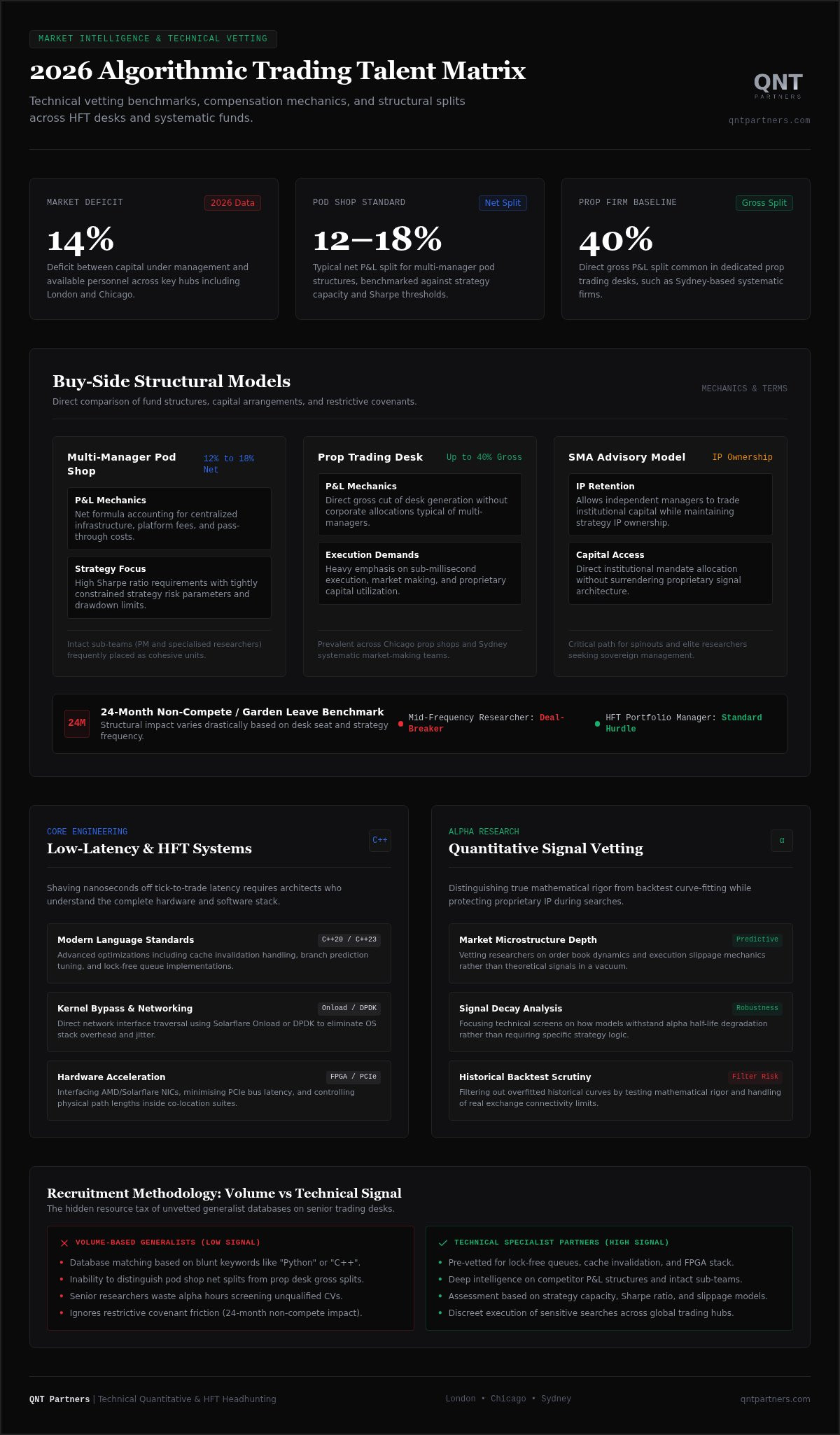
Selecting algorithmic trading recruitment specialists
Vetting a search partner shouldn't be an afterthought. I've seen heads of trading treat recruitment as a low-level procurement exercise, only to end up with an inbox full of noise. You must verify if the person on the other end of the phone has actually seen a P&L split agreement or understands the move from a Chicago prop shop to a London-based multi-manager. If they cannot discuss the structural reasons for a team lift-out, they are intermediaries rather than specialists.
High-signal algorithmic trading recruitment specialists operate as strategic advisors. They distinguish themselves by knowing which firms are currently spinning out pods before the news hits the wires. This level of insight is rare. Most firms rely on the same LinkedIn filters everyone else uses. With the $500 billion asset expansion seen in multi-strategy funds by mid-2026, the competition for the remaining talent is fierce. You need to know where the best researchers are moving and why they are leaving. This requires a partner who tracks the movement of entire sub-teams across the APAC and US markets. For a deeper look at how to evaluate these partners, see our strategic guide to quant trading recruitment firms.
Discretion in high-stakes search
The quant ecosystem is remarkably small. A single indiscreet phone call can alert your competitors to a strategic build-out. I've found that the best searches are executed with a level of silence that generalist firms simply cannot maintain. Approaching senior talent requires a peer-to-peer communication style. A PM with a 15 to 18 per cent payout split won't respond to a generic template. They want to talk to an operator who understands the constraints of their current SMA structure or the duration of their garden leave.
Managing the reputation of your firm during a headhunt is as important as the hire itself. You need a partner who can represent your desk with the same professional gravity you expect from your own partners. If you require a search partner who understands the nuance of the buy-side, you can book a confidential briefing with me.
QNT Partners and the SMA advisory model
The traditional recruitment model is fundamentally misaligned with the capture of elite alpha. Most firms conclude their work at the signature of an employment contract. For top-tier systematic teams, the bottleneck is often a structure that protects intellectual property. QNT Partners integrates talent search with strategic capital advisory to solve this. We identify the specific capital allocations that support your execution requirements.
This approach addresses the structural disconnect in the 2026 market. With global hedge fund AUM at a record 5.6 trillion dollars, the competition for capacity has moved beyond base salaries. It is about how much of the upside you keep and who owns the code. We operate as a peer-level advisor for firms building alpha-generating teams, ensuring that the infrastructure matches the ambition of the strategy.
SMA sourcing and capital advisory
We spend a significant portion of our time sourcing Separately Managed Accounts for institutional clients. This model allows PMs to retain ownership of their proprietary research environments. They secure allocations from platforms willing to pay higher splits, often reaching 20 to 30 per cent. It is a cleaner way to trade for those who have outgrown the standard pod shop model. We vet for operational due diligence to ensure the infrastructure can handle the tick-to-trade latency requirements of a high-frequency strategy. For a breakdown of how these structures work, read our piece on SMA SVA partnerships.
Engaging with QNT
We operate based on our experience as former operators. When we build out HFT infrastructure teams, we look for the specific technical markers I've mentioned, such as FPGA expertise and kernel bypass proficiency. We avoid broad-market appeal. We favour a discreet, high-signal approach that protects the sensitive nature of these searches. We address the 14 percentage point deficit between capital and headcount by identifying intact sub-teams rather than individuals. You can learn more about our specific approach on our firm page.
The future of systematic trading belongs to highly specialised partnerships where capital and talent are aligned through transparent SMA frameworks. The era of the generalist algorithmic trading recruitment specialists is over.
Executing on the 2026 talent mandate
The 14 percentage point deficit between capital and headcount makes high-signal search a necessity. You need a partner who understands that a 12 to 18 per cent P&L split is the benchmark for pod shops and knows why FPGA expertise is non-negotiable for HFT build-outs. We founded QNT Partners as former industry operators specifically to solve this noise problem. Our global reach across Chicago, London, and Sydney allows us to track the movement of talent across every major hub. We specialise in the technical mechanics of AI/ML and low-latency engineering because we've worked in those trenches ourselves. Precision over volume.
Identifying the right algorithmic trading recruitment specialists is the difference between a high-signal shortlist and a wasted quarter. If you are ready to secure the talent that drives alpha in this environment, you should consult with QNT Partners on your next systematic build-out. Scaling with precision is the only way to protect your P&L from the rising cost of human capital.
Frequently Asked Questions
What is the standard P&L split for quant traders in 2026?
Net formulaic P&L payout splits for quantitative portfolio managers at multi-manager hedge funds currently sit between 12 and 18 per cent. High-pedigree PMs with established capacity at newer platforms often negotiate splits reaching 20 to 25 per cent. These splits usually account for desk-level expenses and technology costs. Algorithmic trading recruitment specialists note that proprietary trading firms without external investors typically offer higher splits ranging from 30 to 50 per cent of direct P&L.
How does garden leave affect HFT recruitment?
A 12-month garden leave has become the standard hurdle for senior quantitative researchers and traders across major systematic buy-side firms. This duration protects proprietary signals and prevents immediate talent leakage to competitors. For recruitment, it prolongs placement timelines and requires strategic planning around bench talent. Effectively addressing these gaps involves managing restrictive covenants that remain strictly enforced under state law in the US and common law in the UK.
Why do generalist recruiters fail in low-latency engineering search?
Generalist recruiters fail because they lack the technical depth to distinguish between standard software logic and hardware-accelerated execution. They often confuse basic C++ proficiency with the ability to optimise for cache invalidation or lock-free queues. Finding high-signal candidates requires vetting for FPGA expertise and kernel bypass proficiency. Algorithmic trading recruitment specialists must understand the impact of PCIe bus latency on tick-to-trade paths to avoid providing low-signal shortlists that drain internal resources.
What is the difference between a pod shop and a prop shop for talent?
Pod shops operate as multi-manager platforms where PMs receive a formulaic payout calculated on net P&L after desk-level expenses. The primary risk is termination at a pre-set drawdown threshold, typically around 7.5 per cent. Prop shops use internal firm balance sheets and offer higher payout splits ranging from 30 to 50 per cent. While prop desks share execution infrastructure, pod shops provide significantly more leverage to deploy capital at scale.
How do algorithmic trading recruitment specialists vet technical skills?
Technical vetting at QNT Partners involves a peer-to-peer assessment process led by former industry operators. We look for specific markers:
- Experience with AMD or Solarflare FPGA NICs and hardware acceleration.
- C++20/23 optimisations for cache invalidation and branch prediction.
- Rigorous approach to signal decay and market microstructure.
This approach ensures that candidates can architect systems that shave nanoseconds off execution paths. We focus on technical discipline rather than just reviewing backtesting results.
What role does SMA sourcing play in recruitment advisory?
SMA sourcing allows us to connect elite systematic managers with institutional capital mandates while protecting their proprietary models and IP. This model is an alternative to standard pod shop employment. It provides managers with operational independence and higher payout splits, often between 20 and 30 per cent. Integrating this with recruitment advisory ensures that talent is matched with the right capital structure. This approach facilitates capital growth through structured investment partnerships.