Algorithmic Trading Headhunters: Inside the Market for Systematic Talent in 2026

Most candidate profiles circulating among algorithmic trading headhunters are pure fiction, passed along by contingent agencies that can't read modern C++ or distinguish a shared research framework from personal alpha. If you run a systematic desk, you already know the tax on your review cycles. You spend hours filtering researchers who claim impossible Sharpe ratios, only to discover they were merely tuning parameters inside a multi-manager pod's legacy codebase, or you identify a genuine operator locked behind an eighteen-month non-compete.
You need direct access to unlisted quantitative researchers and low-latency engineers who actually own their trade logic, backed by accurate intelligence on prevailing P&L splits and restrictive covenants. In this breakdown, I show you how specialist operators properly vet production code, verify strategy attribution, and structure clean talent transitions across proprietary desks and systematic funds.
Key Takeaways
- How specialist algorithmic trading headhunters evaluate trade logic to separate individual signal generation from firm-owned execution infrastructure.
- The operational differences between multi-manager platforms and proprietary trading desks, particularly around 15 to 25 percent formulaic P&L payouts.
- Tactical approaches for managing 6 to 12 month garden leave obligations without stalling strategy deployment timelines.
- Why partner-led search execution prevents confidential strategy leaks and stops junior recruiters from wasting desk review cycles.
The Mechanics of Algorithmic Trading Headhunters: Agency Search vs Specialist Operators
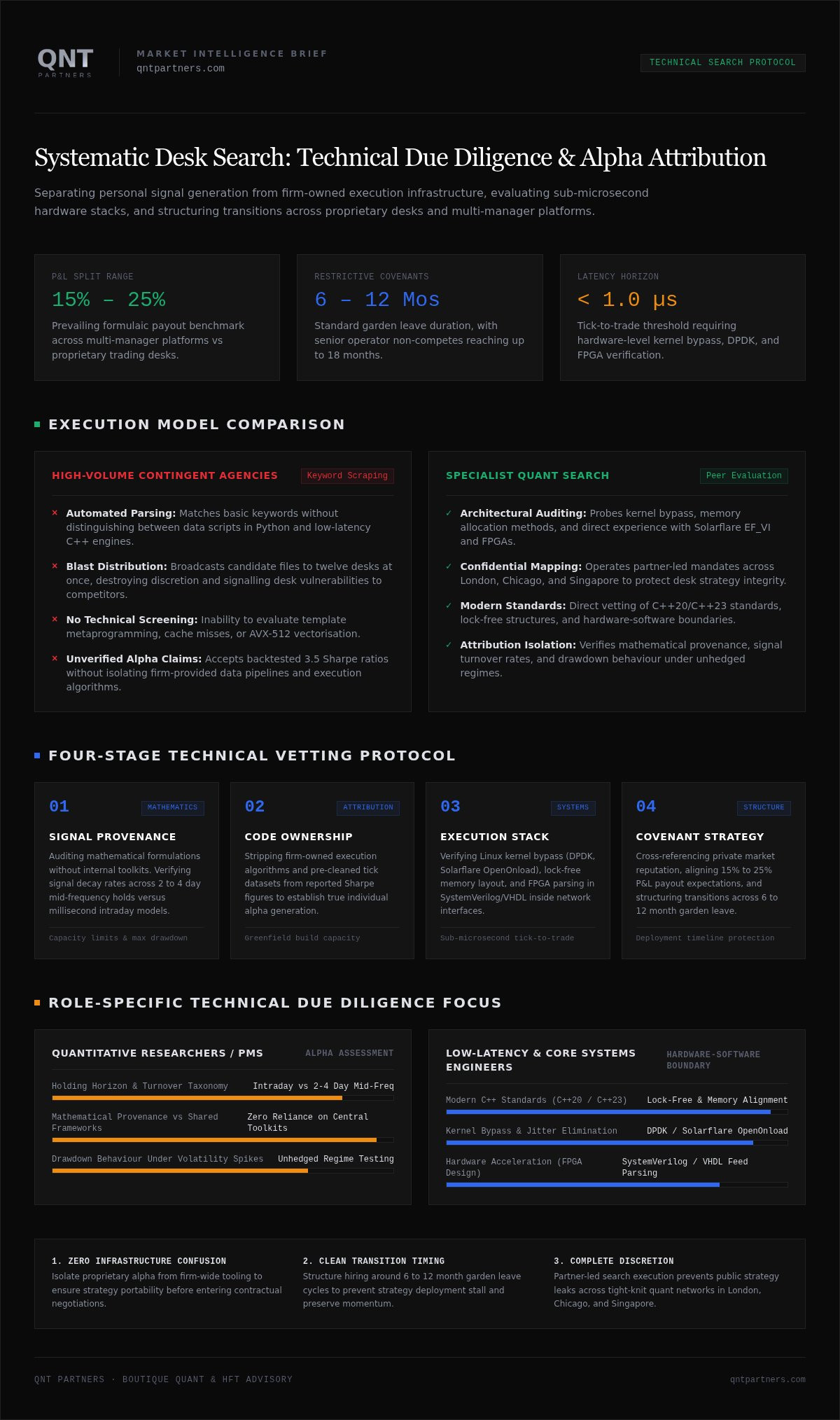
A contingent agency will send you five CVs before lunch because an automated parser matched "C++" and "statistical arbitrage." None of those recruiters have ever looked at template metaprogramming, profiled a cache miss, or debugged an AVX-512 vectorisation issue. To them, a developer writing data pipelines in Python looks identical to an engineer tuning an ultra-low-latency order execution book.
True algorithmic trading headhunters operate as technical peers rather than resume brokers. I evaluate candidates by interrogating their direct architectural contributions. If an engineer claims sub-microsecond tick-to-trade execution, we look into how they bypassed the kernel, their memory allocation strategies, and their direct experience with Solarflare EF_VI or hardware FPGAs. Without that fluency, search firms simply guess, wasting your desk's time on unqualified hires.
The Limitations of High-Volume Contingent Recruitment
High-volume agencies rely on broad keyword scraping. They blast candidate files to twelve desks simultaneously, hoping something sticks. In systematic trading, that practice is toxic.
The quant community across London, Chicago, and Singapore is tiny. Resume blasting damages candidate discretion and tips off the street that your desk has an urgent vulnerability. Worse, surface-level screening fails to verify whether a researcher created original mathematical signals or merely called a shared internal library built by a central tools team five years ago.
The Specialist Search Model in Quantitative Finance
Specialised search requires mapping talent against precise strategy taxonomy. An intraday equity statistical arbitrage book has entirely different latency and risk constraints than an execution desk trading commodity futures. Modern algorithmic trading desks demand talent with exact mathematical and technical depths. A researcher testing signals on GPUs in PyTorch cannot simply be dropped into a low-latency market-making seat without clear validation of their system-level C++ skills.
Discretion is mandatory. When approaching a senior quant researcher or structuring an executive search via our client talent advisory mandates, conversations stay confidential. We ensure structural alignment on capital allocation, risk limits, and hardware access before a CV ever reaches your inbox.
Technical Due Diligence: How Specialist Headhunters Vet Alpha and Infrastructure
Anyone can run a backtest that shows an in-sample Sharpe ratio of 3.5. When algorithmic trading headhunters assess candidates, the primary job is stripping out shared desk infrastructure from individual intellectual contribution. At systematic funds, researchers routinely lean on pre-cleaned tick datasets, proprietary feature libraries, and central execution algorithms that make mediocre signals look profitable. If you isolate that researcher from those resources, their actual edge often drops to zero.
Our vetting process breaks down into four operational stages. We verify mathematical provenance, isolate code ownership, evaluate live execution constraints, and cross-reference desk reputations across private market networks.
Vetting Quantitative Researchers and Alpha Generators
When assessing a quantitative researcher, I begin with signal decay and turnover frequency. A mid-frequency statistical arbitrage strategy holding positions for two to four days degrades differently than an intraday equities model running on millisecond horizons. We want to know how the candidate's signals behaved when volatility spiked, what their historical maximum drawdown was under unhedged regimes, and where the strategy hits capacity limits.
We also audit the boundary between candidate logic and firm property. If a researcher cannot explain their mathematical formulations without relying on proprietary internal toolkits, they cannot build a greenfield book for you.
Assessing Core Engineering and Low-Latency Infrastructure Talent
For systems developers, technical screening focuses directly on the hardware-software boundary. Elite low-latency engineers must demonstrate concrete mastery of modern C++ (C++20 and C++23 standards), lock-free data structures, and memory-mapped cache line management. We probe their direct work with Linux kernel bypass techniques, specifically utilising DPDK or Solarflare OpenOnload to minimise jitter on order routing.
For hardware engineers, we drill into FPGA design using SystemVerilog or VHDL, focusing on parsing direct exchange feeds inside network interface cards. Desk principals must also keep regulatory compliance in mind; candidates must show a working grasp of controls aligned with FINRA guidance on algorithmic trading supervision to avoid rogue execution risks.
If you are planning to build out a new systematic trading pod or need targeted engineering talent, you can contact our partners to review available candidate pipelines.
Multi-Manager Platforms vs Proprietary Desks: Aligning Mandates and P&L Splits
A headline 20 percent payout formula is meaningless until you define who pays for the hardware and what happens when drawdowns hit three percent. Most contingent agencies treat pod shops and proprietary desks as interchangeable destinations with similar balance sheets. They are not. The commercial mechanics, capital costs, and operational freedoms couldn't be further apart.
When algorithmic trading headhunters advise portfolio managers and senior quants, we align candidate strategy parameters directly against organizational structures. The right fit comes down to risk thresholds and capital autonomy.
The Multi-Manager Pod Architecture
Multi-manager platforms offer massive external capital leverage, but that scale comes with strict operational boundaries. P&L splits typically run between 15 and 25 percent on a clean formulaic basis, isolated from other pods so there is zero netting against someone else's bad quarter.
The trade-offs require scrutiny:
- Capital allocation operates inside rigid drawdown collars, where hitting a five percent drawdown often triggers a 50 percent de-allocation or desk liquidation.
- Pass-through expense models charge the pod for market data feeds, exchange co-location, and junior quant developer salaries directly against gross P&L.
- IP ownership remains strictly with the fund, meaning leaving with your production setup is legally impossible.
The Proprietary Trading Desk Structure
Proprietary trading shops run their own balance sheets, completely free from institutional LP redemption pressures. A mid-sized proprietary firm in Chicago or an Amsterdam market maker won't cut your book just because broader equity markets endured a volatile month.
Instead of pass-through deductions, prop desks provide shared, firm-funded execution infrastructure, ultra-low-latency FPGA loops, and direct exchange memberships. Base salaries are higher, and payouts often combine discretionary bonuses with performance pools. Some firms structure 30 to 50 percent net splits for small, autonomous sub-teams that bring their own alpha engines, alongside viable pathways to equity partnership.
If a candidate needs massive leverage across diverse asset classes and prefers an isolated silo, a multi-manager platform works well. If their edge depends on bespoke execution speeds and custom hardware where they can ride out cyclical volatility, a private prop desk is the logical home. For specialized mandates, our work in SMA and SVA partnerships often bridges this divide, letting traders retain strategy isolation while managing institutional capital.
Navigating Garden Leave, Restrictive Covenants, and Strategy Portability
When hiring top-tier quant talent, you aren't just paying for alpha; you're funding their downtime. Across London, New York, and Singapore, standard post-employment covenants keep quantitative researchers and low-latency developers out of the market for 6 to 12 months. For senior portfolio managers running profitable books, 18 to 24 months is increasingly common. Algorithmic trading headhunters must treat this inactive period as an active stage of desk construction.
Managing Non-Competes and Garden Leave Compensation
Despite regulatory posturing, restrictive covenants remain firmly enforceable. The US federal courts blocked the FTC's proposed non-compete ban, and the UK government's plan to cap restrictions at three months never passed into statute. Trading firms will aggressively litigate breaches of post-employment restrictions.
Departing employers typically fund base salary during paid leave, but the real friction sits in deferred bonus structures. To unseat a high-performing trader, the incoming firm must construct clear buyout packages. We structure these using guaranteed sign-on equity, deferred cash distributions, or front-loaded draws against future P&L milestones. The goal is removing financial hesitation while keeping compensation tied to subsequent production.
Intellectual Property and Strategy Rebuilding
Strategy portability is a legal illusion. You cannot transfer code, parameter weights, or proprietary tick data from a former employer. If a researcher touches historical Git repositories or brings local scripts to their new seat, your entire fund risks immediate injunctions and forensic audits.
A successful transition requires clean-room protocols. The researcher must re-derive predictive signals from academic theory and build greenfield models from the ground up on your infrastructure. During garden leave, trading heads can prepare the target execution environment, secure exchange connectivity, and clean alternative datasets so the candidate codes on day one. For teams seeking external backing while retaining operational autonomy, establishing SMA and SVA partnerships provides an established framework to deploy capital without surrendering IP ownership.
If you need to evaluate an active candidate's restrictive covenants or structure a complex buyout, speak with our team to plan the execution.
Selecting an Executive Search Partner for Systematic Trading Desks
You can't delegate an executive quant search to an associate who thinks C++ is just another line on a tech stack checklist. When desk heads retain search firms, they expect the partner who pitched the mandate to run the process. At high-volume agencies, that partner disappears the minute the contract is signed, handing your search to junior recruiters who don't know the difference between execution algorithms and alpha generation.
For systematic funds and proprietary houses, that model fails. Partner-led execution is the only way to safeguard your time and protect your fund's market reputation.
Criteria for Evaluating Quant Search Firms
When you interview search partners, test their technical domain fluency immediately. Ask them to explain the architectural requirements of the last three roles they closed. Did the quant researcher build their own simulation engine or rely on off-the-shelf packages? What were the latency constraints on the execution pipeline?
If a recruiter can't talk through memory allocation bottlenecks or stochastic models without checking notes, they cannot properly represent your desk. True algorithmic trading headhunters track spinouts and team departures months before they become public knowledge. You can review how we benchmark these dynamics across our quant trading recruitment insights.
Engaging Boutique Search Operators for Critical Hires
Boutique firms protect operational security across sensitive hires. If you are launching a greenfield statistical arbitrage book or establishing a new low-latency footprint in Chicago, discretion is vital. Broadcast hiring by generalist agencies tips off competitors, telegraphs your strategy buildout, and risks counter-bids from incumbents.
Working with dedicated operators keeps outreach restricted to proven performers. We combine search execution with talent strategy advisory, helping you refine pod structures, evaluate P&L splits, and audit non-compete liabilities before making initial contact. Trading principals can connect directly with our leadership team for institutional search services to review current market mappings.
A bad hire costs a desk far more than recruitment fees; it burns twelve months of capital and leaves your codebase cluttered with dead logic. Retaining specialist search partners ensures you spend review cycles exclusively with researchers and systems engineers capable of deploying production-grade alpha.
Structuring Your Next Systematic Buildout
Securing production-grade quant talent demands more than scanning CVs. It requires separating individual alpha generation from legacy codebase infrastructure, aligning commercial terms between formulaic pod payouts and proprietary splits, and managing protracted garden leaves without legal friction.
True algorithmic trading headhunters must operate with direct technical fluency. We run operator-led searches across global financial centres, pairing deep engineering and mathematical vetting with total discretion across proprietary desks and multi-manager platforms. When you are ready to expand your research capabilities or build an ultra-low-latency execution pipeline, discuss your systematic talent acquisition requirements with our partners. We ensure your desk backs genuine edge from day one.
Frequently Asked Questions
How much do algorithmic trading headhunters charge for quantitative placements?
Search fee structures vary depending on mandate seniority and search mechanics. Retained headhunters work on exclusive mandates structured around staged delivery milestones based on first-year guaranteed or total compensation, aligning incentives for senior portfolio managers. Contingent recruitment typically calculates fees purely against first-year base salary upon placement. For high-impact quantitative research and core engineering hires, desks almost universally favour retained structures to ensure dedicated technical vetting and discreet market coverage.
What is the standard garden leave duration for senior quantitative researchers?
Standard garden leave across London, New York, and Singapore sits between 6 and 12 months for core researchers. For senior portfolio managers running high-capacity books, 18 to 24 month restrictions have become standard practice. The employing firm pays full base salary throughout this period to enforce market separation. Shorter three-month periods exist only for junior developers without direct access to production alpha logic or live execution parameters.
Can quantitative researchers legally recreate their trading strategies at a new fund?
Yes, but only through clean-room development from theoretical principles. You cannot take code, parameter weights, feature tables, or proprietary data sets when moving desks. If an incoming researcher builds mathematical models from foundational theory without accessing former employer code or confidential trading architecture, the intellectual process is legally protected. Firms routinely enforce technical audits, making documented greenfield implementation essential to prevent trade secret litigation.
How do specialist headhunters verify the performance of a systematic trader?
Specialist algorithmic trading headhunters verify performance by isolating trade logic from firm-level infrastructure. We cross-examine live Sharpe ratios, maximum drawdowns across stress periods, turnover frequency, and capital capacity limits. Crucially, I test whether the alpha came from the candidate's mathematical formulations or from centralised execution routing and proprietary alternative datasets provided by their previous platform. We also conduct discreet reference checks within tight peer networks.
What is the difference between a multi-manager pod and a proprietary trading firm?
Multi-manager pods manage pooled investor capital within isolated silos, offering formulaic P&L payouts between 15 and 25 percent alongside strict drawdown triggers and pass-through infrastructure costs. Proprietary trading firms trade their own balance sheet without external redemption risk. Prop houses generally provide centralised FPGA and execution systems, absorb hardware and data overheads, and compensate teams through higher base salaries, discretionary bonuses, or net P&L splits with equity pathways.
Is it possible to negotiate the buyout of a non-compete clause in quantitative finance?
Direct contract buyouts between competing trading firms are rare because funds treat active models as core intellectual property. Instead, incoming employers structure transition packages that offset the candidate's lost earnings. This includes guaranteed sign-on equity, deferred cash distributions, or front-loaded bonus draws that trigger once the non-compete expires. In select cases, legal counsel can narrow geographic or asset-class restrictions to allow an earlier start date.
Why do systematic trading firms prefer boutique search firms over large agencies?
Boutique operators provide technical domain fluency and confidentiality that mass-market agencies cannot match. Generalist recruiters broadcast resumes broadly, creating information leakage that alerts competitors to desk hiring needs. Boutique algorithmic trading headhunters operate through partner-led execution. We understand low-latency C++ profiling and stochastic modelling, ensuring trading principals spend interview cycles only with candidates who possess genuine mathematical and engineering depth.