AI and Machine Learning Recruitment in Finance: Hiring for Production

A strong backtest doesn’t prove that a finance ML hire can take a model into production. AI machine learning recruitment finance searches often go wrong earlier, when the brief blurs research, production ownership and trading accountability.
A researcher who improves a signal may not have owned its deployment. An engineer who builds reliable systems may not have worked with financial data or model risk in a live trading context. Define the mandate before comparing CVs, then assess candidates against the work they’ll actually own.
This article sets out a practical framework for clarifying the role, assessing research and implementation experience, and running a focused, discreet search. The aim isn’t to favour academic credentials or production experience by default. It’s to establish whether a candidate’s track record matches the remit before they join.
Key Takeaways
- Write the brief around the strategy and intended use of the system, not a generic AI or ML title.
- In AI machine learning recruitment finance, distinguish evidence of research quality from evidence of implementation ownership.
- Compare candidates by the work they have delivered and the remit they can take on, not by fashionable titles.
- Agree assessment criteria, interview ownership and confidentiality expectations before approaching candidates. Treat garden leave and non-competes as individual discussion points.
- A specialist search partner can help clarify the brief and map relevant talent. An internal team may be better placed when it already has the access and capacity to run the search.
AI and machine learning recruitment in finance starts with the mandate
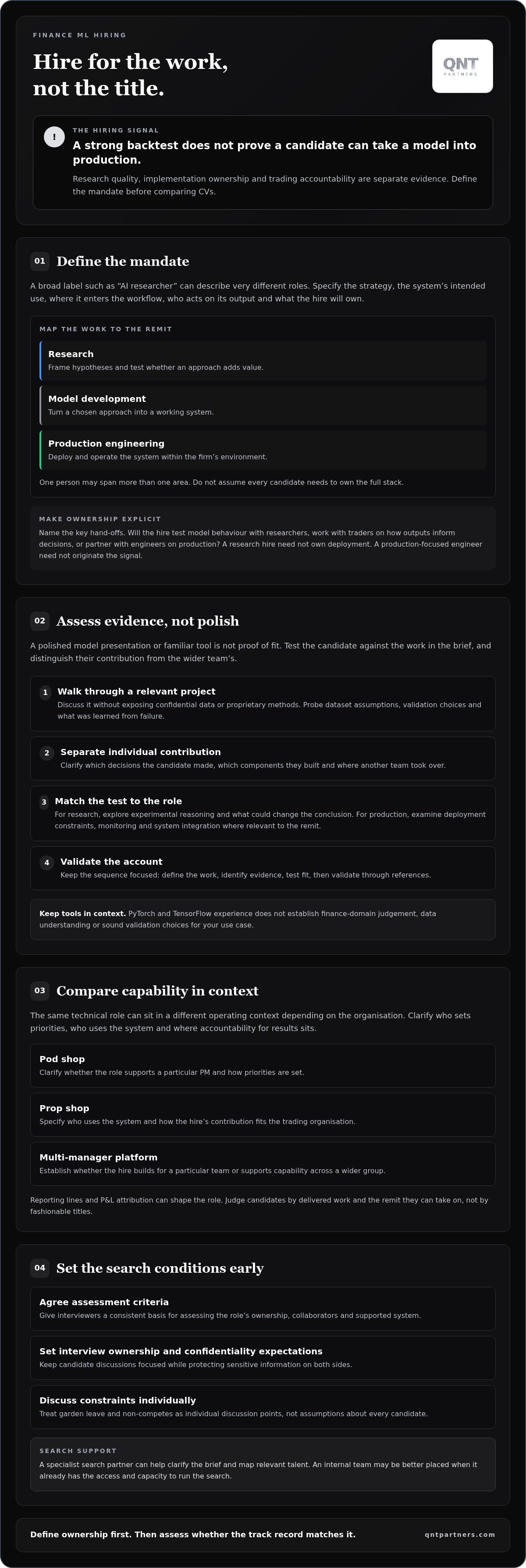
Job titles alone don’t define a useful finance ML search. “AI researcher” might mean developing a predictive signal, adapting a model for a fraud workflow or building the infrastructure that serves predictions in production. Those are different mandates. The brief should specify which capability the team needs.
Start with the strategy and the system’s intended use. A model supporting a trading decision has different users and constraints from one used to flag suspicious activity. For context on the latter, see this overview of AI for fraud detection. Define where the model enters the workflow, who acts on its output and what the hire will own. This keeps AI machine learning recruitment finance focused on the work, not just a broad label.
Separate research, model development and production engineering in the brief. Research may involve framing hypotheses and testing whether an approach adds value. Model development turns a chosen approach into a working system. Production engineering covers deployment and operation within the firm’s environment. One person may span more than one area, but don’t assume every candidate needs to own the full stack.
This is about defining an operating role, not the broader question of hiring AI or ML executives. The mandate should reflect the system and team the person will join.
What work will the hire own?
State whether the remit centres on research, applied modelling or implementation, then specify the hand-offs. Will the hire test model behaviour with researchers, work with traders to understand how outputs inform decisions, or partner with engineers to move a model into production? Name the expected contribution and its boundaries. A research hire needn’t own deployment, and a production-focused engineer needn’t originate the signal.
Where will the work sit in the trading organisation?
A pod shop, a prop shop and a multi-manager platform can place the same technical role in very different contexts. Clarify who sets priorities, who uses the system and where accountability for its results sits. Reporting lines and P&L attribution can shape whether the hire supports a particular PM or builds capability across a wider team. For more context on hiring quantitative trading talent, see our quant trading recruitment guide.
Before opening the search, record the role’s core ownership, key collaborators and the system it will support. This gives interviewers a consistent basis for judging fit without screening out strong candidates because their previous title used different language.
Assess finance ML candidates against the full research-to-production path
A polished model presentation says little about whether someone can do the job you’ve defined. Assess candidates against the actual remit, separating research judgement from implementation ownership and exploring how they work with the people around them.
Keep the process in sequence: define the work, identify evidence of having done it, test fit against the role, then validate the account through references. Otherwise, an impressive research result or a familiar tool can distract from the capabilities the team needs. In AI machine learning recruitment finance, assessment should be specific to the system and the candidate’s part in it.
What technical evidence should an interview explore?
Ask the candidate to walk through a relevant project without disclosing confidential data or proprietary methods. Probe the assumptions behind the dataset, the validation choices and what they learned from failure. For collaborative work, clarify individual contribution: which decisions did they make, which components did they build, and where did another team take over?
Assess research reasoning separately from implementation. A researcher should explain why an experiment was structured as it was and what might have changed their conclusion. For a production-focused role, explore how the candidate handled deployment constraints, monitoring or system integration, where those responsibilities sat within their remit. Communication matters too: can they explain trade-offs clearly to a trader or engineering counterpart?
PyTorch and TensorFlow are useful context, not proof of finance-domain judgement. Framework experience doesn’t establish whether a candidate understands the data assumptions or validation choices relevant to your use case. The CFA Institute on Machine Learning provides a reference for core concepts, but interviews still need to test how candidates apply them to the work at hand.
How does research experience translate into production work?
For research-led candidates, trace a project from experimental result towards implementation, if that transition was part of their role. Ask what changed between the research setting and the deployed system, and how they worked with software or infrastructure teams. Don’t treat collaboration as proof that they owned another team’s responsibilities. Assess candidates for what they actually delivered.
If execution infrastructure is part of the mandate, assess that capability directly rather than assuming it follows from model experience. The relevant technical depth may involve exchange connectivity or low-latency engineering, depending on the role. Keep this assessment separate from the core modelling discussion unless the remit specifically includes execution systems.
Finish by validating specific claims through references, within appropriate confidentiality boundaries. Ask about the candidate’s contribution and how they handled responsibilities relevant to the brief. A reference should confirm evidence, not replace a technical assessment.
Compare candidate profiles by capability, not fashionable titles
Titles such as “quantitative researcher”, “ML scientist” and “ML engineer” can describe very different jobs. For AI machine learning recruitment finance, compare candidates by what they owned, what evidence they can explain and how that work maps to the remit. These profiles are useful shorthand, not fixed categories.
Research-led: Look for clear research design, sound validation reasoning and a candid account of limitations. The candidate should explain how they framed the problem and what evidence would change their view.
Applied modelling: Look for experience translating a modelling approach into a solution for a defined financial use case. Explore their reasoning about relevant data and how they assessed the model’s usefulness in context.
Production-oriented: Look for ownership of implementation or close collaboration with the teams responsible for deployment. Establish where their responsibility began and ended rather than inferring ownership from a project title.
These profiles can overlap. A researcher may have contributed to deployment, while an engineer may have influenced model design. Map that overlap accurately rather than forcing candidates into a single category. Role fit depends on evidence that matches the mandate.
Research-led and applied ML experience
Ask candidates to explain the choices behind their work, including how they designed validation and what limitations they identified. Strong answers distinguish what the analysis showed from what it could not establish. Finance experience is useful context, but it doesn’t automatically demonstrate technical depth. A different sector background doesn’t rule out relevant capability either. Assess the work and reasoning against the actual problem.
Production and low-latency engineering interfaces
Be explicit about whether the hire owns models, deployment, systems engineering or collaboration between those areas. Don’t screen every finance ML candidate for C++, FPGA experience, co-location or tick-to-trade latency. Those skills matter when the remit involves execution infrastructure, not simply because the employer operates in finance.
Where low-latency systems are in scope, ask for evidence tied to the required interface: what the candidate built or changed, how it connected to adjacent systems and which trade-offs they owned. For a modelling role without execution-infrastructure responsibilities, keep that assessment out of the core criteria. This keeps interviews focused and comparisons fair across candidates with different career paths.
Structure the search around confidentiality and decision quality
A search can lose credibility before the first interview if the hiring team hasn’t agreed what it’s hiring for. In AI machine learning recruitment finance, set the mandate, assessment criteria, interview ownership and confidentiality expectations before approaching candidates.
Align the hiring team before approaching candidates
Trading, research and engineering teams may describe the same role differently. Resolve those differences internally. Agree who owns the hire and makes the final decision, then identify which capabilities must be present on day one and which can be developed after joining.
Give each interviewer a defined area to assess against the mandate. A trader might test how the candidate works with the intended users of a model; a researcher can explore analytical reasoning; an engineer can assess implementation where it falls within the role. Keep the interview sequence consistent, but base it on the team’s decision needs rather than an assumed timeline.
Handle senior and confidential searches with care
Discreet outreach is a process consideration, not a promise that every detail can remain confidential at every stage. Agree how candidate identity and current-employer information will be handled before sharing profiles. In early discussions, anonymised experience summaries can help the team assess relevance without circulating identifying details unnecessarily.
Garden leave, non-competes and notice periods are candidate-specific points to discuss, not grounds for recruiters or hiring teams to make legal conclusions. Ask candidates to raise relevant constraints for their circumstances, and don’t treat assumptions about mobility as fact. Confirm compensation and availability for the individual search rather than inferring them from title, employer or seniority.
This discipline supports better decisions and a more considered candidate experience. It gives the hiring team a consistent basis for comparing evidence and reduces the risk of inconsistent outreach or premature disclosure. Keep the brief and evaluation criteria available to everyone involved, and revisit them if the remit changes.
QNT Partners’ contact details are available at the contact page.
When a specialist AI and ML recruitment partner adds value
An external search partner is useful when a team needs help defining a specialised remit or reaching candidates beyond its existing network. It adds less value when the brief is clear and the internal team already has the access and capacity to run the process.
For AI machine learning recruitment finance, a partner should first understand the intended system and where the hire fits. That context shapes which candidates are relevant, what evidence deserves scrutiny and who in the business should assess it. A search based only on titles or broad technology keywords risks surfacing candidates whose experience doesn’t match the mandate.
What should a hiring team expect from a specialist search?
Expect a clear discussion of role scope before candidate outreach begins. The search partner should explain how they’ll distinguish research experience from modelling or implementation ownership, and how they’ll involve trading, research and engineering stakeholders in the evaluation. Ask how they understand the technical and organisational context, not just how they’ll source profiles.
A specialist partner can help map relevant talent and coordinate assessment, while the hiring team retains ownership of technical judgement and the hiring decision. No search partner should promise candidate availability, a particular hiring speed or a placement outcome. Those depend on the mandate and the individuals involved.
Decide whether an external search fits the mandate
Keep the decision practical. If the role definition is unsettled, agree the remit internally first or work with a partner who can help clarify it. If the brief is sound but access to relevant talent is the constraint, external support may make sense. If your team already knows the candidate pool and has the capacity to manage outreach and interviews, running the search in-house may be a better fit.
QNT Partners focuses on quantitative trading, research and technology recruitment, including AI and ML specialist search for financial applications such as predictive modelling and deep learning. This focus is relevant when the role’s technical context needs to shape how candidates are identified and assessed. The firm works with hiring teams to clarify the mandate and coordinate a focused search.
For a specialist search, contact QNT Partners.
Set the mandate before you open the search
Assess a finance ML hire against the work they’ll own, not the title on their CV. Define whether the role centres on research, applied modelling or production, then test evidence against that remit. Keep those capabilities distinct in interviews, even when a candidate brings experience across several areas.
Good AI machine learning recruitment finance also depends on a clear process. Align the hiring team on essential skills, interview ownership and confidentiality before approaching candidates. This makes decisions more consistent and keeps discussions focused on the role rather than assumptions about background or availability.
QNT Partners specialises in quantitative trading, research and technology recruitment, including AI and ML specialist search for financial applications. Technical context matters when a brief crosses research and production responsibilities. Discuss a specialist AI and ML search with QNT Partners.
Frequently Asked Questions
What does AI and machine learning recruitment in finance involve?
AI machine learning recruitment finance involves defining a specialist role, finding candidates with relevant experience and assessing evidence against the mandate. The brief should clarify whether the hire will focus on research, applied modelling or implementation, and how the work fits the financial application. Assessment should test the candidate’s contribution and judgement rather than rely on job titles, academic credentials or familiarity with a particular tool.
How do I assess a machine learning candidate for a finance role?
Assess the candidate against the work they’ll own. Use technical interviews to examine relevant evidence, such as how they framed a modelling problem, chose validation methods or handled implementation constraints. Ask them to distinguish their contribution from collaborators’ work while protecting confidential information. Evaluate research reasoning separately from production ownership, and test whether they can explain trade-offs to the adjacent teams they’ll work with.
Can a machine learning researcher move into quantitative finance?
Potentially, depending on the role and the evidence they can show. Skills in research design, statistical reasoning and model evaluation may transfer, but the hiring team should assess gaps against the mandate. These might include familiarity with financial data, the workflow in which a model will be used, or collaboration with production teams. Don’t assume a researcher will own implementation, or that a background outside finance rules them out.
What is the difference between an ML researcher and an ML engineer in finance?
An ML researcher typically focuses on framing problems, developing approaches and evaluating whether results support a hypothesis. An ML engineer typically focuses on implementing or integrating models within software and production systems. The boundary varies by team, and some candidates have experience across both. Define ownership in the brief: who develops the model, who takes it into production, and which responsibilities sit with other researchers or engineers.
How should a finance firm recruit AI and ML specialists discreetly?
Align stakeholders on the role, assessment criteria and interview ownership before starting outreach. Agree how candidate identities and current-employer details will be handled, and share only the information needed at each stage. Describe the opportunity accurately without naming the firm where confidentiality requires otherwise. Treat garden leave, non-competes and notice periods as candidate-specific discussion points, not assumptions about availability or legal conclusions.
When should a hedge fund use a specialist AI and ML recruiter?
Consider specialist support when the role needs finance-specific technical context or the internal team lacks access to relevant candidates. A search partner can help clarify the remit, map talent and coordinate evaluation, while the firm retains responsibility for technical judgement and hiring decisions. QNT Partners specialises in quantitative trading, research and technology recruitment, including AI and ML specialist search for financial applications. If the brief and access to talent are already clear internally, an in-house search may fit.